Progress toward artificial tissue?
Soft and tough like biological tissue: DNA-wrapped carbon nanotubes
For modern implants and the growth of artificial tissue and organs, it is important to generate materials with characteristics that closely emulate nature. However, the tissue in our bodies has a combination of traits that are very hard to recreate in synthetic materials: It is both soft and very tough. A team of Australian and Korean researchers led by Geoffrey M. Spinks and Seon Jeong Kim has now developed a novel, highly porous, sponge-like material whose mechanical properties closely resemble those of biological soft tissues. As reported in the journal Angewandte Chemie, it consists of a robust network of DNA strands and carbon nanotubes.
Soft tissues, such as tendons, muscles, arteries, and skin or other organs, obtain their mechanical support from the extracellular matrix, a network of protein-based nanofibers. Different protein morphologies in the extracellular matrix produce tissue with a wide range of stiffness. Implants and scaffolding for tissue growth require porous, soft materials -- which are usually very fragile. Because many biological tissues are regularly subjected to intense mechanical loads, it is also important that the implant material have comparable elasticity in order to avoid inflammation. At the same time, the material must be very strong and resilient, or it may give out.
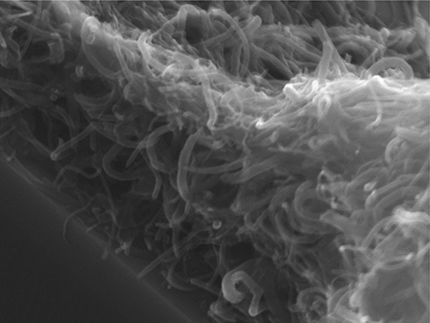
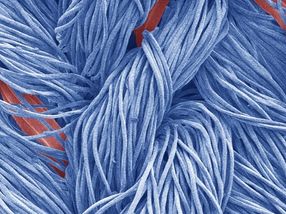
The new concept uses DNA strands as a matrix; the strands completely "wrap" the scaffold-forming carbon nanotubes in the presence of an ionic liquid, networking them to form a gel. This gel can be spun: just as silk and synthetic fibers can be wet-spun for textiles, the gel can be made into very fine threads when injected into a special bath. The dried fibers have a porous, sponge-like structure and consist of a network of intertwined 50 nm-wide nanofibers. Soaking in a calcium chloride solution further cross-links the DNA, causing the fibers to become denser and more strongly connected.
These spongy fibers resemble the collagen fiber networks of the biological extracellular matrix. They can also be knotted, braided, or woven into textile-like structures. This results in materials that are as elastic as the softest natural tissues while simultaneously deriving great strength from the robust DNA links.
An additional advantage is the electrical conductivity of the new material, which can thus also be used in electrodes for mechanical actuators, energy storage, and sensors. For example, the researchers were able to produce a hydrogen peroxide sensor. The carbon nanotubes catalyze the oxidation of hydrogen peroxide, which results in a measurable current. Hydrogen peroxide plays a role in normal heart function and certain heart diseases. A robust sensor with elasticity similar to the heart muscle would be of great help in researching these relationships.
Original publication: Geoffrey M. Spinks et al.; "Tough Supersoft Sponge Fibers with Tunable Stiffness from a DNA Self-Assembly Technique"; Angewandte Chemie International Edition 2009
Other news from the department science









Get the chemical industry in your inbox
From now on, don't miss a thing: Our newsletter for the chemical industry, analytics, lab technology and process engineering brings you up to date every Tuesday and Thursday. The latest industry news, product highlights and innovations - compact and easy to understand in your inbox. Researched by us so you don't have to.
Most read news









More news from our other portals






















See the theme worlds for related content
Topic world Sensor technology
Sensor technology has revolutionized the chemical industry by providing accurate, timely and reliable data across a wide range of processes. From monitoring critical parameters in production lines to early detection of potential malfunctions or hazards, sensors are the silent sentinels that ensure quality, efficiency and safety.

Topic world Sensor technology
Sensor technology has revolutionized the chemical industry by providing accurate, timely and reliable data across a wide range of processes. From monitoring critical parameters in production lines to early detection of potential malfunctions or hazards, sensors are the silent sentinels that ensure quality, efficiency and safety.
