A breakthrough toward industrial production of fluorescent nanodiamonds
The laboratory «Structure - Activité of Normal & Pathologic Biomolecules - SANPB», Inserm / UEVE U829 (Genopole Evry, France) in collaboration with the Material Centre of Mines-ParisTech (Evry, France), the NRG - UMR 5060 CNRS / UTBM (Technology University of Belfort-Montbéliard) and the Physic Institute of Stuttgart University (Germany) discovered a novel route to fabricate fluorescent nanoparticles from diamond microcrystals.
Fluorescence is a major tool in life and material sciences. In biology/medicine, the coupling of fluorescent dyes, to proteins or nucleic acids (RNA, DNA) allows one to investigate their fate and interactions in cultured cells or in the body. Similarly, fluorescence is used in material sciences to detect electromagnetic fields, for optic storage or tracking (notably to detect fake products). However, most of fluorescent dyes are made of molecules with a limited life time due to chemical reactivity.
In this context fluorescent diamond nanoparticles present a valuable alternative thanks to their outstanding photophysical properties. They are very bright and possess long-term non-bleaching, non-blinking fluorescence in the red/NIR region. Based on these unique properties, multiple applications are foreseen in physics, material science, biochemistry and biology. However, until recently, the production of such nanoparticles was limited to the laboratory.
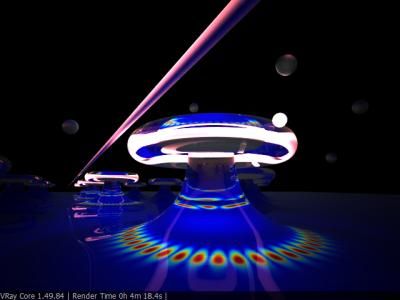
A single route is nowadays taken to fabricate such fluorescent nanoparticles. It consists of irradiating substitutional nitrogen-containing diamond nanocrystals, produced by the diamond industry, with electron or ion beams to create vacancies in the crystal lattice. Isolated substitutional nitrogen atoms then trap a moving vacancy during annealing to form a fluorescent NV centre. Unfortunately, the efficiency and yield of this route are low due to amorphization and the loss of moving vacancies to the surface during irradiation and annealing.
A top-down processing of diamond microcrystals, which are less prone to amorphization and vacancy loss, would provide a more industrially scalable route. However, in this case two barriers have to be surmounted – the difficulties of irradiating large amounts of material and converting microdiamonds into nanocrystals while keeping both fluorescence properties and crystal structure intact.
In a recent study, which is published in Nanotechnology, researchers in France and Germany have explored with success this alternative route to producing homogeneous samples of pure and very small fluorescent diamond nanoparticles with high yield. The fabrication procedure starts with the irradiation of finely controlled micron-size diamonds and requires subsequent milling and purification steps. In this novel process, substitutional nitrogen-containing microdiamonds with defined atomic composition were irradiated using a high-energy electron beam and then annealed at high temperature (800 °C) to create the desired photoluminescent centres in an intact diamond lattice. An original two-step milling protocol was designed to convert the fluorescent microdiamond into very small (down to 4 nm) round-shape nanoparticles of highly pure sp3 diamond with very bright and stable photoluminescent centres.
Such a fine fabrication process can now be used for the large-scale production of fluorescent diamond nanoparticles. One can vary and tailor their properties via the composition of the starting material to answer the needs of future applications. These fluorescent diamond nanoparticles open realistic perspectives to very long term labeling, to quantitative biology and innovative nanotechnology applications in composites, optoelectronics or analytical chemistry.
Original publication: Jean-Paul Boudou et al.; "High yield fabrication of fluorescent nanodiamonds"; Nanotechnology 2009, 20 235602
Other news from the department science



Get the chemical industry in your inbox
From now on, don't miss a thing: Our newsletter for the chemical industry, analytics, lab technology and process engineering brings you up to date every Tuesday and Thursday. The latest industry news, product highlights and innovations - compact and easy to understand in your inbox. Researched by us so you don't have to.