Energy-saving powder
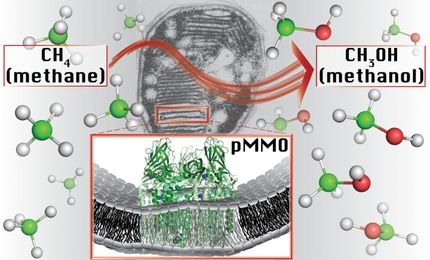
It is currently estimated that natural gas resources will be exhausted in 130 years; however, those reserves where extraction is cost-effective will only flow for another 60 years or so. Scientists at the Max Planck Institute for Coal Research and at the Max Planck Institute of colloids and Interfaces might be helping to make it worthwhile to tap into previously unused resources. They have developed a catalyst that converts methane to Methanol in a simple and efficient process. Methanol can be transported from locations where it is not economical to build a pipeline.
It is not cost-effective to lay pipelines to remote or small natural gas fields; nor is it worthwhile accessing the methane in coal seams or in gas sand, or which is burned off as a by-product of oil production, although the methane burned off throughout the world could more than satisfy Germany's requirement for natural gas. It is also too expensive to liquefy the gas and transport it on trains or in tankers - and even chemistry has so far been unable to offer a solution. Although there are chemical ways to convert methane to methanol, which is easy to transport and which is suitable as a raw material for the chemical industry, "the processes commonly used up to now for producing diesel fuel - steam reforming followed by methanol synthesis or Fischer-Tropsch synthesis - are not economical," says Ferdi Schüth, Director at the Max Planck Institute for Coal Research in Mülheim an der Ruhr. He and his colleagues have been working with Markus Antonietti and his team at the Max Planck Institute of Colloids and Interfaces in Potsdam to develop a catalyst that might change all this.
The catalyst consists of a nitrogenous material, a covalent, triazine-based network (CTF) synthesized by the chemists in Potsdam. "This solid is so porous that the surface of a gram is approximately equivalent in size to a fifth of a football field," says Markus Antonietti. The researchers in Mülheim insert platinum atoms into the voluminous lattice of the CTF. Thanks to the large surface area, the catalyst oxidizes the methane efficiently to methanol, as it offers the methane a large area in which to react when the chemists immerse it in oxidizing sulphuric acid, force methane into the acid and heat the mixture to 215° Celsius under pressure. Methanol is created from more than three-quarters of the converted gas.
A catalyst manufactured by the American chemist Roy Periana more than ten years ago from platinum and simple nitrogenous bipyrimidine also effectively creates methanol, but only supports the reaction in a soluble form. This means that the catalyst - which chemists refer to as a homogenous catalyst - subsequently needs to be separated off in a laborious and somewhat wasteful process. "It's much easier with our heterogeneous catalyst," says Ferdi Schüth. The chemists in Mülheim filter out the powdery platinum and CTF catalyst, and then separate the acid and methanol in a simple distillation.
The catalyst developed by the Max Planck chemists probably uses the same mechanism as the Periana catalyst and was indeed inspired by it. "When I saw the structure of CTF, I noticed the elements which correspond to its bipyrimidine ligands," says Schüth. "That's when I had the idea of manufacturing the solid catalyst."
To get closer to a large-scale technical application, he and his colleagues are now attempting to enable the process to work with reactants in gaseous rather than soluble form. "We are also looking for similar, even more effective catalysts," says Schüth. "We have already found more efficient homogenous catalysts with ligands other than bipyrmidine." They are now using these as a model for simple, easy to manage catalysts like the CTF and platinum powder.
Original publication: Regina Palkovits, Markus Antonietti, Pierre Kuhn, Arne Thomas, and Ferdi Schüth; "Solid Catalysts for the Selective Low-Temperature Oxidation of Methane to Methanol"; Angewandte Chemie International Edition, Volume 48, Issue 37, September 1, 2009
Other news from the department science












Get the chemical industry in your inbox
From now on, don't miss a thing: Our newsletter for the chemical industry, analytics, lab technology and process engineering brings you up to date every Tuesday and Thursday. The latest industry news, product highlights and innovations - compact and easy to understand in your inbox. Researched by us so you don't have to.