NJIT engineer discovers why particles disperse on liquids
Advertisement


Even if you are not a cook, you might have wondered why a pinch of flour (or any small particles) thrown into a bowl of water will disperse in a dramatic fashion, radiating outward as if it was exploding. Pushpendra Singh, PhD, a mechanical engineering professor at NJIT who has studied and written about the phenomenon, has not only thought about it, but can explain why.
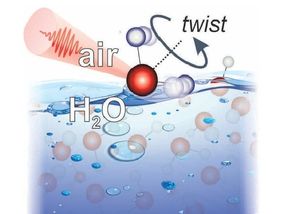
He says that what's known as the "repulsive hydrodynamic force arising from the oscillation of particles" causes them to disperse. A particle trapped in a liquid surface vibrates up and down from its equilibrium position on the surface, or interface, where air meets water. When many particles do this simultaneously, an explosive dispersion occurs.
"Spontaneous Dispersion of Particles on Liquid Surfaces," which appeared in the Nov. 11, 2009 early edition of the Proceedings of the National Academy of Sciences explains the theory. The National Science Foundation has supported this research.
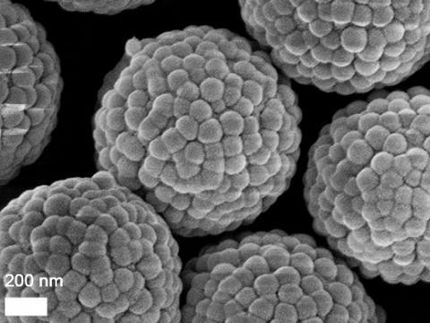
Singh says that when small particles, such as flour or pollen, come in contact with a liquid surface, they immediately disperse and form a monolayer. The dispersion occurs so quickly that it appears explosive, especially on the surface of liquids like water.
This explosive dispersion is a consequence of the capillary force pulling particles towards their equilibrium positions in the interface. The capillary force causes the particles to accelerate very rapidly.
"If a particle barely touches the interface, it is pulled onto the surface," said Singh. "For example, if the contact angle for a spherical particle is 90 degrees, it floats in the state of equilibrium so that one-half of it is above the surface and the remaining half is below. If the particle, however, is not in this position, the capillary force will force it to be."
What's interesting is that the smaller the particles, the faster they move. For nanometer-sized particles like viruses and proteins, the velocity or speed on an air-water interface can be as high as 167 kilometers (about 100 miles) per hour.
Singh says the motion of the particles is dominated by inertia because the viscous damping—which is like friction—is too small. He compares the situation to a moving pendulum. "The pendulum will oscillate many times before friction makes it stop," he says. "If friction is too great, it won't oscillate."
Eventually, the particles which have been oscillating around their equilibrium point will stop--thanks to viscous drag which causes resistance to the motion.
"Let me explain more about viscous drag," said Singh. "When a body, such as a ball, moves through air or liquid, it will resist the motion. This resistance is caused by viscous drag. Or look at it this way. When a particle is adsorbed at a surface, it acquires a part of the released interfacial energy as kinetic energy," he says. "The particle dissipates this kinetic energy by oscillating from its equilibrium height in the interface. The act gives rise to repulsive hydrodynamic forces, the underlying cause of why particles disperse."


Other news from the department science