Investigating how spiders spin their silk, researchers unravel a key step
Discovery opens the way toward biomimetic production of ultra-strong, elastic fibers
Advertisement


Five times the tensile strength of steel and triple that of the currently best synthetic fibers: Spider silk is a fascinating material. But no one has thus far succeeded in producing the super fibers synthetically. How do spiders form long, highly stable and elastic fibers from the spider silk proteins stored in the silk gland within split seconds? Scientists from the Technische Universitaet Muenchen (TUM) and the University of Bayreuth have now succeeded in unraveling the secret. They present their results in the current issue of the prestigious scientific journal Nature.
"The high elasticity and extreme tensile strength of natural spider silk are unmatched, even by fibers produced from pure spider silk proteins," says Professor Horst Kessler, Carl-von-Linde Professor at the Institute for Advanced Study of the TU Muenchen. That highlights a key question in the artificial production of stable spider silk fibers: How do spiders manage to keep the high concentrations of raw material available in the silk gland, ready to produce the high tensile strength fiber at a moment's notice. Thomas Scheibel has been pursuing the secret of spider silk for years, until 2007 at TUM and since then at the University of Bayreuth.
Spider silk consists of protein molecules, long chains comprising thousands of amino-acid elements. X-ray structure analyses show that the finished fiber has areas in which several protein chains are interlinked via stable physical connections. These connections provide the high stability. Between these connections are unlinked areas that give the fibers their great elasticity.
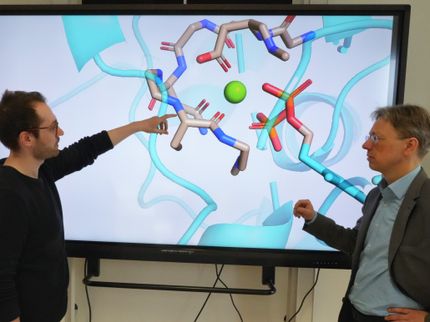
The situation within the silk gland is, however, very different: The silk proteins are stored in high concentrations in an aqueous environment, awaiting deployment. The areas responsible for interlinking may not approach each other too closely; otherwise the proteins would clump up instantaneously. Hence, these molecules must have some kind of special storage configuration.
X-ray structure analysis, which is so successful in other domains, was of little help here, since it can only be used to analyze crystals. And up to the instant in which the solid silk fiber is formed, everything takes place in solution. The method of choice was therefore nuclear magnetic resonance spectroscopy (NMR). Using the equipment of the Bavarian NMR Center, Franz Hagn, a biochemist from Horst Kessler's work group at the Institute for Advanced Study (TUM-IAS) at the TU Muenchen, managed to unravel the structure of a control element responsible for the formation of the solid fiber. Now the researchers could, together with Lukas Eisoldt and John Hardy from Thomas Scheibel's group, shed light on this control element's mode of operation.
"Under storage conditions in the silk gland these control domains are connected pair-wise in such a way that the interlinking areas of both chains can not lie parallel to each other," Thomas Scheibel explains. "Interlinking is thus effectively prevented." The protein chains are stored with the polar areas on the outside and the hydrophobic parts of the chain on the inside, ensuring good solubility in the aqueous environment.
When the protected proteins enter the spinning duct, they encounter an environment with an entirely different salt concentration and composition. This renders two salt bridges of the control domain unstable, and the chain can unfold. Furthermore, the flow in the narrow spinning duct results in strong shear forces. The long protein chains are aligned in parallel, thus placing the areas responsible for interlinking side by side. The stable spider silk fiber is formed.
"Our results have shown that the molecular switch we discovered at the C-terminal end of the protein chain is decisive, both for safe storage and for the fiber formation process," says Franz Hagn. An important foundation for these results was established through cooperation of Thomas Scheibel's group with Professor Andreas Bausch's workgroup at the Physics Department at TUM. Using microsystem technology, they developed an artificial spinning duct. Meanwhile the Bayreuth scientists are working intensively to develop a biomimetic spinning apparatus, within the framework of a federally supported joint project with industrial partners. The potential applications are countless, from resorbable surgical suture material to technical fibers for the automotive industry.
The research has been supported through the provision of testing and measuring time by the Bavarian NMR Center, through the Deutsche Forschungsgemeinschaft (DFG), the Excellence Cluster Center for Integrated Protein Science Munich (CIPSM) and the Institute for Advanced Study at the TU Muenchen, where Horst Kessler has been working as Senior Fellow since becoming Emeritus. Franz Hagn's work is funded by the Bayerisches Elitenetzwerk CompInt, co-author John G. Hardy from the Alexander von Humboldt Foundation.


Other news from the department science











Most read news









More news from our other portals





















See the theme worlds for related content
Topic World Spectroscopy
Investigation with spectroscopy gives us unique insights into the composition and structure of materials. From UV-Vis spectroscopy to infrared and Raman spectroscopy to fluorescence and atomic absorption spectroscopy, spectroscopy offers us a wide range of analytical techniques to precisely characterize substances. Immerse yourself in the fascinating world of spectroscopy!

Topic World Spectroscopy
Investigation with spectroscopy gives us unique insights into the composition and structure of materials. From UV-Vis spectroscopy to infrared and Raman spectroscopy to fluorescence and atomic absorption spectroscopy, spectroscopy offers us a wide range of analytical techniques to precisely characterize substances. Immerse yourself in the fascinating world of spectroscopy!
Last viewed contents
Lyondell to Restart PO/SM Unit at Channelview