NIST puts a new twist on the electron beam
Advertisement


Electron microscopes are among the most widely used scientific and medical tools for studying and understanding a wide range of materials, from biological tissue to miniature magnetic devices, at tiny levels of detail. Now, researchers at the National Institute of Standards and Technology (NIST) have found a novel and potentially widely applicable method to expand the capabilities of conventional transmission electron microscopes (TEMs). Passing electrons through a nanometer-scale grating, the scientists imparted the resulting electron waves with so much orbital momentum that they maintained a corkscrew shape in free space.
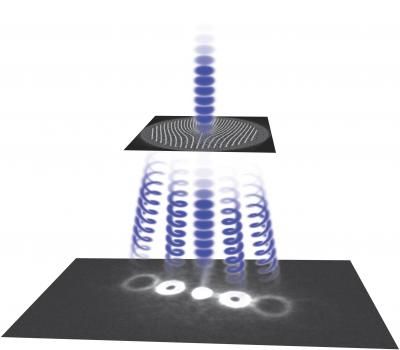
NIST researchers twisted the flat electron wavefronts into a fan of helices using a very thin film with a 5-micron-diameter pattern of nanoscale slits, which combines the wavefronts to create spiral forms similar to a pasta maker extruding rotini. This method produces several electron beams fanning out in different directions, with each beam made of electrons that orbit around the direction of the beam.
B. McMorran/NIST
The development opens the possibility of adapting transmission electron microscopy, which can see tinier details than optical microscopy and can study a wider range of materials than scanning probe microscopy, for quick and inexpensive imaging of a larger set of magnetic and biological materials with atomic-scale resolution.
"The spiral shape and angular momentum of these electrons will let us look at a greater variety of materials in ways that were previously inaccessible to TEM users," said Ben McMorran, one of the authors of the forthcoming research paper. "Outfitting a TEM with a nanograting like we used in our experiment could be a low-cost way to dramatically expand the microscope's capabilities."
Although NIST researchers were not the first to manipulate a beam of electrons in this way, their device was much smaller, separated the fanned out beams 10 times more widely than previous experiments, and spun up the electrons with 100 times the orbital momentum. This increase in orbital momentum enabled them to determine that the electron corkscrew, while remarkably stable, gradually spreads out over time.
The corkscrewing electron beams have the potential to help obtain more information from magnetic materials, according to McMorran "Magnetism, at its most fundamental, results from charges spinning and orbiting, so an electron beam that itself carries angular momentum makes a good tool for probing magnetic materials."
This technique could also help improve TEM images of transparent objects like biological specimens. Biological material can be difficult to image in ordinary TEMs because electrons pass through it without deflecting. But by using corkscrew electron beams, researchers hope to provide high-contrast, high-resolution images of biological samples by looking at how the spiral wavefronts get distorted as they pass through such transparent objects.
While these imaging applications have not yet been demonstrated, producing corkscrew electrons with nanogratings in a TEM provides a significant step toward expanding the capabilities of existing microscopes.
Original publication


Other news from the department science














Most read news









More news from our other portals
























Last viewed contents
New adsorption process makes headway in the United States - Iron hydroxide proves to be a highly effective adsorbent
DuPont to Sell Clysar® Industrial Shrink Film Business
Dow Corning Ramps Up Pharmaceutical Grade Silicone Tubing Production in Response to Influenza Outbreak
FMC Corporation Elects Eduardo E. Cordeiro and William H. Powell to Board of Directors