Iowa State chemist designs new polymer structures for use as 'plastic electronics'
Advertisement


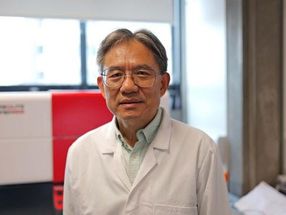
Iowa State University's Malika Jeffries-EL says she's studying doing structure-property studies so she can teach old polymers new tricks.
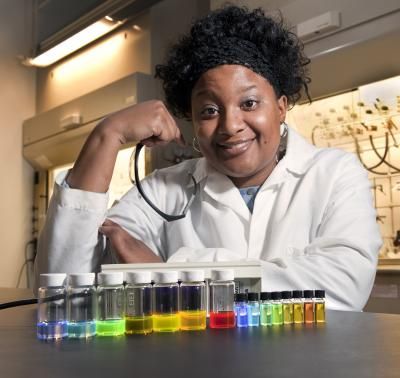
Malika Jeffries-EL and her Iowa State University research group are studying polymers that can conduct electricity.
Photo by Bob Elbert/Iowa State University
Those tricks improve the properties of certain organic polymers that mimic the properties of traditional inorganic semiconductors and could make the polymers very useful in organic solar cells, light-emitting diodes and thin-film transistors.
Conductive polymers date back to the late 1970s when researchers Alan Heeger, Alan MacDiarmid and Hideki Shirakawa discovered that plastics, with certain arrangements of atoms, can conduct electricity. The three were awarded the 2000 Nobel Prize in Chemistry for the discovery.
Jeffries-EL, an Iowa State assistant professor of chemistry, is working with a post-doctoral researcher and nine doctoral students to move the field forward by studying the relationship between polymer structures and the electronic, physical and optical properties of the materials. They're also looking for ways to synthesize the polymers without the use of harsh acids and temperatures by making them soluble in organic solvents.
The building blocks of their work are a variety of benzobisazoles, molecules well suited for electrical applications because they efficiently transport electrons, are stable at high temperatures and can absorb photons.
And if the polymers are lacking in any of those properties, Jeffries-EL and her research group can do some chemical restructuring.
"With these polymers, if you don't have the properties you need, you can go back and change the wheel," Jeffries-EL said. "You can change the chemical synthesis and produce what's missing."
That, she said, doesn't work with silicon and other inorganic materials for semiconductors: "Silicon is silicon. Elements are constant."
The National Science Foundation is supporting Jeffries-EL's polymer research with a five-year, $486,250 Faculty Early Career Development grant. She also has support from the Iowa Power Fund (a state program that supports energy innovation and independence) to apply organic semiconductor technology to solar cells.
The research group is seeing some results, including peer-reviewed papers over the past two years in Physical Chemistry Chemical Physics, Macromolecules, the Journal of Polymer Science Part A: Polymer Chemistry, and the Journal of Organic Chemistry.
"This research is really about fundamental science," Jeffries-EL said. "We're studying the relationships between structure and material properties. Once we have a polymer with a certain set of properties, what can we do?"
She and her research group are turning to the molecules for answers.
"In order to realize the full potential of these materials, they must be engineered at the molecular level, allowing for optimization of materials properties, leading to enhanced performance in a variety of applications," Jeffries-EL wrote in a research summary. "As an organic chemist, my approach to materials begins with small molecules."


Other news from the department science