Watching an electron being born
Advertisement


A strong laser beam can remove an electron from an atom – a process which takes place almost instantly. At the Vienna University of Technology, this phenomenon could now be studied with a time resolution of less than ten attoseconds (ten billionths of a billionth of a second). Scientists succeeded in watching an atom being ionized and a free electron being "born". These measurements yield valuable information about the electrons in the atom, which up until now hasn't been experimentally accessible, such as the time evolution of the electron's quantum phase – the beat to which the quantum waves oscillate.
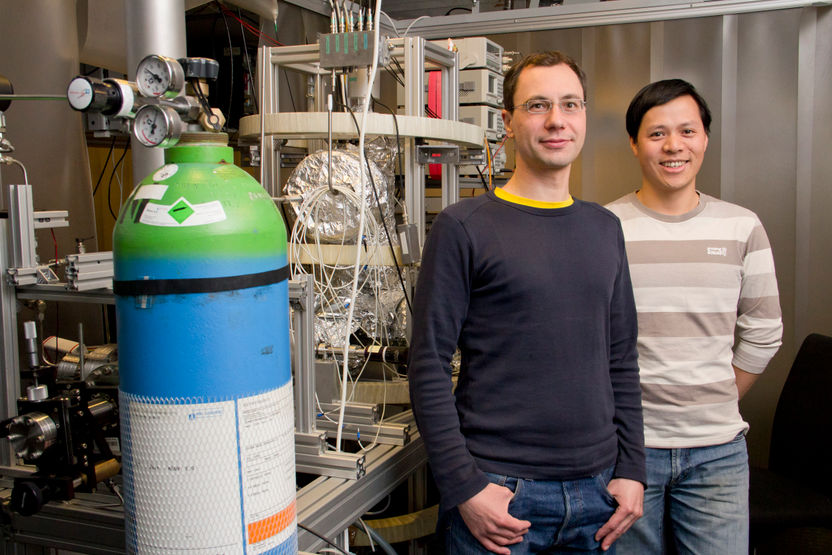
Markus Kitzler (left) and Xinhua Xie
Copyright: TU Wien
Wave-like Quantum Interference
In the experiment, short laser pulses are fired at atoms. Each laser pulse can be described as a light wave - the wave sweeps over the atom, and therefore, the electric field around the atom changes. The electric field rips an electron away from the atom – but the precise moment at which this happens cannot be defined. "The electron is not removed from the atom at one point in time during the interaction with the laser pulse. There is a superposition of several processes, as it is often the case in quantum mechanics", says Markus Kitzler from the Photonics Institute at TU Vienna. One single electron leaves the atom at different points in time, and these processes combine, much like waves on a water surface, combining to a complex wave pattern.
"These quantum mechanical wave-interferences give us information about the initial quantum state of the electron during the ionization process", says Professor Joachim Burgdörfer (Institute for Theoretical Physics, TU Vienna), whose research team closely collaborated with the experimentalists at the Photonics Institute.
It's All About the Phase
Like waves, quantum particles in this experiment can interfere constructively or destructively. The wave cycle of the electrons is extremely short, the quantum phase changes rapidly. "Usually, this quantum phase can hardly be measured", says Markus Kitzler. Combining high precision measurements and elaborate theoretical calculations, information about the electron's quantum phase can now be obtained.
An important tool for these measurements was a very special laser beam, containing two different wavelengths. The laser pulse interacting with the atom could be tailored very precisely. Using these pulses, the scientists could measure the quantum phase which the electron had inside the atom (with respect to the beat defined by the laser light) before it was removed by the laser. "This quantum phase that we can measure now, also tells us about the electron's energy states inside the atom, and about the precise position at which the ionization took place", says Markus Kitzler. To do that, the scientists had to measure the quantum phase with an incredible precision of less than ten attoseconds.
Ultrashort timescales – far away from everyday experience
The time span of ten attoseconds (10*10^(-18) seconds) is so short that any comparison to everyday timescales fails. The ratio of ten years to a second is 300 million to one. Dividing a second by the same factor takes us to the incredibly short time scale of three nanoseconds – in this period, light travels one meter. This is the time scale of microelectronics. Again dividing this tiny period of time by a factor of 300 million, we arrive at about ten attoseconds. This, is the timescale of atomic processes. It is the order of magnitude of an electron's period orbiting the nucleus. In order to measure or to influence these processes, scientists have been striving to access these timescales for years.
Original publication


Other news from the department science











Most read news









More news from our other portals























Last viewed contents

Siemens AG - Process Automation - Karlsruhe, Germany
Amersham Biosciences Updates Its Chromatography Handbook Reference Set - Handbooks Provide Detailed Descriptions of Common Chromatographic Techniques
FDS Group becomes The Flexitallic Group - Operating companies to adopt Flexitallic brand over next 18 months
ISU researcher develops green, bio-based process for producing fuel additive
Merck and ESK Enter Cooperation Agreement for Functional Fillers
Going underground to monitor carbon dioxide

Rainbows on a Nanoscale - Big impact on solar cells, television screens
High expectations for ACHEMA 2012
analyticon instruments gmbh - Rosbach, Germany
(Benzylideneacetone)iron_tricarbonyl