200-year long dispute resolved: First direct evidence that elemental fluorine occurs in nature
Advertisement


fluorine is the most reactive chemical element. That is why it is not found in nature in its elemental form, but only in compounds, such as fluorite – that was the accepted scientific doctrine so far. A special fluorite, the “fetid fluorite” or “antozonite”, has been the subject of many discussions for nearly 200 years. This mineral emits an intensive odor when crushed. Now, for the first time, scientists from the Technische Universitaet Muenchen (TUM) and the Ludwig-Maximilians-University Munich (LMU) have successfully identified natural elemental fluorine in this fluorspar.
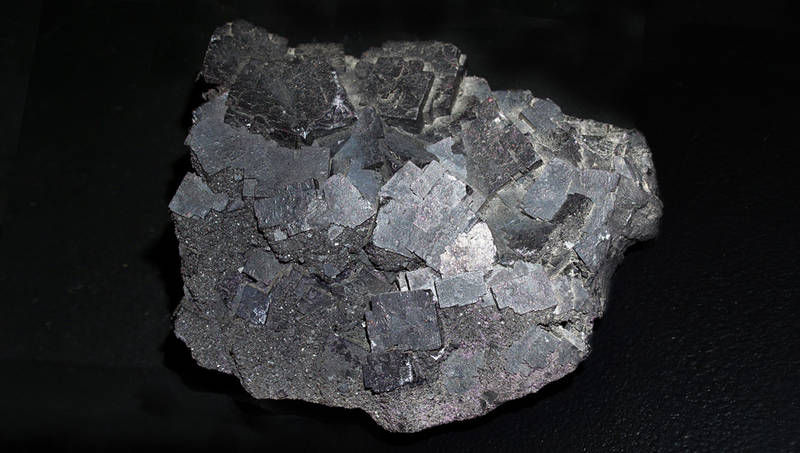
Antozonite or „Stinkspat"
Dr. Rupert Hochleitner, Mineralogische Staatssammlung München
Fluorine is the most reactive of all chemical elements and calls for extremely careful handling. It is so aggressive that glass laboratory instruments cannot resist it and even bricks burn when exposed to fluorine gas. Yet elemental fluorine has numerous industrial applications including corrosion prevention or fuel tank diffusion barriers and it is used for the production of sulphur hexafluoride, which serves as insulating material in high voltage switches.
Because of its extreme properties, until now chemists were convinced that fluorine cannot occur in nature in its elemental form, but only as a fluoride ion, for instance in minerals such as fluorite (CaF2), also known as fluorspar. A certain variety of it, the so-called “fetid fluorite” or “antozonite” from the “Maria” mine in Woelsendorf in the Upper Palatinate (Germany), has been an object of contention in science for some 200 years. When crushed, it emits an unpleasant, pungent smell.
A number of eminent chemists, among them Friedrich Woehler (1800-1882) and Justus von Liebig (1803-1873), proposed various substances to explain the odor. Over the years, scientists resorted to olfactory tests, chemical analyses and complex mass spectrometer studies – coming to very different conclusions. Next to elemental fluorine, substances like iodine, ozone, phosphorus compounds, arsenic, sulphur, selenium, chlorine, hypochlorous acid and hydrofluorocarbons were made responsible for the smell. Direct evidence that this fluorspar has inclusions of fluorine and that the gas does not form during crushing was lacking hitherto.
Now, finally, a scientific team led by Florian Kraus, head of the Fluorine Chemistry Work Group at the Department of Chemistry of the Technische Universitaet Muenchen, and by Joern Schmedt auf der Guenne, head of the Emmy-Noether Work Group for Solid State NMR at the Department of Chemistry of the Ludwig-Maximilians-University Munich, have succeeded in directly proving the presence of fluorine in “antozonite” beyond any doubt. Using 19F-NMR spectroscopy, they were able to identify the fluorine “in-situ”, i.e. non-destructively in its natural environment, and thereby put an end to the long discussions about the cause for the odor of “stinking fluorspar”.
“It is not surprising that chemists doubted the existence of elemental fluorine in fetid fluorite,” explain the researchers. “The fact that elemental fluorine and calcium, which would normally react with each other at once, are found here side by side is indeed hard to believe.” However, in the case of “antozonite” there are very special conditions: The elemental fluorine is generated through minute uranium inclusions in the mineral, which constantly emit ionizing radiation and thus split the fluorite into calcium and elemental fluorine. The fluorine remains in minute inclusions, separated from the calcium by the non-reactive fluorite and thus retains its elemental form. The ionizing radiation also leads to the formation of calcium clusters, which give “antozonite” its dark color.
Original publication


Other news from the department science