Plants do not produce methane gas
Dutch scientists disprove recent claim that living plants would produce a large part of the greenhouse gas methane.
A group of scientists of Plant Research International (Wageningen UR), Radboud University Nijmegen, Utrecht University, and the Wageningen-based companies IsoLife and Plant Dynamics has demonstrated that the 'methane emission' by living plants is negligibly small. This is shown in their publication in New Phytologist. The scientists thus disprove the claim made by other scientists in 2006 that plants would through the production of methane gas make a substantial contribution to the emission of Greenhouse Gases.
Early 2006 Nature published an article claiming that plants emit the greenhouse gas methane and thus make a substantial contribution to the global production of this greenhouse gas. At the time this claim caused quite some controversy. These conspicuous and controversial findings have urged a group of Dutch scientists to test these findings.
The group of Dutch scientists brought together a unique combination of expertise and facilities. Their cooperation led to an innovative experiment. Plants were grown in an environment with 13C, a non-radioactive carbon isotope. Any methane emission could thus easily be detected against the methane background of the natural atmosphere in which 12C-methane is dominant.
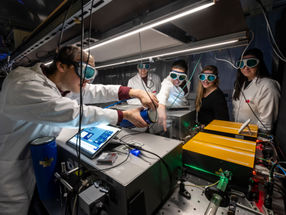
The scientists grew six plant species and methane emission was measured very accurately and highly sensitive by using the so-called photoacoustic laser technique. Even this technique with a sensitivity of one particle in one billion showed no significant methane emission. The scientists neither measured noticeable methane gas emission in experiments in which plants were grown for a longer period of time in a closed chamber.
This is, insofar as known, the first independent research in which the 2006 claim has been tested. The results are clear: plants emit no methane. The search for the explanation of the gap in the global methane balance remains unfinished.
Other news from the department science











Get the chemical industry in your inbox
From now on, don't miss a thing: Our newsletter for the chemical industry, analytics, lab technology and process engineering brings you up to date every Tuesday and Thursday. The latest industry news, product highlights and innovations - compact and easy to understand in your inbox. Researched by us so you don't have to.