The Nobel Prize in Chemistry 2008
For the discovery and development of the green fluorescent protein, GFP
The Royal Swedish Academy of Sciences has decided to award the Nobel prize in chemistry for 2008 jointly to Osamu Shimomura, Marine Biological Laboratory (MBL), Woods Hole, MA, USA and Boston University Medical School, MA, USA, Martin Chalfie, Columbia University, New York, NY, USA and Roger Y. Tsien, University of California, San Diego, La Jolla, CA, USA "for the discovery and development of the green fluorescent protein, GFP".
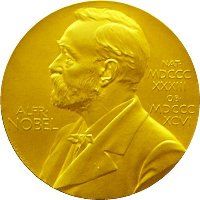
Nobel Foundation/Nobel Web AB
Glowing proteins – a guiding star for biochemistry
The remarkable brightly glowing green fluorescent protein, GFP, was first observed in the beautiful jellyfish, Aequorea victoria in 1962. Since then, this protein has become one of the most important tools used in contemporary bioscience. With the aid of GFP, researchers have developed ways to watch processes that were previously invisible, such as the development of nerve cells in the brain or how cancer cells spread.
Tens of thousands of different proteins reside in a living organism, controlling important chemical processes in minute detail. If this protein machinery malfunctions, illness and disease often follow. That is why it has been imperative for bioscience to map the role of different proteins in the body.
This year's Nobel Prize in Chemistry rewards the initial discovery of GFP and a series of important developments which have led to its use as a tagging tool in bioscience. By using DNA technology, researchers can now connect GFP to other interesting, but otherwise invisible, proteins. This glowing marker allows them to watch the movements, positions and interactions of the tagged proteins.
Researchers can also follow the fate of various cells with the help of GFP: nerve cell damage during Alzheimer's disease or how insulin-producing beta cells are created in the pancreas of a growing embryo. In one spectacular experiment, researchers succeeded in tagging different nerve cells in the brain of a mouse with a kaleidoscope of colours.
The story behind the discovery of GFP is one with the three Nobel Prize Laureates in the leading roles:
Osamu Shimomura first isolated GFP from the jellyfish Aequorea victoria, which drifts with the currents off the west coast of North America. He discovered that this protein glowed bright green under ultraviolet light.
Martin Chalfie demonstrated the value of GFP as a luminous genetic tag for various biological phenomena. In one of his first experiments, he coloured six individual cells in the transparent roundworm Caenorhabditis elegans with the aid of GFP.
Roger Y. Tsien contributed to our general understanding of how GFP fluoresces. He also extended the colour palette beyond green allowing researchers to give various proteins and cells different colours. This enables scientists to follow several different biological processes at the same time.
Other news from the department science




Get the chemical industry in your inbox
From now on, don't miss a thing: Our newsletter for the chemical industry, analytics, lab technology and process engineering brings you up to date every Tuesday and Thursday. The latest industry news, product highlights and innovations - compact and easy to understand in your inbox. Researched by us so you don't have to.