Miniaturizing memory: Taking data storage to the molecular level
Advertisement


Computers are getting smaller and smaller. And as hand-held devices — from mobile phones and cameras to music players and laptops — get more powerful, the race is on to develop memory formats that can satisfy the ever-growing demand for information storage on tiny formats. Researchers at The University of Nottingham are now exploring ways of exploiting the unique properties of carbon nanotubes to create a cheap and compact memory cell that uses little power and writes information at high speeds.
Miniaturisation of computer devices involves continual improvement and shrinking of their basic element, the transistor. This process could soon reach its fundamental limit. As transistors approach nanoscales their operation is disrupted by quantum phenomena, such as electrons tunnelling through the barriers between wires.
Current memory technologies fall into three separate groups: dynamic random access memory (DRAM), which is the cheapest method; static random access memory (SRAM), which is the fastest memory — but both DRAM and SRAM require an external power supply to retain data; and flash memory, which is non-volatile — it does not need a power supply to retain data, but has slower read-write cycles than DRAM.
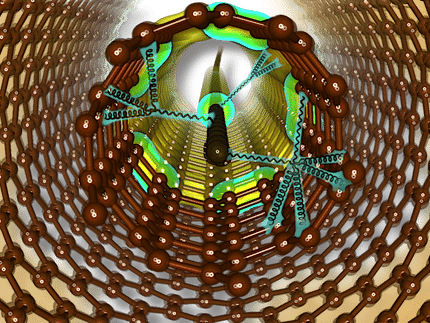
Carbon nanotubes could provide the answer. If one nanotube sits inside another — slightly larger — one, the inner tube will 'float' within the outer, responding to electrostatic, van der Waals and capillary forces. Passing power through the nanotubes allows the inner tube to be pushed in and out of the outer tube. This telescoping action can either connect or disconnect the inner tube to an electrode, creating the 'zero' or 'one' states required to store information using binary code. When the power source is switched off, van der Waals force keeps the Inner tube in contact with the electrode. This makes the memory storage non-volatile, like Flash memory.
Researchers from across the scientific disciplines will be working on the 'nanodevices for data storage' project, which is funded by the Engineering and Physical Sciences Research Council. Colleagues from the Schools of Chemistry, Physics and Astronomy, Pharmacy and the Nottingham Nanotechnology and Nanoscience Centre will examine the methods and materials required to develop this new technology, as well as exploring other potential applications for the telescoping properties of carbon nanotubes. These include drug delivery to individual cells and nanothermometers which could differentiate between healthy and cancerous cells.
Dr Elena Bichoutskaia in the School of Chemistry at the University is leading the study. "The electronics industry is searching for a replacement of silicon-based technologies for data storage and computer memory," she said. "Existing technologies, such as magnetic hard discs, cannot be used reliably at the sub-micrometre scale and will soon reach their fundamental physical limitations.
"In this project a new device for storing information will be developed, made entirely of carbon nanotubes and combining the speed and price of dynamic memory with the non-volatility of flash memory."


Other news from the department science