Planting the seeds for nanoparticle growth
Metal sulphide building blocks can be used to create functional heterostructured nanoparticles say scientists from Japan.
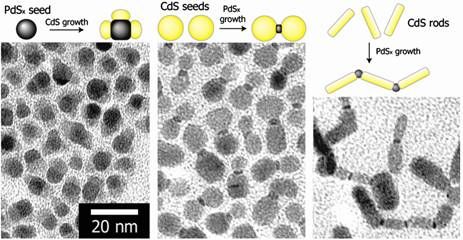
Toshiharu Teranishi and co-workers from the University of Tsukuba, Ibaraki, have developed a seed-mediated growth strategy to make flower- and dumbbell-shaped heterostructured nanoparticles. The group demonstrated that the resulting heterostructured nanoparticles consisted of metal sulphide building blocks.
The aim of the research was to find both ‘new heterostructured nanoparticles with interesting morphologies and to create the structure-specific novel functions of heterostructured nanoparticles.’ This work could provide a new mechanistic insight into the processes underlying formation of these nanoparticles says Teranishi.
Teranishi explains that there are still several challenges facing future research in this area, such as extending this method to enrich the heterostructured nanoparticle library, and being able to program the assembly of these nanoparticles by selective surface modification.
Teranishi’s group are currently studying the structure-specific functions of these new nanoparticles, including their self-assembly, and are applying this method to the synthesis of other heterostructured nanoparticles.
Original article: Masaki Saruyama et al.; "CdPd sulfide heterostructured nanoparticles with metal sulfide seed-dependent morphologies"; Chem. Commun. 2009
Other news from the department science

















Get the chemical industry in your inbox
From now on, don't miss a thing: Our newsletter for the chemical industry, analytics, lab technology and process engineering brings you up to date every Tuesday and Thursday. The latest industry news, product highlights and innovations - compact and easy to understand in your inbox. Researched by us so you don't have to.
Most read news












More news from our other portals




























See the theme worlds for related content
Topic world Synthesis
Chemical synthesis is at the heart of modern chemistry and enables the targeted production of molecules with specific properties. By combining starting materials in defined reaction conditions, chemists can create a wide range of compounds, from simple molecules to complex active ingredients.

Topic world Synthesis
Chemical synthesis is at the heart of modern chemistry and enables the targeted production of molecules with specific properties. By combining starting materials in defined reaction conditions, chemists can create a wide range of compounds, from simple molecules to complex active ingredients.
