To use all functions of this page, please activate cookies in your browser.
my.chemeurope.com
With an accout for my.chemeurope.com you can always see everything at a glance – and you can configure your own website and individual newsletter.
- My watch list
- My saved searches
- My saved topics
- My newsletter
6 Current news of TU Dresden
rssScanning X-ray microscope reaches record resolution of 10 nanometres
30-07-2012
A novel X-ray microscope at DESY offers the world's sharpest X-ray vision: Thanks to the extraordinary brilliance of DESY's X-ray source PETRA III, this microscope is able to resolve details as small as ten nanometres – which is about ten thousand times thinner than a human hair. Only few ...
Jan Meiß developed transparent organic solar cells with high efficiency
16-07-2012
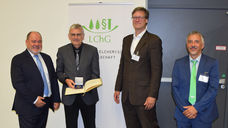
On 4th July 2012 the UMSICHT scientific award 2012 was awarded to the scientist Jan Meiß for his dissertation „New Material Concepts for Organic Solar Cells“. The award was presented to him in Oberhausen by Prof. Dr. med. Dietrich Grönemeyer, Chairman of the Wissenschaftsforum Ruhr e.V., who ...
Researchers Discover a Rare Physical Phenomenon at Low Temperatures and High Magnetic Fields
21-04-2011
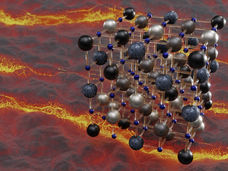
It actually seems impossible: Scientists from the Helmholtz-Zentrum Dresden-Rossendorf (HZDR) and theTU Dresdenwere able to verify with an intermetallic compound of bismuth and nickel that certain materials actually exhibit the two contrary properties of superconductivity and ferromagnetism ...
15-04-2009
Research and industry are increasingly exploiting the potential of aptamers. As well as their application in research, medical diagnosis and treatment, aptamers are also interesting as a basis for biosensors for use in environmental analysis because their characteristics enable them to ...
30-01-2009
Hans-Joachim Knölker, and colleagues from the Technical University of Dresden have developed the first total synthesis of a family of antiostatins. Antiostatins, isolated from a strain of bacteria, are antioxidative agents with potent antibiotic activity. Until now, they have only been ...
An der TU Dresden werden neue Methoden der Wasserstoffspeicherung erforscht
10-04-2007
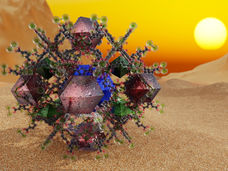
Wissenschaftler in der Fachrichtung Chemie (Physikalische Chemie) der TU Dresden arbeiten deshalb schon seit einiger Zeit an der Entwicklung neuer Festkörperspeicher, in denen sich Wasserstoff in die Zwischenräume des Gerüstmaterials anlagert. Die Eigenschaften dieser neu zu entwickelnden ...