My watch list
my.chemeurope.com  
Login  

54 Current news about the topic viruses

rss

image description
UGA researchers develop rapid diagnostic test for pathogens, contaminants

23-07-2012

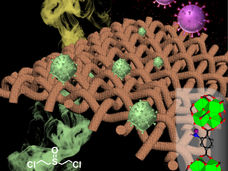
Using nanoscale materials, researchers at the University of Georgia have developed a single-step method to rapidly and accurately detect viruses, bacteria and chemical contaminants. In a series of studies, the scientists were able to detect compounds such as lactic acid and the protein ...

more

Scientists create world’s first ‘super-twisted’ light

08-11-2010

Glasgow scientists have created ‘super-twisted’ light for the first time. The research team at the University of Glasgow twisted the light like a corkscrew by using a polarising filter, before shining it onto a specially shaped piece of gold to create the world’s first ‘super twisting’. ...

more

Carbon nanotubes form ultrasensitive biosensor to detect proteins

30-06-2010

A cluster of carbon nanotubes coated with a thin layer of protein-recognizing polymer form a biosensor capable of using electrochemical signals to detect minute amounts of proteins, which could provide a crucial new diagnostic tool for the detection of a range of illnesses, a team of Boston ...

more

LANXESS builds new plant in Germany

EUR 30 million invested in new chemical production facility in Saxony-Anhalt

25-01-2010

LANXESS AG is building a new chemical plant at its site in Bitterfeld, Germany. This marks the specialty chemicals group’s move into a new segment of the water treatment business. The company is investing a total of around EUR 30 million in this pioneering project. LANXESS plans to develop ...

more

New visible light photocatalyst kills bacteria, even after light turned off

22-01-2010

In the battle against bacteria, researchers at the University of Illinois have developed a powerful new weapon – an enhanced photocatalytic disinfection process that uses visible light to destroy harmful bacteria and viruses, even in the dark. Based upon a new catalyst, the disinfection ...

more

NJIT engineer discovers why particles disperse on liquids

19-11-2009

Even if you are not a cook, you might have wondered why a pinch of flour (or any small particles) thrown into a bowl of water will disperse in a dramatic fashion, radiating outward as if it was exploding. Pushpendra Singh, PhD, a mechanical engineering professor at NJIT who has studied and ...

more

Ben-Gurion University signs Scientific Research Agreement with University of Johannesburg and University of California

07-09-2009

Ben-Gurion University of the Negev has partnered with the University of Johannesburg and the University of California, Los Angeles to conduct scientific research into the fields of water purification and microalgal biotechnology. “This is an international partnership that will benefit the ...

more

Study finds higher pathogen loads in collapsed honeybee colonies

17-08-2009

Honeybees in colonies affected by colony collapse disorder (CCD) have higher levels of pathogens and are co-infected with a greater number of pathogens than their non-CCD counterparts, but no individual pathogen can be singled out as the cause of CCD, according to a study by an international ...

more

Chasing tiny vehicles

Microscope shows how nanoferries invade cells

22-07-2009

Nanoparticles are just billionths of a millimeter in size. Exhibiting novel and often surprising properties, they are finding their way into an endless stream of equally innovative products. In medical therapies, for example, tiny nanovehicles could one day ferry drugs or even genes into ...

more

Toxin detection as close as an inkjet printer

15-07-2009

If that office inkjet printer has become just another fixture, it's time to take a fresh look at it. Similar technology may soon be used to develop paper-based biosensors that can detect certain harmful toxins that can cause food poisoning or be used as bioterrorism agents. In a paper ...

more

Page 1 From 6
Subscribe to e-mail updates relating to your search

You will receive via e-mail the latest search results matching your search criteria. This service is free of charge and can be cancelled at any time.

Your browser is not current. Microsoft Internet Explorer 6.0 does not support some functions on Chemie.DE