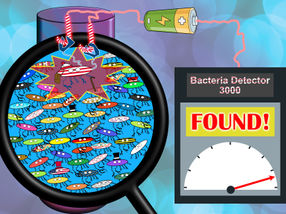
06-07-2004: Belgian researcher Filip Frederix won the first prize in the International DSM Awards for Chemistry and Technology. An international jury selected Filip Frederix, a doctoral student at the Catholic University of Louvain, for his research in the field of biosensors. His work involved the development of sensors for biomedical applications. Frederix's work has made it possible to produce highly sensitive biosensors that enable certain types of blood tests to be performed quickly, easily and cheaply. His research project was a multidisciplinary blend of physics, chemistry, nanotechnology and biomedical technology. Frederix was presented with a cash prize of EUR 7,500 by Mr Jan Zuidam, the vice-chairman of DSM's Managing Board. The winner of the second prize, Jürgen Groll, received a cash prize of EUR 5,000, and the winner of the third prize, Nathalie Charlier, was presented with a cash prize of EUR 2,500. The other six prize-winners all received prizes of EUR 1,250.
Presenting the diplomas and prizes to the nine prize-winners at a ceremony held at Vaalsbroek Chateau in Vaals, the Netherlands, Mr Jan Zuidam, the vice-chairman of DSM's Managing Board, said: "This award underscores the importance we attach to innovation and fundamental research. It's also been gratifying to see that, this year for the first time, most of the nominees were women. The prospects for the future look good."
Since 2003, the DSM Awards have been open to candidates from three regions: the Netherlands, Belgium and the German state of North Rhine-Westphalia. Regional juries short-listed three candidates from their own regions from the large number of entries received this year. After the nine nominees had given presentations on their research to an international jury yesterday, the jury today announced the three prize-winners.
Encouraging pioneering research
The DSM Awards for Chemistry and Technology were founded in 1986 and are presented each year. The contest is rapidly becoming a major event on the international calendar. Until 2001, the contest was open only to doctoral students from research institutes in the Netherlands and Flemish-speaking Belgium. The catchment area was extended to Belgium's French-speaking region in 2002, and since last year, the contest has also been open to researchers from the German state of North Rhine-Westphalia.
The winners of the first, second and third prizes
Filip Frederix conducted his research at the Catholic University of Louvain, Belgium, under the supervision of Professor Guido Maes (Faculty of Chemistry) and Professor Gustaaf Borghs (Faculty of Physics and Astronomy).
Jürgen Groll conducted his research at the University of Ulm, Germany, as a member of the Organic Chemistry III / Macromolecular Chemistry Department, working under the supervision of Professor M. Möller.
Nathalie Charlier conducted her research at the Catholic University of Louvain, Belgium, as a member of the Medical Sciences Faculty, working under the supervision of Professor E. de Clerq and Professor J. Neyts.
Other winners
The other six prize-winners are:
Belgium : An Herreman (Catholic University of Louvain)
The Netherlands : Pascal Jonkheijm(Eindhoven University of Technology), Anna Hotze (University of Leiden), Erik Offerman (Delft University of Technology)
Watchlist
This is where you can add this news to your personal favourites
Following the successful completion of a two-year evaluation phase, the University of Ulm, the Heidelberg-based company CEOS GmbH and Carl Zeiss Nano Technology Systems have signed an agreement to embark on the next phase of the SALVE project. SALVE – which stands for Sub-Angstrom Low Volta ... more
Development of efficient battery systems for future energy supply and mobility is the objective of the Ulm Helmholtz Institute for Electrochemical Energy Storage (HIU). This new research institution celebrated its opening in Ulm. "The new Helmholtz Institute for Electrochemical Energy S ... more
Researchers from the Eindhoven University of Technology and the University of Ulm have made the first high-resolution 3D images of the inside of a polymer solar cell. This gives them important new insights in the nanoscale structure of polymer solar cells and its effect on the performance. ... more
DSM Coating Resins will introduce a price increase of between 0.10-0.25 €/kg, dependingon the product, affecting the entire liquid coatings resins, adhesives and graphic artsproduct portfolio. The price increase will be effective for shipments on or after April 1,2012, or as contracts allow ... more
Royal DSM and POET, LLC announced a joint venture to commercially demonstrate and license cellulosic bio-ethanol, the next step in the development of biofuels, based on their proprietary and complementary technologies. POET-DSM Advanced Biofuels, LLC, is scheduled to start production in the ... more
Royal DSM has made an investment in NanoHoldings LLC, a company that specializes in breakthrough nanotechnology discoveries in the field of energy. Financial details of the investment will not be disclosed.NanoHoldings, LLC finds, nurtures and commercializes breakthrough Materials Science ... more
DSM creates innovative products and services in Life Sciences and Materials Sciences, contributing to the quality of life. DSM’s products and services are used globally in a wide range of markets and applications, supporting a healthier, more sustainable and enjoyable way of living. End mar ... more
DSM Exclusive Synthesis / Intermediates provides innovative solutions in life sciences for a wide range of markets, with a particular focus on the food and agrochemical sectors.
With our flexible, reliable and responsive services we can meet all your requirements for bulk active ingredient ... more
DSM creates innovative products and services in Life Sciences and Materials Sciences, contributing to the quality of life. DSM’s products and services are used globally in a wide range of markets and applications, supporting a healthier, more sustainable and enjoyable way of living. End mar ... more
Molecular oligoacceptors (chelating Lewis acids) are interesting compounds that are potentially applicable in phase-transfer processes, catalysis, or molecular recognition. Compounds with two or more coordinatively unsaturated tricoordinate aluminium or gallium atoms in a single molecule ar ... more
While examining the oldest diamonds in the world, a group of researchers, including Martina Menneken and Dr. Thorsten Geisler from the University of Münster (Institute of Mineralogy), have found evidence that life may have existed 4.25 billion years ago. Up to now, scientists have assumed t ... more
Belgian researcher Filip Frederix won the first prize in the International DSM Awards for Chemistry and Technology. An international jury selected Filip Frederix, a doctoral student at the Catholic University of Louvain, for his research in the field of biosensors. His work involved the dev ... more
More about Leiden University
Contact
Leiden University
Rapenburg 70
2311 EZ Leiden
Netherlands
A comprehensive study of the mechanism by which electrochemical water splitting occurs on gold surfaces has been carried out by scientists.
The researchers used in-situ surface enhanced Raman spectroscopy (SERS), on-line electrochemical mass spectrometry and density functional theory (DFT) ... more
In many biological and pathological processes, glycosidase enzymes attack glycosidic bonds in carbohydrates, glycoproteins, and glycolipids. The ability to modify or block these processes by specific glycosidase inhibitors forms the basis for their potential use in the treatment of viral in ... more
An international team of researchers has modified chlorophyll from an alga so that it resembles the extremely efficient light antennae of bacteria. The team was then able to determine the structure of these light antennae. This is the first step to converting sunlight into energy using an a ... more
Exactly how a crystal forms from solution is a problem that has occupied scientists for decades. Researchers at Eindhoven University of Technology (TU/e), together with researchers from Germany and the USA, are now presenting the missing piece. This classical theory of crystal formation, wh ... more
Researchers at Eindhoven University of Technology (TU/e) together with researchers at the Hong Kong Polytechnic University (PolyU), have developed a special treatment for cotton fabric that allows the cotton to absorb exceptional amounts of water from misty air: 340% of its own weight. What ... more
The Institute for Complex Molecular Systems (ICMS) at Eindhoven University of Technology (TU/e) opens its new facility. The university has transformed its former boilerhouse dating back to 1959 into an architecturally special building for a special user: ICMS. Named the Ceres building, this ... more
Henny Zandbergen, professor at the Kavli Institute of NanoScience, has been awarded an ERC Advanced Grant of 2.5 million euros for his research into improved microscopic technologies. The technologies enable Professor Zandbergen to visualise extremely small structures, such as semiconductor ... more
Thanks to a newly-developed technology at the Delft University of Technology in the Netherlands, global shortages of radio isotopes for cancer diagnosis could be a thing of the past. This is the message from Prof. Bert Wolterbeek of Delft University of Technology's Reactor Institute Delft ( ... more
A team led by Ulf Hanefeld at Delft University of Technology, the Netherlands, made a series mesoporous silicates containing different ratios of aluminium and zirconium metals. They found that in Brønsted acid catalysed reactions, the catalytic activity of the mixed metal silicates was high ... more