Photoluminescent well-organised films
Takayoshi Sasaki and colleagues at the National Institute of Materials Science, Tsukuba, and co-workers from the University of Tsukuba, Japan have prepared rare earth hydroxide films by trapping micrometer-sized crystals at a hexane-water interface and then transferring them to a substrate. The resulting film is of much better quality in terms of orientation and coverage than films fabricated by traditional methods, such as solvent evaporation or spin-coating.
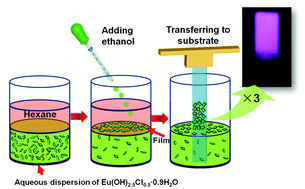
In situ the films show anion-exchange properties at room temperature allowing modification and further design. In addition the films exhibit photoluminescence properties which may have potential applications in optical devices or luminescence probes for chemical sensors.
The motivation for Sasaki and his team was to develop a method that could synthesise well-organised functional material films that could have a wide range of applications.
The next challenge is to "control the lateral alignment of the crystals, then much better films of closely packed crystals may be produced. Such films would exhibit enhanced physical properties," says Sasaki.
Original publication: T. Sasaki et al., Chem. Commun., 2008.
Other news from the department science














Get the chemical industry in your inbox
From now on, don't miss a thing: Our newsletter for the chemical industry, analytics, lab technology and process engineering brings you up to date every Tuesday and Thursday. The latest industry news, product highlights and innovations - compact and easy to understand in your inbox. Researched by us so you don't have to.
Most read news










More news from our other portals























See the theme worlds for related content
Topic world Sensor technology
Sensor technology has revolutionized the chemical industry by providing accurate, timely and reliable data across a wide range of processes. From monitoring critical parameters in production lines to early detection of potential malfunctions or hazards, sensors are the silent sentinels that ensure quality, efficiency and safety.

Topic world Sensor technology
Sensor technology has revolutionized the chemical industry by providing accurate, timely and reliable data across a wide range of processes. From monitoring critical parameters in production lines to early detection of potential malfunctions or hazards, sensors are the silent sentinels that ensure quality, efficiency and safety.
