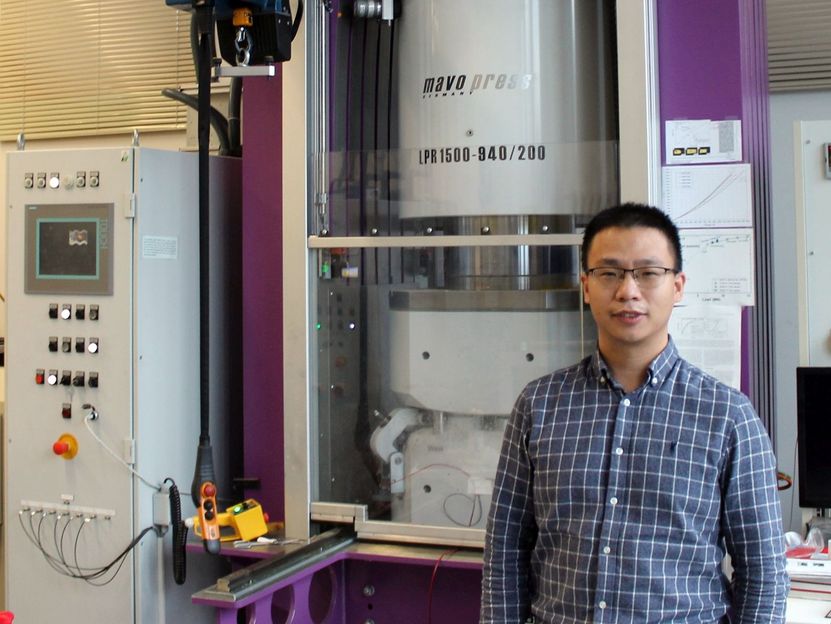
Electric transport across molybdenum disulfide grain boundaries
Advertisement


The Center for Integrated Nanostructure Physics (CINAP) within IBS has reported results correlating the flake merging angle with grain boundary (GBs) properties, and proven that increasing the merging angle of GBs drastically improves the flow of electrons. This correlates to an increase in the carrier mobility from less than 1 cm2V-1s-1 for small angles, to 16cm2 V-1s-1 for angles greater than 20°.
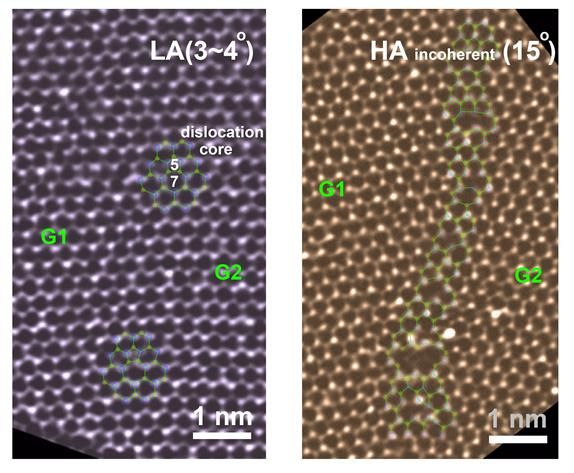
Observing the location and angle of the GBs and the atomic structure.
IBS
According to the paper, it is essential to understand the atomic structures of GBs in order to control and improve electrical transport properties in both bulk and low-dimensional materials. Grain boundaries are the direction that atoms are arranged in a material. For the experiments undertaken by scientists at CINAP, a monolayer molybdenum disulfide (MoS2) was grown by chemical vapour deposition (CVD) and subsequently transferred to a substrate of silicon dioxide (SiO2). The team's reasoning for using MoS2 is twofold: firstly, it is a 2D semiconductor that features high electrical conductance and, crucially, has a natural bandgap, which enables it to be tuned on and off and; secondly, the grain boundaries are well-defined. This is paramount for successful experiments. Previous research from Northwestern University found that the GBs of MoS2 provided a unique way to modulate resistance; this was achieved by using a large electric field to spatially modulate the location of the grain boundaries.
The Northwestern results, published last year in Nature Nanotechnology, opened a pathway for future research, but the debate regarding the transport physics at the GB is still under dispute. This is due to a large device-to-device performance variation, poor single-domain carrier mobility, and, most importantly, a lack of correlation between transport properties and GB atomic structures in MoS2 research. The CINAP team, headed by the Center's director Young Hee Lee, overcame these obstacles by directly correlating four-probe transport measurements across single GBs with both high-resolution transmission electron microscopy (TEM) imaging and first-principles calculations. TEM is a microscopy technique whereby a beam of electrons is transmitted through an ultra-thin specimen, interacting with the specimen as it passes through. An exact atomic-scale image is formed from the interaction of the electrons transmitted through the specimen.
Identifying Grain Boundaries
GBs in the MoS2 layers were identified and regions with no sign of wrinkling or multilayers were then selected to prevent misinterpretations. Four-probe transport measurements were then performed on the substrate with surprising results; when measuring flake misorientations of 8-20o, mobility increased from much less than 1 cm2V-1s-1 up to 16cm2 V-1s-1. Above 20° field effect mobility saturates at a 16cm2 V-1s-1 intra-domain cutoff. Thus, GBs between flakes having a misorientation angle of 20°-60° show better transport properties.
The team has, as reported in their paper, "provided a more unified picture of the relationship between mobility, merging angle and atomistic structures of the GBs of monolayer MoS2." The results provide practical expectations regarding transport properties in large-area films, which will be restricted largely by the poor mobility across GBs. The results obtained in this work are applicable to other similar 2D systems, and contribute to the fundamental understanding of transport in semiconductors.
Original publication


Other news from the department science




















Most read news












More news from our other portals


























Last viewed contents

Magnetic nanoparticles change their magnetic structure in a magnetic field - International research team studies the effects of magnetic fields on magnetic nanoparticles
Breakthrough in capturing 'hot' CO2 from industrial exhaust - A metal-organic framework is capable of capturing CO2 at extreme temperatures
Quantum Tricks to Unveil the Secrets of Topological Materials
The nano-lasagna: Novel 2D materials gain momentum - Research team develops environmentally friendly MXene synthesis without hazardous hydrofluoric acid for industrial scaling
Starch Instead of Plastic: Colombian Startup Reinventing Fruit Packaging - Natupla: From ISC3 start-up of the month to a pioneer in starch-based, biodegradable plastics
Researchers Test Novel Titanium-Air Battery - This is the first time that experimental results of such a battery have been published
Flow research on the outskirts of space - Experiments in weightlessness isolate classic diffusion phenomenon
Hydrogen chloride can now be stored, processed, and electrolyzed safely thanks to breakthrough - New method paves the way for safer, more sustainable hydrogen and base chemical production
Bayer wins BDI Environmental Prize - Complexing agent helps to reduce impact on inshore waters

Do We Need to Reassess Chemicals? - Chlorinated organic substances can be converted into dioxins in the atmosphere

ASCO SAS - Lucé, France