Synthesis Platform for Methanol and Its Downstream Chemistry from Renewable Sources
Advertisement


Using CO2 as its sole carbon source, a pilot plant at the LIKAT Catalysis2Sacle Technical Center in Rostock produces the basic chemical methanol as well as downstream products in the form of two synthetic fuels. The demonstration plant shows how fundamental chemical processes can function using exclusively renewable feedstocks and be effectively integrated into production lines. It is part of a global effort among experts to capture climate-damaging carbon dioxide (CO2) from civilization’s exhaust streams and utilize it as a raw material. The development of the plant was funded by the Federal Ministry of Digital and Transport.
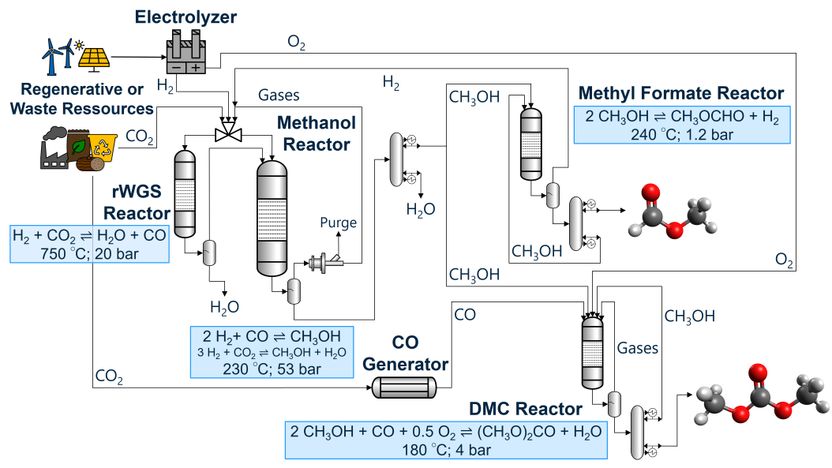
Hydrogen produced by electrolysis reacts with CO2—either together with additional H2 to form carbon monoxide, which is then converted into synthesis gas and subsequently into methanol—or it reacts directly with CO2 to form methanol. This then reacts to form either MeFo or DMC.
Copyright: LIKAT
The goal of the project, called SuME (Sustainable Mobility Enabler), was to produce two examples of “a new generation of fuels,” as stated on the official project website: methyl formate (MeFo) and dimethyl carbonate (DMC). “Both are CO2-neutral compounds that burn with virtually no pollutants and have an octane rating similar to that of conventional fuels,” explains Dr. Sebastian Wohlrab, coordinator of the SuME project. DMC also serves as an electrolyte for e-mobility.
Carbon Derived Entirely from CO₂
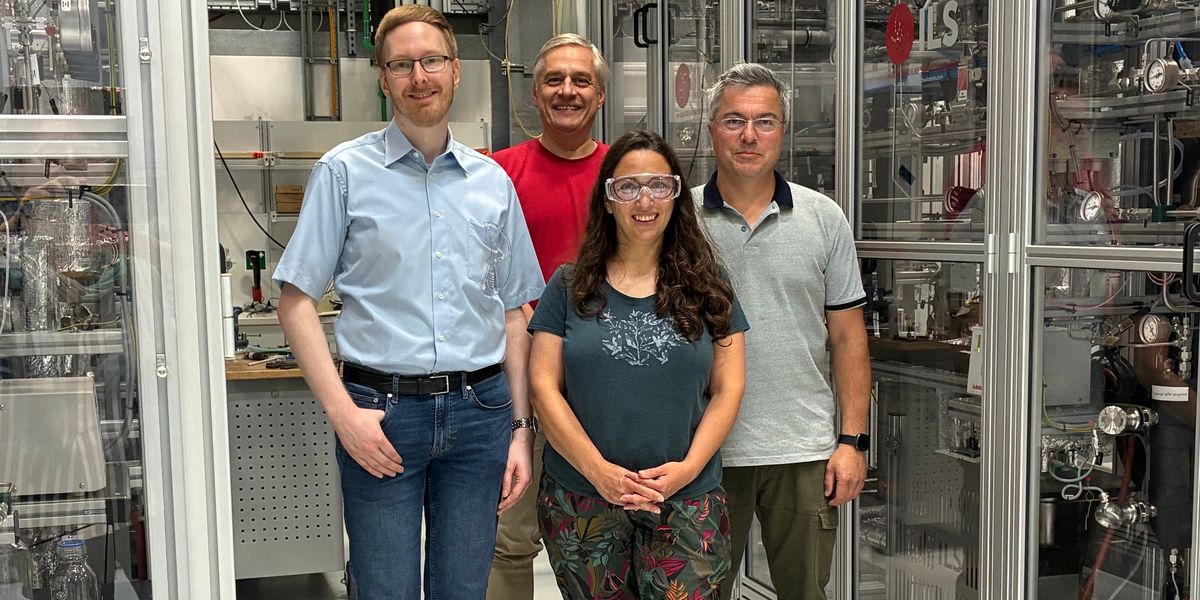
At the Leibniz Institute for Catalysis, Sebastian Wohlrab leads a four-person research team that developed and commissioned the pilot plant in collaboration with partners over the course of three and a half years. The plant operates continuously with a maximum yield of one liter per hour. The project received 7.11 million euros in funding. “As a central building block, our target products contain carbon, just like so many important basic chemical raw materials,” explains Sebastian Wohlrab. The key point: Unlike what is customary in the chemical industry, this carbon does not come from oil, gas, or coal, but entirely from CO2. Sources for this include, for example, exhaust gases from cement or biogas production, or carbon dioxide from the air. The other raw materials for methanol as well as for the two fuels, DMC and MeFo—namely hydrogen and oxygen—also come from sustainable sources.
Alternative Pathways in Chemistry
Methanol, with the structural formula CH3OH, is the simplest molecule in the alcohol group and, with an annual production of 112 million metric tons (2024), ranks among the most important basic chemicals in global industry. It is produced on an industrial scale from synthesis gas, a fossil-based mixture of carbon monoxide (CO) and hydrogen (H₂). The transition of methanol synthesis to renewable raw materials is a long-term research goal worldwide. At LIKAT and other leading laboratories, initial solutions have been developed for this purpose, some of which are already being tested on a pilot plant scale. The Rostock facility now combines an alternative methanol process with equally sustainable reaction pathways for downstream products in a continuous manufacturing process. Dr. Wohlrab: “From this synthesis platform, the entire downstream chemistry of methanol can be explored through alternative reactions.” In addition to the two C1 oxygenates, MoFe and DMC, his research team has its sights set on other target products, such as kerosene and higher hydrocarbons, including longer-chain alkanes and olefins.
How the SuME Plant Works
In the LIKAT pilot plant hall, the pilot facility immediately catches the eye: reactors, pumps, controllers, pressure systems—all towering and surrounded by piping and a protective Plexiglas enclosure. The flow diagram, a 160-page document, can be roughly outlined as follows: An electrolyzer first splits water into hydrogen (H₂) and oxygen (O₂). The electricity required for this is fed into the grid from the LIKAT pilot plant’s PV system. The hydrogen is then processed in two different ways. In one variant, it reacts with CO₂ to form carbon monoxide (CO), which—with the addition of H₂—is converted into synthesis gas, from which methanol is then produced. This process is similar to the industrial-scale method, but entirely without fossil fuels. In the second variant, H₂ is added to the CO₂, which then reacts directly to form methanol, with water as a byproduct. The methanol is then processed further in two production streams: either it is converted to MeFo with the release of H₂, or it reacts with CO and oxygen to form DMC.
Challenging CO₂ Chemistry
Chemistry based on CO₂ is trending, and it is challenging because this greenhouse gas is extremely inert. This poses a particular challenge for catalyst development—LIKAT’s core area of expertise—where the institute possesses recognized expertise and know-how in methanol synthesis. It may sound surprising, but as Dr. Wohlrab explains, copper-zinc catalysts—the same type the industry uses for methanol production from fossil synthesis gas—are suitable for activating CO₂ molecules for methanol production. However, these catalysts lose their effectiveness upon contact with water, which is unavoidable in this alternative reaction. Four years ago, researchers at LIKAT succeeded in synthesizing a catalyst with greater stability, “with a similar chemical composition but a significantly altered micro- and surface structure,” as Sebastian Wohlrab explains. During this time, the idea also emerged to develop a synthesis platform for methanol at the newly opened LIKAT technical center and to seek out funding and research personnel.
Project Partners and Current Topics
Project partners included the TU Bergakademie Freiberg and Fraunhofer IKTS Dresden, as well as the companies EnProCo Berlin and HydroExeed. Since then, the SuME project team has gained a great deal of insight into the influence of water and other reaction components on the catalytic process and has been able to further develop the copper-zinc catalyst. Currently, the chemists are investigating which of the two reaction pathways to methanol is more economically favorable: from CO₂ via CO, or the pathway directly from CO₂.
Note: This article has been translated using a computer system without human intervention. LUMITOS offers these automatic translations to present a wider range of current news. Since this article has been translated with automatic translation, it is possible that it contains errors in vocabulary, syntax or grammar. The original article in German can be found here.


Other news from the department science











Most read news







More news from our other portals






















See the theme worlds for related content
Topic world Synthesis
Chemical synthesis is at the heart of modern chemistry and enables the targeted production of molecules with specific properties. By combining starting materials in defined reaction conditions, chemists can create a wide range of compounds, from simple molecules to complex active ingredients.
Topic world Synthesis
Chemical synthesis is at the heart of modern chemistry and enables the targeted production of molecules with specific properties. By combining starting materials in defined reaction conditions, chemists can create a wide range of compounds, from simple molecules to complex active ingredients.