How sustainable is a material that doesn’t even exist yet
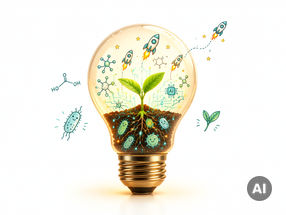
International research team demonstrates how AI can take potential environmental impacts into account even at the stage of searching for new materials
Advertisement


new materials are intended to enable technical innovations—from more powerful electronic components to more environmentally friendly building materials. But what use is a material with outstanding properties if its production consumes enormous amounts of energy or requires scarce raw materials? Such questions are often only considered at a late stage in the development of new materials. By then, considerable amounts of time, energy and money may already have been invested in a solution that proves unsuitable for practical application.
An international research team, including researchers from Friedrich Schiller University Jena, has now developed a strategy whereby artificial intelligence can not only select future material solutions based on technical properties, but can also take sustainability issues—such as potential environmental impacts—into account right from the early stages of research. To this end, the researchers propose an approach that combines AI-supported materials development with forward-looking life-cycle analyses and other sustainability considerations. They have published their roadmap in the specialist journal »Nature Sustainability«.
Questions such as whether a material requires energy-intensive production, what resources it requires, or what happens to it at the end of its life cycle can often only be answered at a late stage or even only whilst it is in use under real-world conditions. At the same time, the effort required for such investigations usually increases rapidly as progress is made.
In their newly published paper, the researchers propose integrating life-cycle analysis methods directly into AI-based development processes and designing them in such a way as to enable predictive statements. »Such an analysis captures environmental impacts from raw material extraction through to manufacture and use, right up to the end of a product’s life. In future, this information could influence at an early stage which material candidates an AI system pursues and which ultimately make it into the real-world development process outside the computer environment«, says Prof. Dr.-Ing. Lothar Wondraczek from the University of Jena. Together with researchers from the Indian Institute of Technology Delhi, Imperial College London, the Indian Institute of Technology Madras, Chalmers University of Technology and the University of Gothenburg, he developed the basic concept behind the work.
Five building blocks for a more sustainable search for materials
The roadmap comprises five interlinked tasks. Information from scientific publications and other sources is to be automatically extracted and consolidated into materials and environmental databases. Building on this, models are to estimate how a material’s composition and structure relate to manufacturing processes and environmental impacts. Several possible production pathways and their associated uncertainties are to be explicitly taken into account. Finally, technical performance and environmental impacts are to be jointly incorporated into the optimisation process.
A particular difficulty lies in the fact that, for entirely new materials, no data yet exists from industrial production or long-term use. The researchers therefore propose first calculating various plausible scenarios and making the associated uncertainties transparent. The models could then be gradually improved using new experimental and industrial data. »A particular challenge lies in linking very different types of information together«, explains N. M. Anoop Krishnan, Professor at the Indian Institute of Technology Delhi and former Humboldt visiting scholar at the University of Jena. »In future, alongside measured data and computer simulations, AI models must also take into account information on manufacturing processes, legal requirements and the social acceptance of a material.«
From plastics to glass to cement
Using polymers, glass, photoresists for semiconductor manufacturing and cement as examples, the team demonstrates just how varied the requirements for such AI models are. In the case of polymers, there is a lack of systematically processed data on environmental impacts, amongst other things; for new types of glass, there is a lack of suitable models that combine composition, properties and environmental performance. For cement, on the other hand, there is a comparatively large amount of life cycle assessment data, whilst modelling material properties across multiple scales remains difficult.
»Multimodal AI models that look to the future can help us filter out, from the multitude of theoretically possible materials, precisely those that are highly likely to lead to sustainable applications. However, they will not prevent us from also curiously pursuing unlikely approaches in the laboratory«, concludes Prof. Wondraczek.
Original publication



Other news from the department science