Enzymes in Beads for a More Sustainable Chemistry
KIT Files a Patent Application for the Process
Advertisement


Thanks to biocatalysis using enzymes, an enormous range of active pharmaceutical ingredients and other complex molecules can now be synthesized in an environmentally friendly manner. Researchers at the Karlsruhe Institute of Technology (KIT) have now developed a technology that allows enzymes to be assembled into millimeter-sized, storable beads. The enzymes serve not only as catalysts but also as the material from which the beads are made. In another variant, the enzyme networks can be combined with living cells. A patent application has been filed for the process. Results published in *Advanced Materials*.
In biocatalysis, enzymes accelerate reactions and can be used in place of chemical, often toxic, catalysts. This helps conserve raw materials and energy. However, for this technology to find the widest possible application in the chemical industry, it is crucial to be able to produce the biocatalysts continuously and in large quantities. They must also be storable, transportable, and easy to dose. To meet all these requirements, a team led by Professor Christof Niemeyer from KIT’s Institute for Biological Interfaces 1 has further developed the concept of so-called all-enzyme hydrogels (AEHs). In this process, enzymes are equipped with suitable molecular binding modules. “When the complementary building blocks come into contact, they self-assemble into three-dimensional protein networks,” explains Niemeyer. “The enzymes thus serve simultaneously as both catalysts and building blocks for the beads—a major advantage over conventional methods. We avoid using inactive carrier material and increase the efficiency of the desired chemical reaction.”
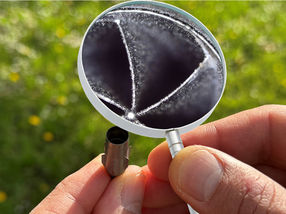
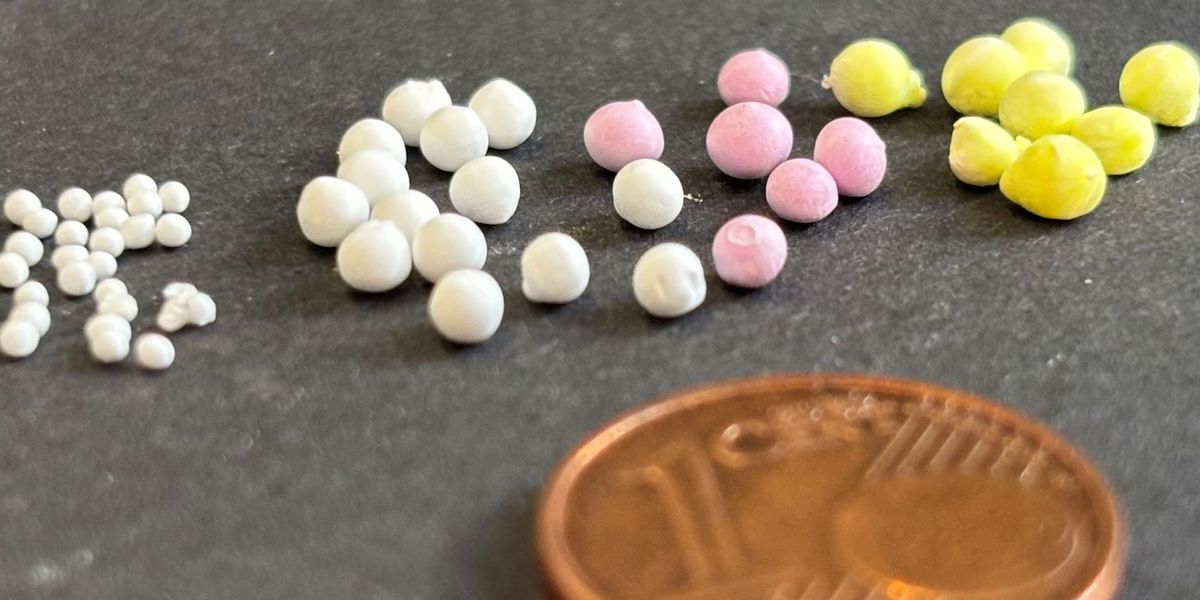
The researchers used these properties to produce manageable beads in a two-step process. First, they brought complementary enzyme building blocks together in liquid droplets and fixed them by rapidly freezing them in liquid nitrogen. Subsequent freeze-drying resulted in mechanically stable, porous protein beads of a defined size. The dried particles can be re-dissolved in liquid and used for biocatalytic reactions.
Modular System of Enzymes and Cells
Using a wide variety of enzymes and reaction types, the team demonstrated that the method is highly versatile. Both individual catalytic functions and systems consisting of multiple enzymes—with or without additional additives—could be organized within the beads. “Depending on the desired reaction, the composition of the material can be adjusted,” explains Niemeyer. “It’s a kind of modular system: We can assemble different enzyme building blocks into catalytic networks using defined binding modules and then convert these into an easily handled particle form.” The scientists also demonstrated the use of the AEH beads over many hours in flow reactors.
In further tests, the team combined the enzyme building blocks with cells from the bacterium Escherichia coli to produce hybrid beads. Unlike enzymes, cells can, for example, provide chemical energy or produce intermediate products. The hybrid beads remained catalytically active even after more than four weeks of dry storage at room temperature. Even after five months of storage, the functions of the cell-enzyme system were still detectable. The researchers also showed that viable cells can be recovered from the materials while preserving their genetic function.
Suitable for Fine Chemicals or Medicines
“With the hybrid beads, we combine two forms of biocatalysis that are normally considered separately,” says Niemeyer. “We can specifically combine individual enzymes within them while simultaneously utilizing the capabilities of living cells. This results in a material that combines both approaches and is easy to handle.” Potential applications include, for example, the production of fine chemicals, flavorings, building blocks for active pharmaceutical ingredients, and other high-value chemical products.
Note: This article has been translated using a computer system without human intervention. LUMITOS offers these automatic translations to present a wider range of current news. Since this article has been translated with automatic translation, it is possible that it contains errors in vocabulary, syntax or grammar. The original article in German can be found here.
Original publication
Jennifer Kühne, Julian S. Hertel, André Delavault, et al.; "Programmable Carrier‐Free All‐Enzyme Beads for Modular Continuous‐Flow Biocatalysis"; Advanced Materials, 2026-9-24
Marius Stoeckle, Kersten S. Rabe, Christof M. Niemeyer; "Self‐Assembled Hybrid Cell‐Enzyme Materials for Gas‐Powered Biocatalysis"; Advanced Functional Materials, 2026-9-2


Other news from the department science