The Invisible Power of the Metal Triangle
Why a triangle of iron atoms can produce ammonia, but a triangle of chromium cannot
Advertisement


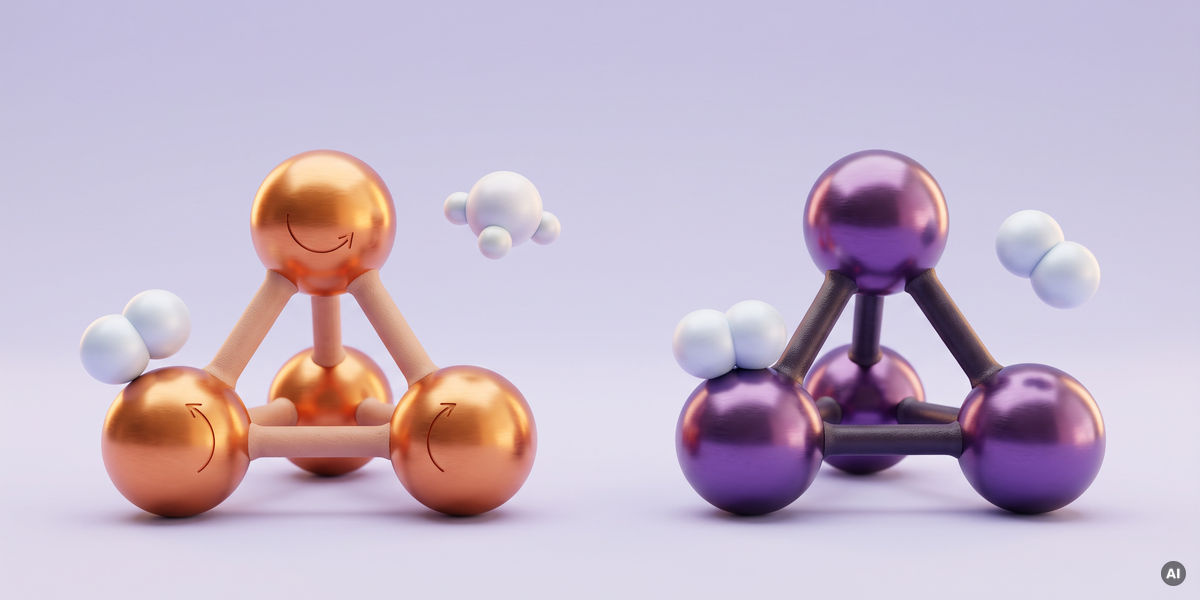
Two nearly identical materials, but with completely different chemical behaviors: Research teams at the University of Vienna and the Vienna University of Technology investigated catalysts that can be used to harness the energy of sunlight to produce ammonia. Surprisingly, it turned out that if three iron atoms—which are arranged in tiny triangles in such catalysts—are replaced with chromium atoms, the chemical reaction no longer takes place.
Now, researchers have succeeded in explaining the reason for this: Iron and chromium triangular structures have very different magnetic properties, and it is precisely these magnetic properties that determine whether the material is suitable as a catalyst or not. Both research teams are part of the FWF Cluster of Excellence MECS (Materials for Energy Conversion and Storage), which focuses on the development of novel materials for the energy transition.
Energy-Intensive Fertilizer Production
Ammonia is indispensable to humanity: Fertilizers made from ammonia help feed a large portion of the world’s population. However, the industrial production of ammonia from nitrogen and hydrogen typically requires high temperatures and high pressure—making it extremely energy-intensive. Therefore, researchers are working on an alternative that requires less energy: photocatalysts are special, novel materials that absorb sunlight and use its energy to convert nitrogen into ammonia.

“Organometallic framework compounds are promising candidates for this,” says Jana Bischoff (Vienna University of Technology). “These are crystals that contain small cavities. Their framework consists of nodes with metal atoms that are connected to one another by organic molecules.”
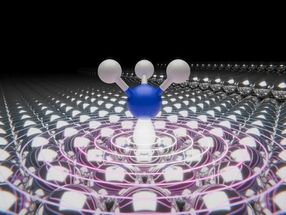
The team conducted research on a structure called MOF MIL-101. In this structure, each node contains three metal atoms arranged in a triangle around a central oxygen atom. This structure can be produced using different types of metal atoms without altering the framework. But chemically, the difference is enormous: when iron atoms are used, the structure can produce ammonia when exposed to light; with chromium, this reaction does not occur.
Initially, researchers attempted to explain this difference based on the differing numbers of electrons. But now the team has discovered that the magnetic orientation of the atoms—known as spin—plays the decisive role.
Three Can’t Look Each Other in the Eye
The spin of such an atom can assume various states. For neighboring atoms in this crystal structure, it is advantageous to have spin directions that are as opposite as possible—for example, one pointing up and the other down. “But with our catalyst, we’re dealing with a triangle of three iron atoms,” says Patrick Lechner (University of Vienna). “This means that the first two iron atoms can adopt opposite magnetic orientations, but the third can no longer meet this requirement.” This phenomenon is known as “magnetic frustration.”
“It’s as if three people at a table all want to sit directly across from each other,” explains Patrick Lechner. “The first two can look each other straight in the eye. But it’s impossible for all three to do so at the same time.”
A triangle of chromato atoms, on the other hand, behaves fundamentally differently: Here, two of the atoms form a significantly stronger magnetic coupling and, in a sense, form a pair. The third atom couples only weakly to them—as if two people were facing each other and speaking directly to one another, while the third person stands apart.
It All Comes Down to the Strength of the Coupling
It has now become clear that these different magnetic couplings are closely related to the fact that nitrogen binds to the metal atoms with varying strengths from the outside. In the case of the iron atoms with their “magnetic frustration,” the binding strength between iron and nitrogen is moderate—strong enough to hold onto this nitrogen and convert it into ammonia, but weak enough to release the nitrogen atoms again afterward. This is nearly optimal: it allows one ammonia molecule to be produced after another.
With chromium atoms, however, the bond to nitrogen is significantly stronger. This means that this nitrogen cannot be released quickly enough; the metal site remains occupied, and the structure can no longer hold any more nitrogen. As a result, this structure is not suitable as a catalyst.
The team’s work shows that even when the crystal structure is otherwise completely identical, the choice of metal can determine how the spins interact. “This magnetic fingerprint is a key factor in understanding how these materials function as catalysts,” emphasizes Leticia González (University of Vienna).
“We can now, in a sense, observe how the metal atoms at a node in these crystals ‘communicate’ magnetically with one another, and what effects this has on the material’s behavior as a catalyst,” says Dominik Eder (Vienna University of Technology). “This is an important step toward energy-efficient ammonia production.”
Note: This article has been translated using a computer system without human intervention. LUMITOS offers these automatic translations to present a wider range of current news. Since this article has been translated with automatic translation, it is possible that it contains errors in vocabulary, syntax or grammar. The original article in German can be found here.
Original publication


Other news from the department science