Enzymes Overcome the 100-Degree Heat Barrier
The process is of interest to the chemical industry
Advertisement


enzymes can specifically accelerate chemical reactions. Among other things, they are used to produce chemicals in a more sustainable way. However, some substances can only be processed at high temperatures—and these sensitive proteins often do not tolerate such temperatures well. Researchers at Bielefeld University have now found a way to use enzymes even at 100 degrees Celsius and above: they encapsulate them in a protective porous structure. This keeps the enzymes functional and allows them to be reused multiple times. The results have now been published in the journal “Angewandte Chemie Novit.”
Enzymes play an important role in nature. As biocatalysts, they enable and accelerate chemical reactions in living organisms and ensure that these reactions proceed in a controlled manner. These properties also make them of interest to the chemical industry: Compared to many conventional chemical processes, enzyme-catalyzed reactions can often be carried out under milder conditions. This saves energy, allows for more efficient use of raw materials, and helps prevent waste.
However, as protein molecules, enzymes have a weakness: they require a specific three-dimensional structure to perform their function. At high temperatures, this structure can be lost. In the process, the enzyme unfolds much like a ball of yarn being pulled apart. As a result, it loses its desired activity as a reaction catalyst.
A polymer cage protects the enzyme
Professor Dr. Harald Gröger from the Department of Chemistry and his team, together with Professor Dr. Andreas Hütten and his team from the Department of Physics, investigated how enzymes can be stabilized even at high temperatures and used for chemical reactions. Their idea: The enzyme should be embedded in a protective three-dimensional environment so that it retains its shape—and thus its activity—even at high temperatures.
For their experiments, the researchers encapsulated the enzyme in a porous structure made of an organic polymer. The pores are large enough to allow the substances the enzyme needs to carry out the chemical reaction to enter and the resulting products to exit.
At the same time, the structure protects the enzyme from unfolding and deforming when exposed to heat. In conventional chemical processes, enzymes are often attached to a surface and are thus directly exposed to the environment. In the new process, however, the enzyme is protected within a porous cage-like structure, yet it can continue to function and be reused multiple times.
Enzyme Remained Protected Even at 100 Degrees Celsius
The researchers used a lipase for their experiments. This enzyme is frequently used in chemical syntheses but is normally sensitive to heat. By embedding it in the porous material structure, the researchers were able to demonstrate that the lipase remains active even at high temperatures, confirming that the porous structure effectively protects the enzyme from heat. Without this protection, however, the lipase largely loses its activity.
Even at 100 degrees Celsius, the encapsulated enzyme remained active. At this temperature, it actually worked about twice as fast as at room temperature. The protected enzyme, which is used as a biocatalyst, remained effective even after repeated use. In an experimental setup designed to investigate its reusability, its performance remained virtually unchanged at 100 degrees Celsius over twelve reaction cycles.
“The research began with the fundamental question of which methods could prevent enzymes from denaturing, even at high temperatures and under challenging reaction conditions,” says Dr. Jianing Yang, the study’s first author. “It turned out that enzymes exhibit the desired properties when incorporated into cage compounds in a tailored manner.”
Method Is of Interest to the Chemical Industry
The advantage of high-temperature stability extends beyond the enzyme itself. Some chemical starting materials are solid at room temperature and do not melt until temperatures reach 100 degrees Celsius or higher. For enzymatic reactions, such substances often had to be mixed with a solvent first, which made the process more complex.
With the new method, however, the researchers can use the substances directly in their molten form. In their experiments, they succeeded, among other things, in carrying out a reaction at 110 degrees Celsius. Further experiments showed that the approach also works at temperatures up to 120 degrees Celsius. The reactions took place without the use of organic solvents.
This is of interest to the chemical industry: one potential application lies in the production of so-called esters. These are used, among other things, in cosmetics, fragrances, and plastic products. Many of the starting materials used for this purpose have melting points exceeding 100 degrees Celsius.
Using Enzymes Where It Was Previously Impossible
“Our goal was to make biocatalytic processes efficiently applicable even in areas where this was previously considered impossible,” says Professor Dr. Harald Gröger, head of the Industrial Organic Chemistry and Biotechnology Research Group and co-author of the study. “We want to consistently advance research toward practical applications and drive the transfer into industrial processes.”
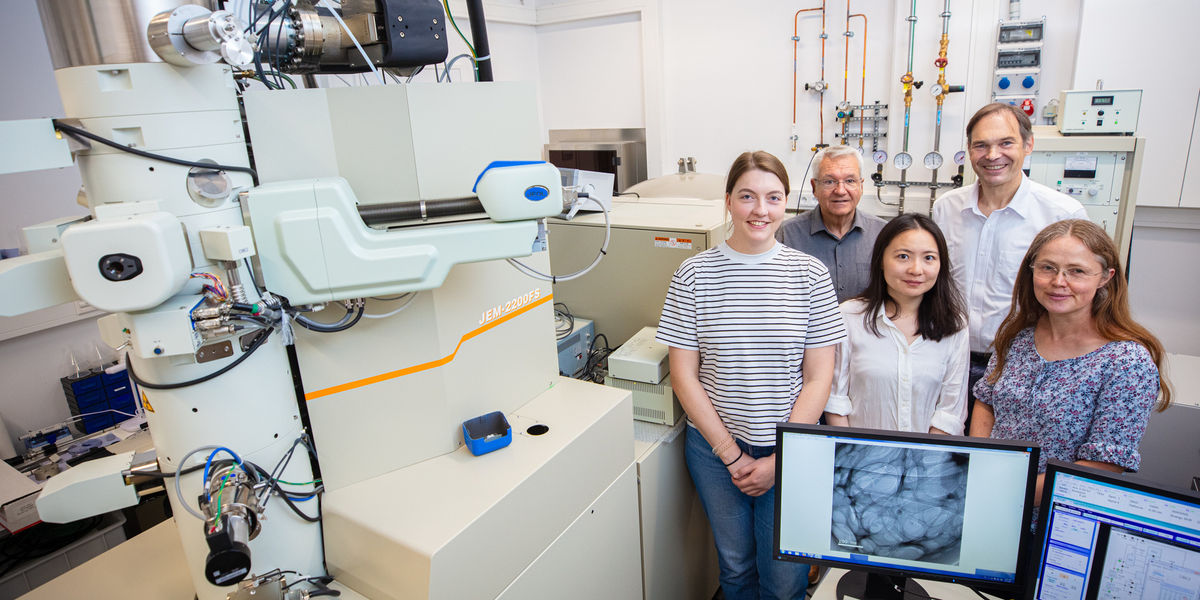
Professor Dr. Andreas Hütten, Senior Professor of Physics in Bielefeld and co-author of the study, and his team investigated, among other things, the structure of the material and how the enzyme is encapsulated within it. Electron microscopy techniques were also used for this purpose.
“We examined the structure of the material using a high-resolution transmission electron microscope and gained insights into the interior of the porous polymer structure,” says Hütten. “This was a particular challenge because the material is not structured as regularly as a crystal.” The investigations were crucial for understanding how the porous structure is organized and how the enzyme is encapsulated.
Further Research for Industrial Applications
The collaboration also demonstrates how a fundamental scientific question can lead to a potential industrial application. The researchers have since held discussions with companies from various product sectors. The goal is to further develop the process and extend it to other enzymes and industrial processes. Further investigations are still needed, including studies on the long-term stability of the biocatalysts and the scaling up of the process to an industrial scale.
The research was honored in early 2026 with the Jörg Schwarzbich Inventor Award 2025. The prize, worth 40,000 euros, is awarded by the Bielefeld University Society and Bielefeld University and recognizes scientific inventions with high innovation and application potential.
Professor Dr. Harald Gröger’s assessment of the topic: “The decisive step was not to attach the enzyme to surfaces, but to incorporate it into a three-dimensional cage structure. This allows us to use enzymes at temperatures that were previously too high for efficient biocatalytic reactions and were therefore unsuitable. The next step is to further develop this concept and make it suitable for industrial applications.”
Note: This article has been translated using a computer system without human intervention. LUMITOS offers these automatic translations to present a wider range of current news. Since this article has been translated with automatic translation, it is possible that it contains errors in vocabulary, syntax or grammar. The original article in German can be found here.
Original publication


Other news from the department science