Safe Carbene Transfer via Thianthrenium Salts
Max Planck Institute researchers develop safer carbene transfer reagents using benchstable thianthrenium salts
Advertisement


Many useful reactions in chemistry come with a trade-off: the reactive reagents that make them effective can also present practical and safety challenges. Carbene chemistry is one such example. For decades, chemists have relied on diazo compounds to generate reactive carbenes, even though diazoalkanes can be toxic, unstable and potentially explosive.
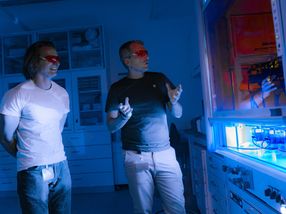
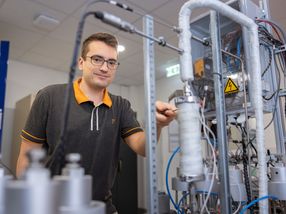
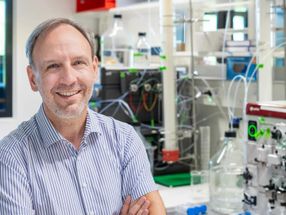
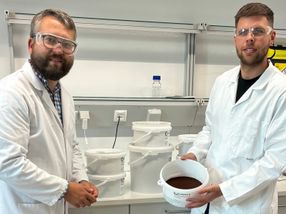
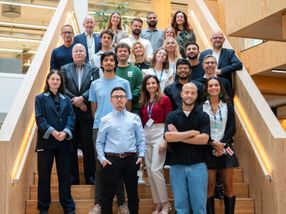
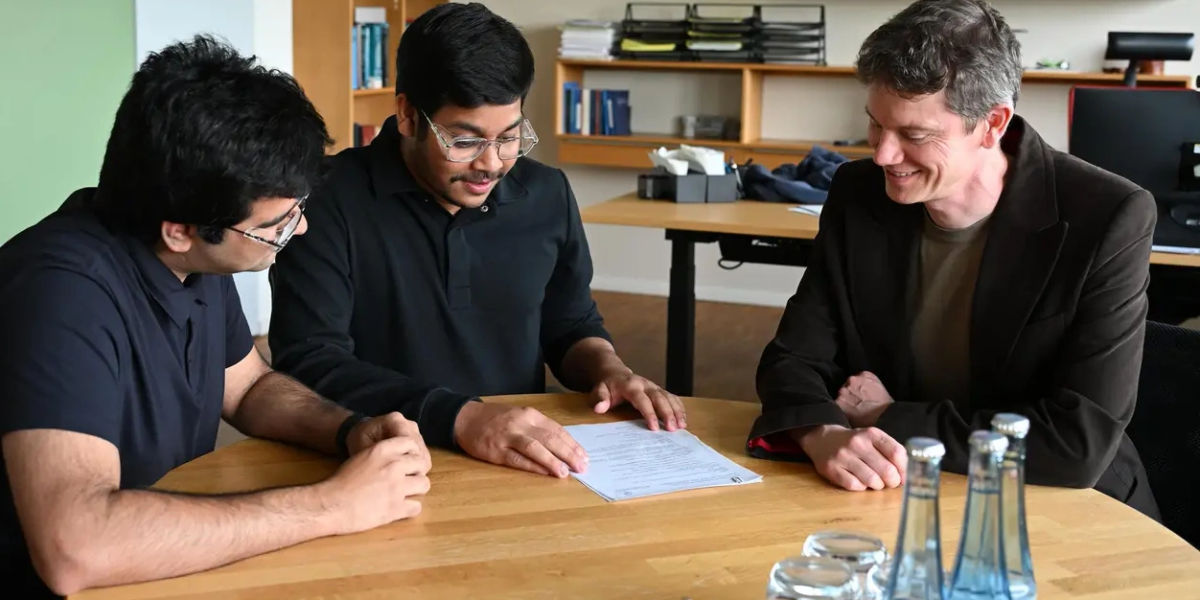
Researchers at the Max-Planck-Institut für Kohlenforschung have now developed a safer approach to access metal carbenes. The breakthrough, published in the flagship journal Nature, shows that bench-stable thianthrenium salts can serve as practical and versatile precursors for carbene-transfer reactions. Sagnik Chatterjee, Deepak Kumar Behera und Tobias Ritter (from left) discuss the results of their research.
Sulfonium salts, although safer, have not been useful as general carbene precursors. Sulfonium ylides are inherently nucleophilic, and carbene transfer from them to generate electrophilic metal carbenes is compromised by the Lewis basicity of the corresponding sulfides. The approach demonstrated here by Tobias Ritter’s group changes the picture. The unusual electronic and steric properties of thianthrene make carbene transfer to the metal more favourable, overcoming a long-standing limitation in sulfonium based carbene chemistry. The researchers demonstrated this metal-mediated reactivity through cyclopropanation, combining diverse carbene fragments with a broad range of alkenes, including challenging internal, unactivated alkenes. Deepak Behera says: “Sulfonium ylides have been used in cyclopropane chemistry for almost 60 years, but their reactivity was limited to Michael acceptors.”
Alkyl thianthrenium salts are readily prepared, bench-stable compounds that can be isolated and stored, which avoids safety concerns associated with diazoalkanes. Thermal analysis showed no detectable exotherm for the salts tested, which supports a favourable safety profile. The researchers also demonstrated decagram-scale cyclopropanation using solvent-free ball-milling. “The combination of bench-stable reagents and solvent-free ball-milling makes the carbene chemistry particularly attractive from a practical and scalability perspective,” says Sagnik Chatterjee.
The researchers also demonstrated σ-bond insertion and sigmatropic rearrangements, which extend the use of thianthrenium ylides beyond cyclopropanation. “Our aim was to establish a general approach to carbene- transfer chemistry that allows diverse carbene fragments to participate in different classes of reactions,” says Tobias Ritter, Director at the Max- Planck-Institut für Kohlenforschung.
The study establishes thianthrenium salts as a general platform for carbene- transfer chemistry and opens the possibility of applying the same concept to an even wider range of carbene-mediated transformations in the future.
Original publication


Other news from the department science