Hydrogen from Waste Materials for Stationary and Mobile Engines
Lower purity requirements open up the use of fermentation residues and sewage sludge as sources of hydrogen
Advertisement


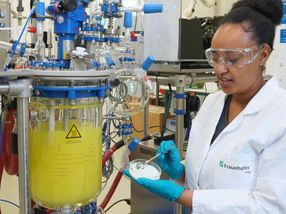
The BMFTR-funded Waste2HyEngine project has developed a process chain to produce hydrogen-rich gas from biogenic waste materials. This gas is used in a retrofitted diesel engine with 40 to 100 vol.% hydrogen. Since its purity requirements are lower than those for fuel cells, this enables cost-effective H₂ sources from waste materials. Options include direct power generation in a combined heat and power (CHP) plant or H₂ concentration for mobile applications. Fraunhofer UMSICHT, Fraunhofer IKTS, Heilbronn University, and DEUTZ AG tested the process chain on a pilot plant scale.
The decarbonization of stationary and mobile energy systems requires new approaches to hydrogen production and utilization. The supply of electrolytically produced, high-purity hydrogen (99.999 percent) for fuel cells represents the state of the art but involves significant technical and financial costs. In particular, for decentralized applications outside the planned core hydrogen network—such as in agriculture or the construction industry—economically viable solutions have been lacking to date. At the same time, robust diesel engines are well-established in these sectors and can be converted to hydrogen internal combustion engines at a manageable cost.
In the Waste2HyEngine project, the Fraunhofer Institutes UMSICHT and IKTS, Heilbronn University, and DEUTZ AG are pursuing an approach tailored to this specific application: Using thermochemical conversion processes such as pyrolysis, biogenic residues are converted into a hydrogen-rich synthesis gas. This gas is tested in continuous operation on a converted stationary hydrogen internal combustion engine. The focus is on the engine’s operating behavior under different gas compositions. The results so far are promising: The engine runs smoothly and stably even with varying hydrogen concentrations ranging from 40 to 100 vol.% in the gas. This opens up two new application scenarios.

Path 1: Direct use at the point of generation
For use solely as a fuel in stationary systems, further concentration of the hydrogen content in the pyrolysis gas is not technically necessary. At locations with high volumes of residual material—such as composting plants, biowaste recycling facilities, mills, or sawmills—a cost-effective, environmentally friendly fuel source is thus available for combined heat and power plants without the need for additional hydrogen concentration, providing electricity and heat for the facility’s own operations. Upstream gas purification to remove tars, dust, and sulfur compounds remains necessary to protect the engine in the long term—however, the processing effort is significantly lower than that required to produce gas of a quality suitable for fuel cells.
Path 2: Enrichment for Mobile Applications and Transportation
If the hydrogen-rich gas is to be used for mobile applications in tractors or construction machinery, it makes sense to concentrate the hydrogen. As part of the project, the project partners Fraunhofer UMSICHT and IKTS developed and tested various membrane processes for this purpose. So far, a hydrogen content of 90% by volume has been achieved. This increases the mass-based energy density and simplifies subsequent hydrogen logistics in terms of transport and storage. In the future, this could lead to decentralized refueling solutions for agricultural and construction machinery whose engines have been converted to hydrogen operation—a path that, however, requires not only high-quality hydrogen but also advances in on-board storage systems, safety technology, and regulatory approval.
Lower purity requirements open up new raw materials
The research project combines two advantages. Hydrogen internal combustion engines operate reliably even with traces of by-product and inert gases such as nitrogen, carbon dioxide, carbon monoxide, or methane—unlike fuel cells, whose catalysts are sensitive to trace impurities in the ppm range. At the same time, a wide variety of biogenic residues are available that cannot currently be used as a source of hydrogen, such as digestate from biogas plants, green waste, sewage sludge, or municipal biowaste. These material streams are generated regionally and are currently utilized primarily for low-value applications; processing them into high-purity hydrogen is not economically feasible. Thanks to the modified engine’s lower gas-quality requirements, they can now be used for the first time as stationary or mobile hydrogen sources.
“We are combining the thermochemical conversion of residual materials with the use of hydrogen in engines to create an integrated process chain,” explains Dr.-Ing. Christopher Graf-Kick, project coordinator at Fraunhofer UMSICHT. “The key lies in the engine’s flexibility regarding the composition of the gas mixture: This opens up the use of residual materials that were previously not considered for hydrogen production. Further concentration, for example using novel membrane technologies, is also promising. It enables applications in mobility or hydrogen logistics.”
In the first phase of the project, the tolerance limits of a hydrogen engine with regard to gas composition were systematically determined. To this end, various gas mixtures were simulated and tested in the engine on the engine test bench at Heilbronn University. The test engine is based on a 4-cylinder diesel engine manufactured by DEUTZ AG. The new mechanically controlled gas injection system developed by Heilbronn University is a key component in the conversion to hydrogen operation. “It enables precise gas metering even with extremely fluctuating gas compositions and can be installed in virtually any diesel engine,” explains Professor Karsten Wittek, head of the Laboratory for Reciprocating Engines at Heilbronn University.
In the second phase of the project, the entire process chain—using real pyrolysis gas derived from waste materials and power generation in the newly developed gas engine—was tested at Fraunhofer UMSICHT.
Dr.-Ing. Georg Töpfer of DEUTZ AG says: “DEUTZ has been offering reliable propulsion solutions for the agricultural and construction sectors for many years. By offering the option to retrofit to a hydrogen internal combustion engine, we’re opening up a path to decarbonization for our customers. If the hydrogen is produced from regional waste materials, they can take this path without having to wait for the expansion of the hydrogen infrastructure.”
Stationary Applications as a Starting Point
The immediate development goal of the project is to demonstrate the functionality of the process chain for stationary combined heat and power plants. In the long term, the technology also addresses mobile applications. Since the gas is of biogenic origin, the energy supply would be nearly climate-neutral in terms of its carbon footprint. Furthermore, the thermochemical conversion produces a carbon-containing carbonized residue. If this is permanently stored—for example, as biochar in the soil—the overall process has the potential to result in a net negative CO₂ balance. In Germany, the use of biogenic hydrogen in the transportation sector counts toward the greenhouse gas quota (GHG quota) under the 37th BImSchV (Regulation on the Crediting of Electricity-Based Fuels and Co-Processed Biogenic Raw Materials).
Waste2HyEngine is a collaborative project funded by the BMFTR (funding code 03SF0754A) with a total budget of 3.3 million euros and a duration from March 2024 to September 2026. The project is managed by PtJ (Projektträger Jülich).
Note: This article has been translated using a computer system without human intervention. LUMITOS offers these automatic translations to present a wider range of current news. Since this article has been translated with automatic translation, it is possible that it contains errors in vocabulary, syntax or grammar. The original article in German can be found here.


Other news from the department science