Old batteries turned into magnetic pollutant traps
A remarkable water purification method has been developed at TU Wien
Advertisement


How can harmful substances be removed from water? When it comes to dyes that cannot simply be filtered out, this is usually very laborious: you need substances to which the dyes attach, and then the water often has to be painstakingly centrifuged.
A method has now been developed at TU Wien that makes this much easier: the dyes are bound to magnetic materials and can then simply be removed with magnets. The particular highlight of the method is that the magnetic materials themselves come from waste that would otherwise require costly disposal – namely electronic waste and battery waste.
Turning waste into a waste-removal technology
“The idea is to turn materials that are considered waste into something valuable,” says Prof. Günther Rupprechter from the Institute of Materials Chemistry at TU Wien. “Spent batteries contain metals that are potentially harmful if disposed of improperly, but that can also be useful as building blocks for functional materials.”
Zinc was recovered from spent alkaline batteries, nickel from spent nickel-metal hydride (Ni-MH) batteries, and iron from rusty scrap iron. These metals were used to synthesize nanoparticles consisting either of pure zinc ferrite or of zinc ferrite combined with nickel-doped iron oxide.
These nanoparticles were then tested with Congo red, a synthetic organic dye that is frequently used as a model pollutant in wastewater research. Such dyes are difficult to remove because they have a stable molecular structure and are highly persistent in bodies of water.
The nanoparticles bind the dye molecules to their surface. The nickel-modified material ZnF-Ni showed a particular advantage: thanks to its stronger magnetic properties, the pollutant-laden nanoparticles could be separated from the water much more quickly.
“For practical water treatment, the magnetic properties of the nanoparticles are just as important as their ability to bind pollutants,” says Dr. Qaisar Maqbool, first author of the study. “By modifying the zinc ferrite with nickel, we obtained a material with significantly better magnetic properties. This allows us to recover the nanoparticles much faster – simply with magnets, without having to rely on centrifugation.”
From laboratory experiment to practical application
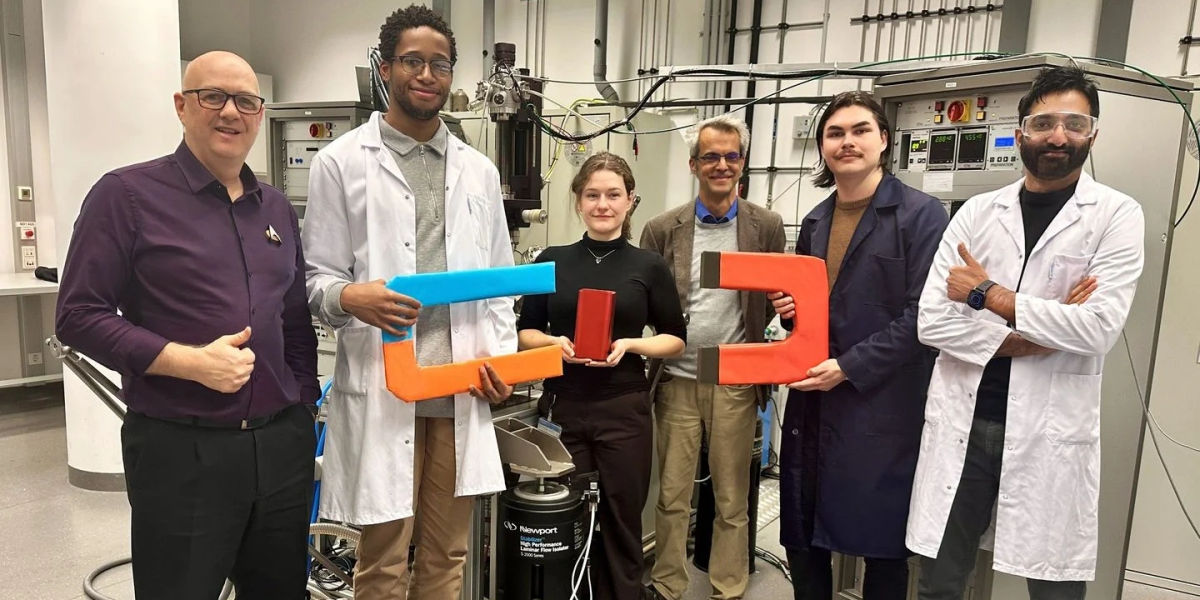
In the laboratory at TU Wien, the entire removal and separation process took only about 5 to15 minutes. The team also demonstrated the approach in a flow-through prototype: contaminated water was pumped through a glass tube surrounded by an external neodymium magnet. This magnet held the magnetic nanoadsorbents against the tube wall while the purified water flowed on. Within 25 minutes, the water was visibly clarified, and the nanoparticles could be almost completely recovered.
“If the adsorbent is captured directly from the flowing suspension, complex separation procedures are no longer needed – this enables continuous water treatment,” explains Prof. Michael Stöger-Pollach from TU Wien’s electron microscopy center (USTEM), who investigated the local magnetic properties of the materials using electron magnetic circular dichroism (EMCD). Even the pollutant itself can be recovered and reused.
Future work will aim to improve the process further in order to increase the proportion of recovered materials. It is also important to ensure that the nanoparticles do not themselves release pollutants into the water. The method is to be tested with larger volumes of wastewater under realistic wastewater treatment conditions.
Original publication


Other news from the department science











Most read news







More news from our other portals


























See the theme worlds for related content
Topic World Battery Technology
The topic world Battery Technology combines relevant knowledge in a unique way. Here you will find everything about suppliers and their products, webinars, white papers, catalogs and brochures.

Topic World Battery Technology
The topic world Battery Technology combines relevant knowledge in a unique way. Here you will find everything about suppliers and their products, webinars, white papers, catalogs and brochures.