Innovative Functional Materials for Contactless Heating
Characterization of 3D Nanostructures for Applications in Medicine, Biotechnology, and Materials Science
Advertisement


Once again, the presentation of the KoMBio project (hyperthermia systems made of superparamagnetic functional materials for contactless heating in medical technology and biotechnology) caused a stir at international conferences. The presentation of the research findings has already led to one published scientific article and another paper that has been accepted for publication.
The goal of the project is to develop novel contactless heating methods using superparamagnetic functional materials. To date, the project has focused on the characterization of 3D nanostructures. The findings provide an important foundation for the development of novel functional materials and future contactless heating applications.
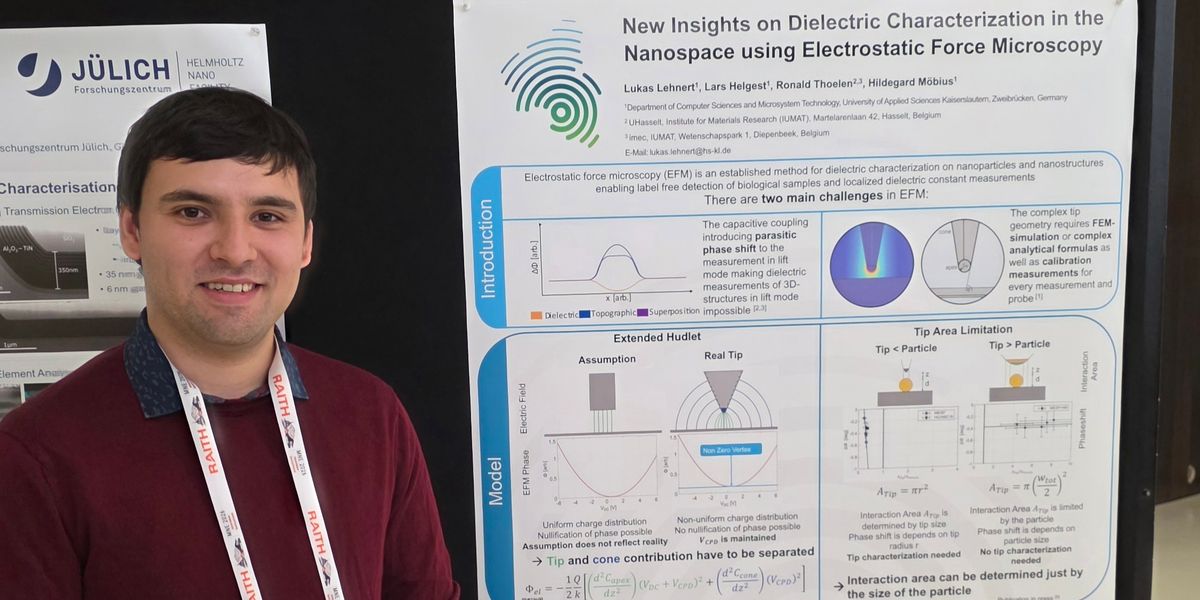
The research results were presented at the Micro and Nano Engineering Conference (MNE 2025) in Southampton, EnFi 2026 in Hanover, and most recently at the Micro and Nano Engineering Conference (MNE 2026) in Interlaken. At MNE 2026, doctoral student Lukas Lehnert presented a poster titled “New Insights on Dielectric Characterization in the Nanospace using Electrostatic Force Microscopy.” The focus was on new approaches for the simple and rapid quantitative characterization of nanoscale 3D materials using electrostatic force microscopy.
Earlier this year, the paper “Revisiting Contact Potential Difference in Electrostatic Force Microscopy” was published in the Journal of Physics Communications (IOP). This work investigates the influence of the contact potential difference on the measurement signal and, through a deeper understanding of the electrostatic interaction between the sample and the probe tip, enables a more accurate characterization of 3D nanostructures, such as nanoparticles.
Another paper within the framework of the overall project has since been accepted for publication and is currently in the publication process. This paper investigates the influence of the size ratio between the probe tip and the nanostructure and uses this to determine the dielectric constant of nanoparticles simply and precisely. As part of the KoMBio project, Lukas Lehnert is pursuing a joint doctoral program with Hasselt University in Belgium. The collaboration with Hasselt University has a history spanning more than 15 years and has already resulted in several successfully completed doctorates.
The KoMBio project is funded by the European Regional Development Fund (ERDF) and the state of Rhineland-Palatinate. The project began in February 2026 and, with three conference presentations and two publications to its credit, is making a significant contribution to the further development of materials characterization at the nanoscale. The findings will be used to develop novel contactless heating applications in analytics and for cancer aftercare.
Note: This article has been translated using a computer system without human intervention. LUMITOS offers these automatic translations to present a wider range of current news. Since this article has been translated with automatic translation, it is possible that it contains errors in vocabulary, syntax or grammar. The original article in German can be found here.
Original publication
Lukas Lehnert, Ronald Thoelen, Hildegard Möbius; "Revisiting contact potential difference in electrostatic force microscopy"; Journal of Physics Communications, Volume 10, 2026-2-2
Lukas Lehnert, Lars Helgest, Benjamin Baumann, et al.; "Exploiting the interaction area limitation in Electrostatic Force Microscopy for dielectric measurements of nanoparticles"; Micro and Nano Engineering, Volume 33



Other news from the department science






These products might interest you