Data-Driven Reaction Optimization in Process Chemistry
Bayesian Optimization, Transfer Learning, and Practical Paths to Self-Driving Labs
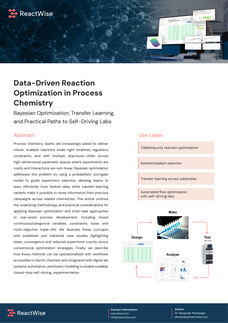
Process chemistry teams are increasingly asked to deliver robust, scalable reactions under tight timelines, regulatory constraints, with multiple objectives - often across high-dimensional parameter spaces where experiments are costly and interactions are non-linear. Bayesian optimization addresses this problem with a probabilistic surrogate model to guide experiment selection, allowing teams to learn efficiently from limited data, while transfer-learning variants make it possible to reuse information from previous campaigns across related chemistries.
This article outlines the methodology and practical considerations for applying Bayesian optimization and multi-task approaches to real-world process development, including mixed continuous/categorical variables, constraints, noise, and multi-objective trade-offs. We illustrate these concepts with published and industrial case studies highlighting faster convergence and reduced experiment counts versus conventional optimization strategies. Finally, we describe how these methods can be operationalized with workflows accessible to bench chemists and integrated with digital lab systems, automation, and kinetic modeling to enable scalable, closed-loop self-driving experimentation.
Download white paper now
Data-Driven Reaction Optimization in Process Chemistry
Bayesian Optimization, Transfer Learning, and Practical Paths to Self-Driving Labs