Hanbat National University study shows cation disorder could improve lithium-rich cathodes
Experiments show a disordered structure enhances lithium transport while preventing performance degradation
Advertisement


Lithium-rich cathode materials are promising candidates for next-generation batteries, as they can store considerably more charge than materials used today in electric vehicles and electronics. Because the cathode’s capacity is a major factor in how much energy a battery can hold, lithium-rich materials could eventually lead to batteries with higher energy density, enabling phones, laptops, and electric vehicles to run longer on a single charge.
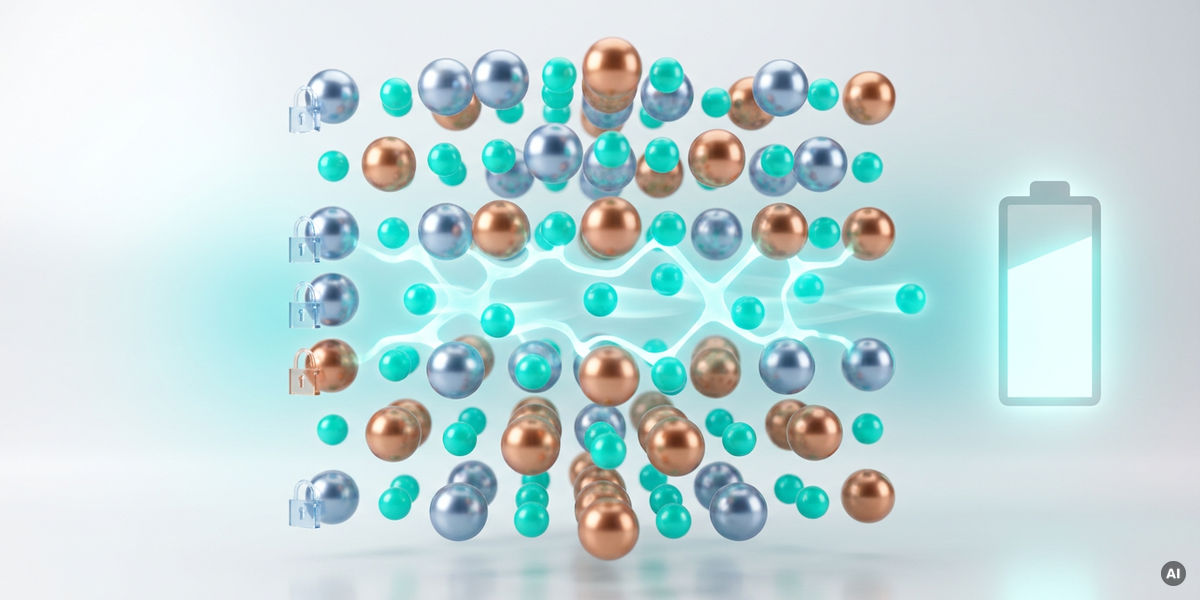
However, lithium-rich cathodes face a longstanding problem. During charging and discharging, transition-metal ions such as nickel and manganese can drift away from their original positions in the crystal structure. These migrating ions can obstruct the pathways that lithium ions need to travel through, slowing the movement of lithium and contributing to irreversible performance loss over repeated cycles. Scientists have mostly tried to tackle this issue by preserving an orderly crystal structure in the cathode, assuming an orderly arrangement would give lithium a clearer path to move through. But what if the opposite approach was better?
In a recent study published in Energy Storage Materials, a research team led by Professor Kyojin Ku of the Department of Materials Science and Engineering at Hanbat National University, Korea, explored this question by intentionally disrupting the atomic structure of a lithium-rich cathode. Their work was made available online on July 18, 2026, and appeared in Volume 90 of the journal on August 1, 2026.
The team focused on Li1.2Ni0.4Mn0.4O2, a nickel-manganese composition that avoids expensive metals like cobalt. This particular composition normally forms a neatly layered structure, where lithium and transition-metal ions (nickel and manganese) sit in separate planes. To produce the desired disordered form, the researchers used high-energy ball milling with two structurally compatible layered starting materials. This mechanochemical process disrupted the arrangement of the cations, resulting in a crystal structure where lithium and transition-metal ions are distributed more randomly. “To our knowledge, this is the first time this type of composition has been made in the disordered form,” remarks Prof. Ku.
By comparing the disordered material with its ordered counterpart, the researchers found that the disordered version showed more symmetric charge-discharge behavior, delivered higher capacity, and performed better under high currents. Moreover, it exhibited stable operation, retaining about 90% of its initial capacity after 50 cycles without a reduction in voltage.
Detailed theoretical and computational analysis helped explain the observed improvements. “By deliberately scrambling the atoms into a disordered rock-salt arrangement, we decoupled the movement of lithium from the harmful movement of the transition-metals,” explains Prof. Ku. “Lithium still flows efficiently through a connected network of open pathways, while the transition-metals become effectively locked in place and can no longer block those pathways.”
Overall, the findings point to an innovative and impactful approach for developing higher-energy-density cathodes. “We have shown that cation disorder can be used as a deliberate engineering tool to solve a problem that has held back an entire family of high-energy battery materials for years,” concludes Prof. Ku. “If this principle is developed further, it could help move lithium-rich cathodes closer to real commercial use, paving the way for longer-lasting batteries for electric vehicles and energy storage.”
Original publication


Other news from the department science















These products might interest you


Most read news










More news from our other portals



























See the theme worlds for related content
Topic World Battery Technology
The topic world Battery Technology combines relevant knowledge in a unique way. Here you will find everything about suppliers and their products, webinars, white papers, catalogs and brochures.

Topic World Battery Technology
The topic world Battery Technology combines relevant knowledge in a unique way. Here you will find everything about suppliers and their products, webinars, white papers, catalogs and brochures.
