A KAIST research team has developed a high performance flexible solid state battery
The team of Professor Keon Jae Lee from the Department of Materials Science and Engineering, Kaist has developed a high performance flexible all-solid-state battery, an essential energy source for flexible displays.
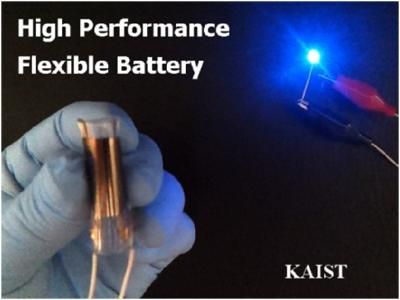
This shows a blue LED emission operated by flexible solid state battery.
Korea Advanced Institute of Science and Technology
The technological advance of thin and light flexible display has encouraged the development of flexible batteries with a high power density and thermal stability. Although rechargeable lithium-ion batteries (LIB) have been regarded as a strong candidate for a high-performance flexible energy source, compliant electrodes for bendable LIBs are restricted to only a few materials (e.g., organic materials or nano/micro structured inorganic materials mixed with polymer binders). The performance of LIBs has not been sufficient either, thereby difficult to apply to flexible consumer electronics including rollable displays.
In addition, lithium transition metal oxides used as a cathode electrode have to be treated in high temperature (e.g., ~ 700 degrees for lithium cobalt oxide). However, it is not possible to anneal the metal oxides, an active material, at this high temperature on flexible polymer substrates.
Recently, Professor Lee's research team has developed a high performance flexible LIB structured with high density inorganic thin films by using a universal transfer approach. The thin film LIB fabricated on a mica substrate with high annealing temperature is transferred onto polymer substrates through a simple physical delamination of sacrificial substrates.
Professor Lee said, "The advent of a high performance flexible thin film battery will accelerate the development of next-generation fully flexible electronic systems in combination with existing flexible components such as display, memory, and LED."
The research team is currently investigating a laser lift-off technology to facilitate the mass production of flexible LIBs and 3D stacking structures to enhance charge density of batteries.
Original publication
Bendable Inorganic Thin-Film Battery for Fully Flexible Electronic Systems; Nano Letters
Other news from the department science












Get the chemical industry in your inbox
From now on, don't miss a thing: Our newsletter for the chemical industry, analytics, lab technology and process engineering brings you up to date every Tuesday and Thursday. The latest industry news, product highlights and innovations - compact and easy to understand in your inbox. Researched by us so you don't have to.
Most read news






More news from our other portals






















See the theme worlds for related content
Topic World Battery Technology
The topic world Battery Technology combines relevant knowledge in a unique way. Here you will find everything about suppliers and their products, webinars, white papers, catalogs and brochures.
Topic World Battery Technology
The topic world Battery Technology combines relevant knowledge in a unique way. Here you will find everything about suppliers and their products, webinars, white papers, catalogs and brochures.
