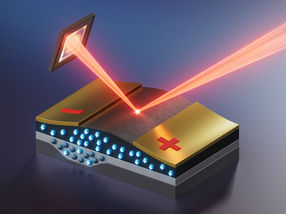
Laser light guides micro-particles to their target
US and German scientists have used laser light to guide micro-particles through a solution towards a target. The technique could be applied to transport the particles to specific locations inside living cells, they say. These so-called ‘micro-swimmers’ consist of a polystyrene sphere with one hemisphere coated with a thin layer of gold.
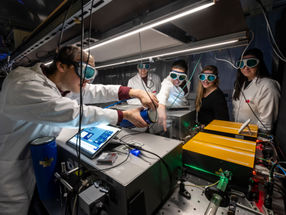
The team used ‘photon nudging’, in which a weak laser light is used to intermittently illuminate the swimmers, to cause body-centred propulsion by photophoresis. The technique also allows adaptive control: the system continuously monitors the 3D orientation of the particle as it randomly rotates through the solution, so the operator can choose to only turn on the swimmer’s ‘engine’ when it is pointing towards the desired target.
Original publication
B Qian et al, Chem. Sci., 2013.
Other news from the department science
















Get the chemical industry in your inbox
From now on, don't miss a thing: Our newsletter for the chemical industry, analytics, lab technology and process engineering brings you up to date every Tuesday and Thursday. The latest industry news, product highlights and innovations - compact and easy to understand in your inbox. Researched by us so you don't have to.