New method for measuring luminescence lifetime offers breakthrough in scientific imaging
Accelerating the pace of discovery in science and industry
Advertisement


Researchers at the Max Planck Institute for Marine Microbiology, Leibniz-Institute for Baltic Sea Research and University of Copenhagen introduce an innovative approach to image luminescence lifetimes. This simple approach uses readily-available cost-effective equipment, paving the way for advanced studies of chemical dynamics in environmental and biological systems. For example, it allows to record oxygen dynamics with much higher temporal and spatial precision.

The setup of the novel approach for imaging the lifetime of luminescent dyes which is based on the frame-straddling technique and allows for an easy implementation.
Soeren Ahmerkamp, Max Planck Institute for Marine Microbiology
Take oxygen, for example: Oxygen is a key molecule for life, and in order to understand ecosystem dynamics it can be important to follow its ways in much detail. Optical sensors that use luminescent dyes have long been used to map oxygen levels in marine systems: Oxygen reduces the phosphorescence lifetimes of the dyes, which thus indicate oxygen concentrations. However, until now, imaging luminescence lifetimes has required costly, specialized equipment, making the technique out of reach for many research and industrial applications. A joint research team at the Max Planck Institute for Marine Microbiology, Leibniz-Institute for Baltic Sea Research and University of Copenhagen, in collaboration with international partners, has developed a pioneering method for imaging the lifetime of luminescent signals. The breakthrough technique enables high-speed luminescence lifetime measurements, transforming fields that rely on optical sensing and chemical imaging. The findings have been published in the journal ACS Sensors.
Bringing luminescence lifetime measurement to the masses
“Our new integrated method simplifies these measurements, allowing researchers to determine luminescence lifetimes using standard camera systems”, explains Soeren Ahmerkamp, who carried out the research at the Max Planck Institute for Marine Microbiology in Bremen and at the Leibniz-Institute for Baltic Sea Research in Warnemünde, both in Germany. By synchronizing short bursts of light with precise camera timing through a technique called frame-straddling, two images are captured: One that records the initial light burst and another that measures the initial light burst and the longer-lasting luminescent after-glow. The difference between these images reveals the integrated luminescence lifetime, providing a detailed and accurate readout at time scales below one millisecond.
“We offer a more accessible way to measure luminescence lifetimes, which is often considered the gold standard in optical sensing”, says Michael Kühl from the University of Copenhagen, Denmark. “By adopting the frame-straddling technique originally developed for high-speed flow measurements, we’ve created a technique that can be used with a wide range of commercially available cameras. This will make it possible for a wider range of laboratories to perform high-resolution lifetime imaging.”
Unlocking new possibilities in chemical imaging
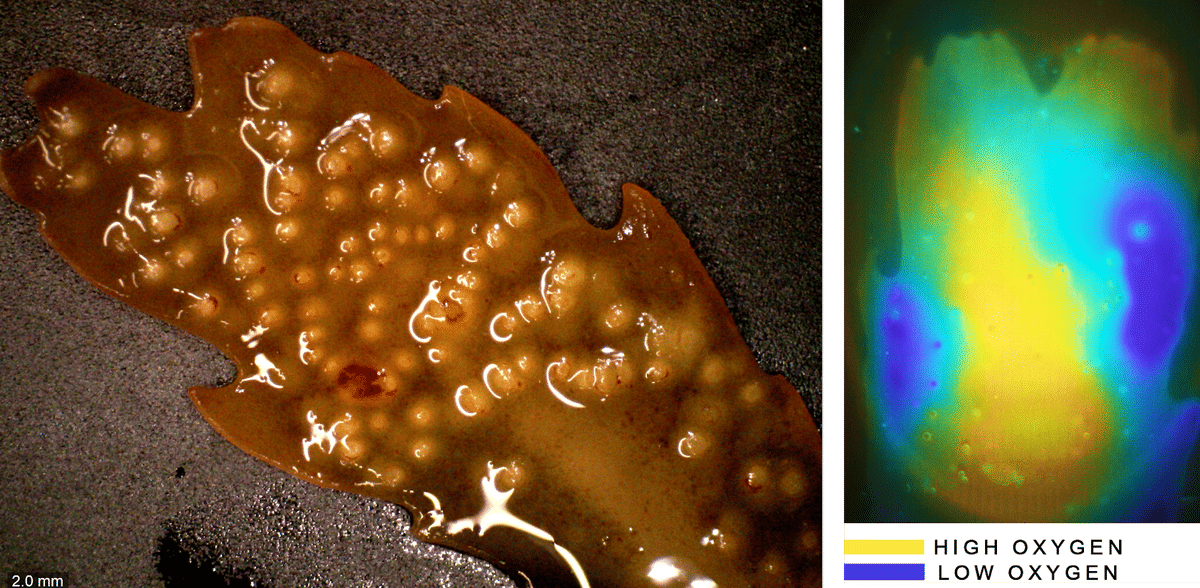
The ability to measure luminescence lifetimes with ease and high-speed opens up new possibilities for chemical imaging. Researchers can now record oxygen dynamics with much higher temporal and spatial precision. “We tracked oxygen dynamics around algae within a hundredth of a second and visualized how oxygen-consuming particles move through water, thereby showcasing the utility of the method”, says Ahmerkamp. “The integrated luminescence decay method can be used to gain deeper insights into how oxygen varies in marine environments, from the scale of microscopic particles to entire ecosystems.”
Accelerating the pace of discovery in science and industry
This new approach could stimulate more luminescence lifetime imaging applications in environmental and biomedical sciences and engineering. By making high-precision measurements more accessible, it can stimulate novel experimental approaches, accelerating the pace of discovery in these areas.
“Our goal was to democratize access to a powerful analytical tool,” adds Ahmerkamp. “We believe this method will enable researchers to explore complex chemical interactions with greater ease and flexibility than ever before.”
Original publication


Other news from the department science




















Most read news












More news from our other portals


























See the theme worlds for related content
Last viewed contents

ACME Group and Hydrogenious LOHC Technologies to jointly explore hydrogen value chains from Oman to Europe
Netzsch Acquires Bruker’s Thermal Analysis Instruments Business in Japan
Researchers produce polymers from ballbot-type carbenes for the first time - Researchers have produced long-chain mobile polymers on metallic surfaces, doing so by means of ballbot-type molecules which glide over the surface
Fujitsu Develops World's Fastest Method of Quantum Chemical Calculations for Drug Discovery - Succeeds in validating its feasibility together with Tokai University

The Secret Contamination of Polar Bears - Hundreds of unrecognized halogenated contaminants discovered in polar bear serum

A more complete picture of the nano world
BASF increases prices for methylamines and derivatives in Europe

Unilever appoints Hein Schumacher as new CEO

New clues help explain why PFAS chemicals resist remediation - Work suggests new avenues for cleaning up these 'forever chemicals'