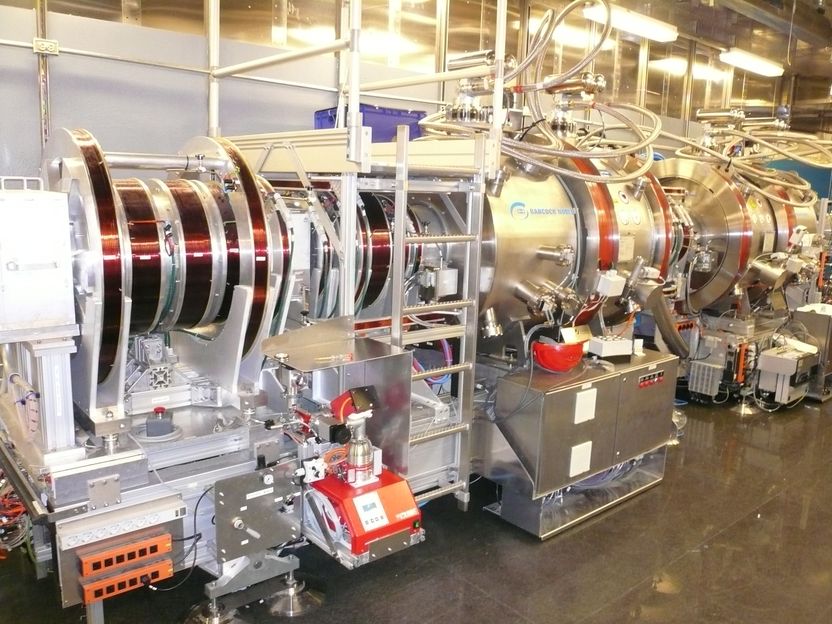
ChatGPT, run my particle accelerator!
A first step towards a future in which complex scientific systems can be optimised simply by voice input

Advertisement


Do you sometimes find yourself thinking, ‘I wonder what ChatGPT has to say about this’? It has become common practice to consult artificial intelligence (AI) on a wide range of topics and problems. Scientists at DESY and the University of Hamburg have now asked this question with regard to operating an accelerator and have discovered that ChatGPT can help them to run these machines. They recently published their findings in the journal Science Advances.
Machine learning is often used in physics to automate certain routines and tasks. In accelerator physics, an extremely attractive field of application is tuning particle accelerators in real time to ensure that the best performance at all times. A research group led by DESY scientist Jan Kaiser has now demonstrated how this can be done using a special type of machine learning – with the help of ‘large language models’ (LLMs). These AI programmes, which are also behind popular chatbots such as ChatGPT, are trained on huge amounts of data (hence the ‘large’ in the name) and are able to recognise, interpret and generate human language.
The team experimented with 14 different LLMs and used them to control ARES, an experimental electron accelerator at DESY. Their task was to adjust five magnets in such a way that the electron beam from ARES was focused and steered in the best possible way. Instead of ‘coding’ the requirements, however, the scientists described the problem to the LLMs using natural language prompts. The LLMs then suggested how to set the five tuning parameters with the utmost precision, explaining what each value would achieve.
“We were totally surprised at how well some of the LLMs were able to solve the problem,” says Kaiser. “What’s even more fascinating, though, is that they don’t even need to know that they are operating a particle accelerator. So in theory, LLMs can solve any type of optimisation problem, which means that our approach is relevant far beyond the field of accelerator physics.”
Of course, the researchers also encountered certain obstacles during their proof-of-concept investigations. “Just like with human operators, you have to ask the right LLM the right question to get a good solution,” says Annika Eichler (DESY and Hamburg University of Technology), whose research group is responsible for the intelligent control of accelerator systems using AI. The computational power and thus the environmental impact of solving such problem is currently substantial. Furthermore, the systems are still lagging behind other specialised methods. For the time being, LLMs would probably be better serving as advisory ‘co-pilots’ in accelerator control rooms.
“Nevertheless, our work is an important first step towards a future in which complex and highly relevant scientific facilities can be operated simply by asking for the desired result using natural language,” says Eichler.
Original publication


Other news from the department science




















Most read news












More news from our other portals


























Last viewed contents

Chemtrix BV - Geleen, Netherlands

Deep brines in northern Germany could be among Europe's largest lithium resources - Project RoLiXX aims to develop extraction methods that work even under high-salinity conditions

Metso introduces an advanced lithium carbonate process to support battery materials production - At the core of the process is soda pressure leaching, which selectively extracts lithium with fewer soluble impurities in one pass

Longer-lasting and more sustainable green hydrogen production - The findings impact the ability to achieve a lasting and sustainable hydrogen-based energy economy
Merck and Mulliken Center for Theoretical Chemistry Collaborate in Machine Learning Project - The three-year collaboration will focus on the development of new tools for computational chemistry modelling as well as new molecular representations
Self-assembled superlattices create molecular machines with 'hinges' and 'gears'

On the way to sustainable chemistry? Iron makes it possible - Hydroformylation of olefins using iron catalysis and light
3M to sell pressurized polyurethane foam adhesives business
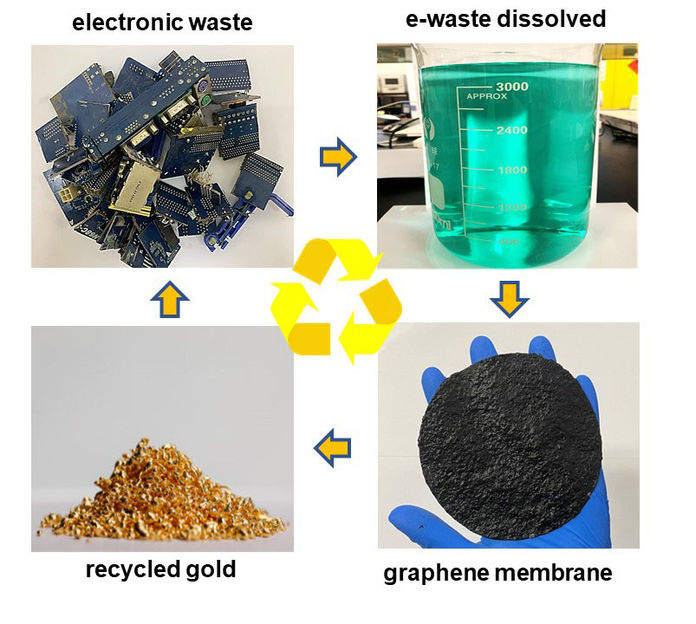
Graphene as 'the philosopher’s stone’: turning waste into gold - "This apparent magic is essentially a simple electrochemical process"

Cleaner air as a result of coronavirus lockdown - Lockdowns in early summer 2020 meant that the amount of soot in the atmosphere, which is harmful to the climate and to health, almost halved
DSM and Chemtrix sign collaboration agreement in Continuous Flow Chemistry