New electrochemical strategy boosts uranium recovery from complex wastewater
Advertisement


Researchers have unveiled a promising new method that could transform how uranium is recovered from challenging wastewater streams. By combining a specially engineered covalent organic framework with an indirect electrochemical process, the approach delivers high efficiency, long term stability, and strong tolerance to chemically complex environments. The findings provide fresh insight into how advanced functional materials and optimized operating conditions can work together to support cleaner and more sustainable nuclear energy development.
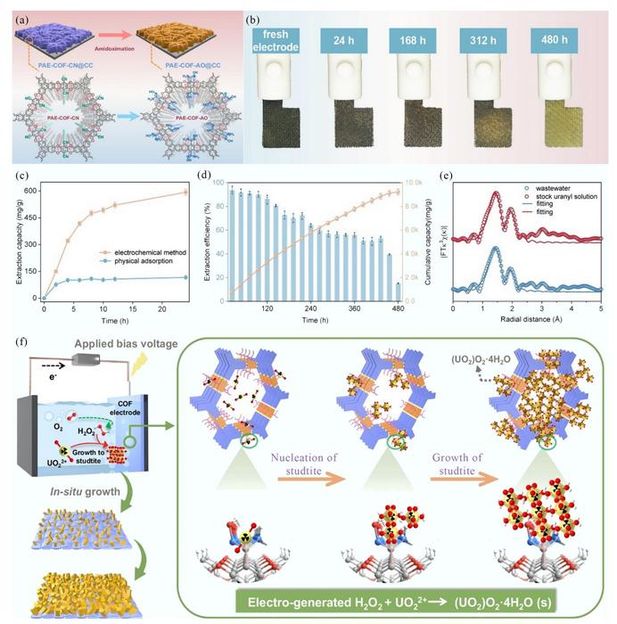
Synergistic parameter optimization in electrochemical upcycling of uranyl: mechanisms and perspectives of self-standing COF electrodes
Tao Wen, Muhammad Wakeel
Uranium is a vital resource for nuclear power generation, yet conventional mining faces growing environmental and economic pressures. Scientists worldwide are exploring new ways to extract uranium from unconventional sources such as wastewater, seawater, and contaminated industrial effluents. Electrochemical uranium extraction has emerged as an attractive alternative because it allows controllable operation, rapid response, and high selectivity. However, the technology still struggles with issues like electrode passivation, interference from competing ions, and the high cost of fabricating efficient electrodes.
A recent study addressed these limitations by creating a self standing covalent organic framework electrode capable of performing two tasks simultaneously. Built on a carbon cloth support, the electrode contains a polyarylether backbone that drives the oxygen reduction reaction to produce hydrogen peroxide, along with amidoxime groups that selectively bind uranyl ions. The combination provides a coordinated chemical and electrochemical pathway that greatly improves the extraction process.
One of the strengths of the study is its systematic evaluation of the factors that influence extraction performance. The researchers found that solution pH plays a central role. In acidic environments, protonation of the amidoxime groups reduces their ability to attract uranium. In contrast, neutral to alkaline conditions promote stronger binding and support the formation of studtite, a crystalline uranium peroxide compound that forms during extraction. When the pH is maintained within a favorable range, the system achieves extraction efficiencies above 90 percent.
Applied voltage is another key parameter. The rate of hydrogen peroxide production depends directly on the voltage, which controls the two electron oxygen reduction reaction. Increasing the applied potential significantly improves uranium recovery by elevating the local concentration of hydrogen peroxide near the electrode surface. This accelerates studtite formation and boosts extraction efficiency, especially at high uranium concentrations.
The system also shows excellent resistance to interference from sodium ions and organic additives commonly found in real wastewater. Even in solutions with high ionic strength or complex organic components, the electrode maintains uranium extraction efficiencies above 85 percent. This resilience reflects the strong intrinsic selectivity of amidoxime groups for uranyl ions.
Long term performance tests further illustrate the durability of the approach. In organic rich radioactive wastewater, the electrode accumulated more than nine thousand milligrams of uranium per gram of material over 450 hours of continuous operation, which ranks among the highest values reported for electrochemical uranium extraction systems.
The synergistic mechanism behind this success involves two interconnected steps. First, amidoxime groups chelate uranyl ions and initiate nucleation. Second, electro generated hydrogen peroxide drives sustained crystal growth. Together, these processes enable stable and efficient extraction even under difficult chemical conditions.
The authors note that several challenges remain before the technology can be widely deployed, including improving electrode fabrication, reducing sensitivity to pH fluctuations, and preventing blockage of active sites during long term operation. They highlight future directions such as machine learning guided material design, advanced voltage control strategies, operando characterization, and modular flow system engineering to support large scale applications.
This research provides an important step toward practical, high performance uranium recovery systems that can operate in complex real world environments. It also offers valuable guidance for designing next generation electrochemical materials and processes for environmental remediation and resource recovery.


Other news from the department science




















Most read news












More news from our other portals


























See the theme worlds for related content
Topic world Extraction
Extraction is a fundamental process in the chemical laboratory that enables specific components to be isolated and concentrated from a mixture. Whether it's extracting active ingredients from natural products, removing impurities from synthesis products, or preparing analytical samples, extraction is a key step in achieving precise and efficient results in chemical research and analysis.
Topic world Extraction
Extraction is a fundamental process in the chemical laboratory that enables specific components to be isolated and concentrated from a mixture. Whether it's extracting active ingredients from natural products, removing impurities from synthesis products, or preparing analytical samples, extraction is a key step in achieving precise and efficient results in chemical research and analysis.
Last viewed contents
Click & Try: A Failed Experiment and Chance Opened up new Paths to an Established Reaction for Chemists - Freed from the Niche with Click Chemistry

Methane emissions from landfill could be turned into sustainable jet fuel in plasma chemistry leap - New research could help create a circular economy for waste-generated greenhouse gas emissions

Milestone for laser technology: Huge research machine much smaller and cost-effective - Research team demonstrates free-electron laser driven by plasma accelerated electron beams and seeded by additional light pulses

‘Trustworthy AI’ focus for a new materials and chemicals project - Project to help drive adoption of machine learning wins funding from Innovate UK

A quantum wave in two crystals - Breakthrough in neutron physics

Magnetic material could help monitor battery life - Researchers demonstrate the technique in a lithium-ion battery
A step closer to single-atom data storage

Röhm to build innovation center in Worms - Pooling of research activity in Germany - Research also strengthened in China and the USA

AI instead of rare earths: Munich start-up searches for magnets made from abundant elements - Interview with the founder: alqem

A new way to produce ammonia more efficiently - By boosting ammonia production, the price of electricity from hydrogen could drop

LANXESS signs contract to acquire Emerald Kalama Chemical - Targeted portfolio expansion in the Consumer Protection segment
