Automation and robotics drive growth in the laboratory
Skills shortage and efficiency pressure accelerate automation
Advertisement


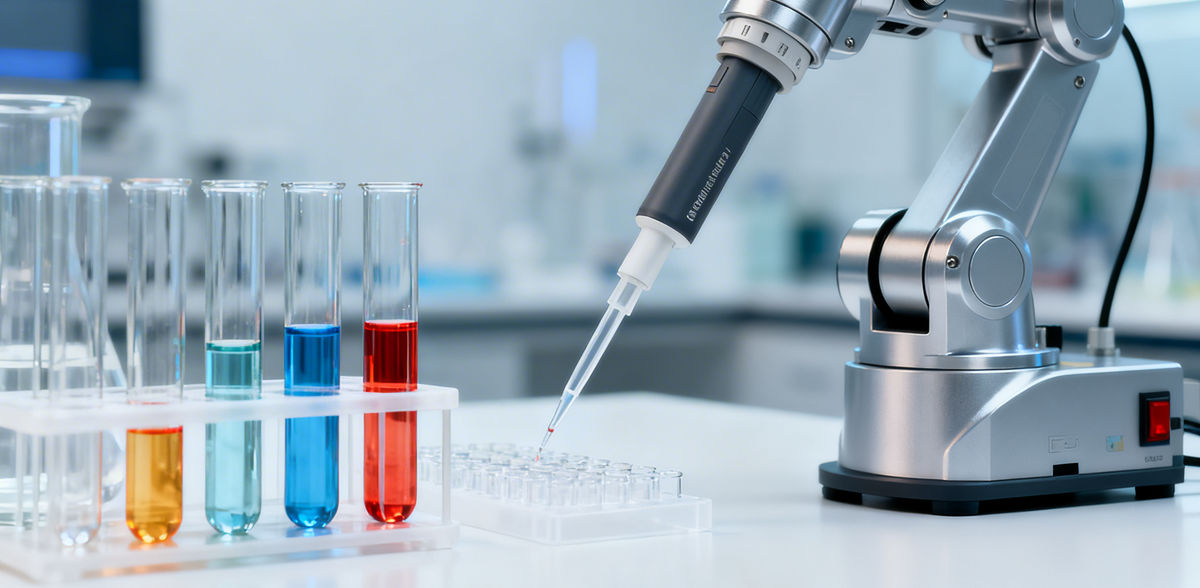
The market for laboratory robotics is growing dynamically - driven by a shortage of skilled workers, increasing efficiency requirements and the need for digitalized laboratory processes. The global market for laboratory robotics was worth around USD 2.4 billion in 2023 and will grow to almost USD 3.9 billion by 2030 - an average annual growth rate of around 7% according to Grand View Research.
Adjacent areas are also developing at a rapid pace: for example, sales figures for professional service robots in the medical sector recently rose by around 90% to around 16,700 units worldwide - applications in diagnostics and laboratory analysis in particular are experiencing exceptionally strong growth, according to the International Federation of Robotics (IFR). The main drivers of these developments are a shortage of skilled workers, increasing cost and efficiency pressure and the need for end-to-end digitalization and consistent data quality.
"Laboratories are investing in automation and robotics not only for reasons of technical modernization, but also to ensure their competitiveness in times of increasing cost pressure," says Jörg Mayer, Managing Director of the German industry association SPECTARIS. According to a recent SPECTARIS member survey, 86% of participants rate the shortage of skilled workers and 81% the cost pressure as the most important drivers of these developments.
The publication "Robotics and Automation in the Laboratory", published by SPECTARIS and Messe München, shows: The industry is evolving from isolated automation solutions to integrated, data-driven and increasingly AI-supported complete systems. For the first time, robotics also enables the automation of less standardized tasks and the linking of complete process chains - from sample preparation to evaluation. Contributions from industry and research show further growth, particularly in sample handling, analysis and data processing. The numerous practical examples in the report underline the enormous range of developments. For example, in addition to logistics tasks such as autonomous sample transport, mobile robots are increasingly taking over central steps in sample preparation and handling - such as identifying, sorting and transferring samples - and linking individual analysis devices to create integrated, automated processes.
"Robotics and AI-supported automation are no longer a vision of the future, but are already shaping everyday laboratory work today," adds Dr. Reinhard Pfeiffer, Managing Director of Messe München. "They increase efficiency, improve reproducibility and relieve specialists of routine tasks."
The publication will be presented at analytica 2026 (March 24-27, 2026 in Munich), the world's leading trade fair for laboratory technology, analysis and biotechnology. The special exhibition "Digital Transformation" uses specific applications to demonstrate networked laboratory processes and the interplay of automation, robotics and data solutions.
Note: This article has been translated using a computer system without human intervention. LUMITOS offers these automatic translations to present a wider range of current news. Since this article has been translated with automatic translation, it is possible that it contains errors in vocabulary, syntax or grammar. The original article in German can be found here.



Other news from the department business & finance











These products might interest you


Most read news












More news from our other portals



























See the theme worlds for related content
Topic world Digitalization in the laboratory
The topic world Digitalization in the lab presents innovations and trends from digital data systems (ELN, LIMS) to laboratory robots and networked devices (IoT) to AI and machine learning.

Topic world Digitalization in the laboratory
The topic world Digitalization in the lab presents innovations and trends from digital data systems (ELN, LIMS) to laboratory robots and networked devices (IoT) to AI and machine learning.
Trade-fair preview analytica 2026
Here, innovative exhibitors present their trade fair innovations, premieres and product innovations for analytica 2026.

Trade-fair preview analytica 2026
Here, innovative exhibitors present their trade fair innovations, premieres and product innovations for analytica 2026.
Last viewed contents

Turning waste into the future: scientists produce base materials for nylon from polystyrene - They have made bacteria break down polystyrene and convert it into useful chemicals

New paths for quantum technologies: Optical control of nuclear spins in molecules - Molecular systems can be chemically tailored and could thus enable atomically precise qubits

How Carbon Accounting Rules Shape Incentives for Hydrogen Production

How Chemicals End Up in the Mountains - Permanent chemicals harm insects—even in near-natural habitats
Quasiparticle solves mystery of vanishing conductivity - CAU team detects polarons in rare earth compound for the first time
Cryo-electron microscopy – Reaction cycle of an enzyme for CO2 fixation decoded - A promising enzyme candidate for biofuel production from carbon dioxide

Protein Content in Foods — New Conversion Factors Enable More Precise Assessment - Max Rubner Institute Releases New Database for Nitrogen-to-Protein Conversion

AI-driven microorganism mix has the potential for groundbreaking innovation - Federal Ministry for the Environment Launches First Joint SPRIND Challenge for a Biotech Breakthrough in the Circular Economy
Researchers develop cleaner, scalable process to recycle lithium-ion batteries - "We’ve shown that it’s possible to create high-performance batteries from recycled materials at scale"
30 Million Euros for Catalyst Research Using AI-Controlled Laboratories - ASCEND is leveraging automated learning loops and 3D thin-film catalysts to develop industrially viable drop-in substitutes.
