Startup EDENenergy: Used E-Scooter Batteries Become Industrial Energy Storage System
The Fraunhofer spin-off’s first storage unit contains 112 second-hand batteries
Advertisement


In Germany alone, about one million high-performance batteries from e-bikes and scooters end up in the trash prematurely every year, even though they often still retain a large portion of their capacity. At the same time, stationary energy storage systems are expensive and resource-intensive to manufacture. The Freiburg-based startup EDENenergy solves both prob-lems: It develops modular industrial storage systems from second-life batteries that are high-performance, cost-effective, and sustainable. Former researchers at the Fraunhofer Institute for Solar Energy Systems ISE have developed a system featuring interchangeable battery modules and flexible power electronics that efficiently and safely combine heterogeneous batteries into stationary storage systems.
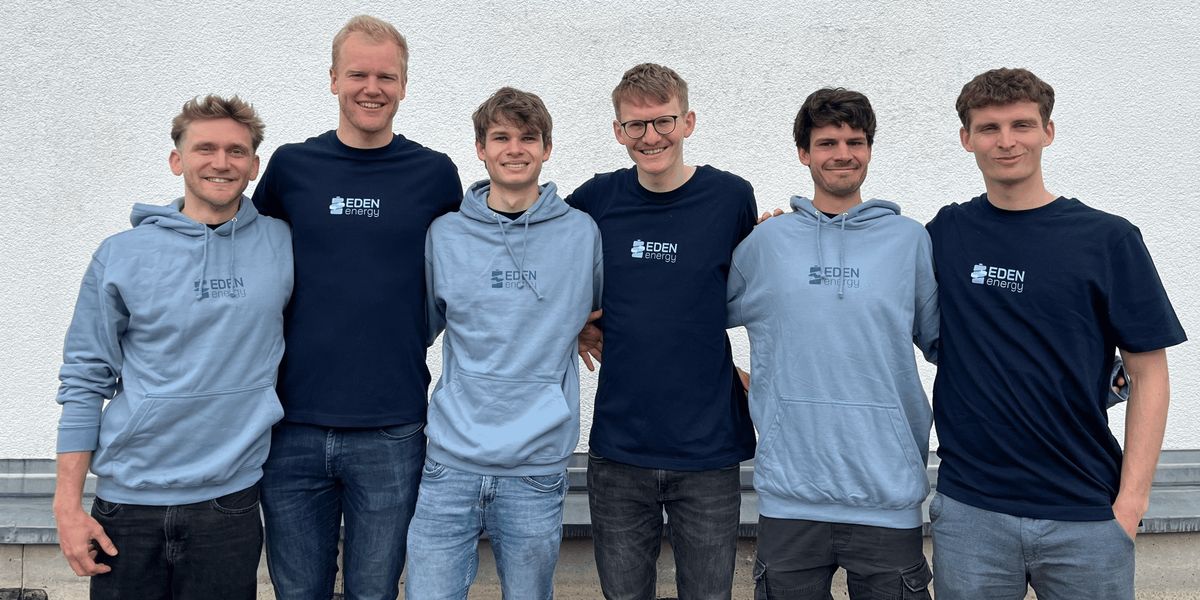
In the field of car batteries, “second-life” concepts have already demonstrated just how valuable used energy storage devices can be. The potential of micromobility—that is, the millions of e-bikes and e-scooters, an increasing number of which are being returned—has not yet been tapped. This is due to the enormous variety of batteries—designs, cell types, energy management systems—which make standardized reuse difficult. This is where the startup EDENenergy comes in with power electronics developed at Fraunhofer ISE: “It allows different storage units to be connected and enables communication with various modules without having to disassemble the batteries,” explains Florian Bierwirth, who, like his co-founders Daniel Seeger and Hannes Kurzmann, previously worked in the Power Electronics Department at Fraunhofer ISE.
From E-Bikes to Industrial Applications
To enter the market, the startup is focusing on industrial storage systems with a capacity of 70 kilowatt-hours. “In mid-October, we delivered the first storage system to a customer, which was an important milestone for our young company. With this storage size, we initially aim to target medium-sized companies in the region that have a photovoltaic system but do not yet have a storage solution.” The storage systems could also be of interest to municipal utilities, which can use them to optimize self-consumption, smooth out peak loads, or for electricity trading.
For the first industrial storage system, 112 second-life e-scooter batteries—after being thoroughly tested during an initial screening—will be interconnected. Currently, EDENenergy relies on large suppliers (such as e-bike and e-scooter fleet operators), which ensures that enough batteries of the same type are available to start with. In the future, thanks to innovative power electronics, different types of batteries will also be interconnected. “To do this, the connector interfaces, battery management system, and communication protocols must be adapted for each new battery. There’s a particularly wide range of options when it comes to e-bikes,” says Florian Bierwirth, outlining the challenge. In the long term, he notes, standardized communication protocols for battery storage systems and “second-life” legislation governing the use of mobile batteries in stationary applications will be necessary.
The first 350 batteries tested held a pleasant surprise for the three young entrepreneurs: they were in significantly better condition than expected. While EDEN-energy had estimated a remaining capacity (“State of Health”) of 80 percent for second-life batteries, the used batteries actually had an average remaining capacity that, in some cases, was well over 90 percent. In stationary storage systems, where—unlike in their first life—they are exposed to fewer vibrations or temperature fluctuations, these batteries can continue to perform well for several more years. EDEN-energy remotely monitors the battery modules via a monitoring system. When they reach the end of their service life, the battery modules are replaced individually, which can be done even while the battery system is in operation. The batteries that are finally at the end of their useful life are then sent for recycling by partner companies. Compared to standard energy storage systems on the market, this turns an apparent disadvantage into a technical advantage: replacing individual modules makes it possible to maintain the storage system’s capacity at a constant 70 kWh even after 10 years. Due to battery degradation, conventional manufacturers typically guarantee only 80 percent of the original capacity after 10 years.
In the next steps, the young company—which now employs three part-time staff members in addition to its three founders—plans to expand the storage capacity to up to 300 kWh. They are also looking for additional pilot customers among regional businesses that can receive 50 percent funding for the storage system through the state grant program “Mittelstand trifft Start-ups,” which has already been approved. EDENenergy also receives funding from the Center of Excellence for Sustainability and through the state grant program for innovative startups “BW Pre-Seed,” under which JobRad founder Ulrich Prediger is the company’s first investor.


Other news from the department business & finance












Most read news







More news from our other portals























Something is happening in the chemical industry ...
This is what true pioneering spirit looks like: Plenty of innovative start-ups are bringing fresh ideas, lifeblood and entrepreneurial spirit to change tomorrow's world for the better. Immerse yourself in the world of these young companies and take the opportunity to get in touch with the founders.
See the theme worlds for related content
Topic World Battery Technology
The topic world Battery Technology combines relevant knowledge in a unique way. Here you will find everything about suppliers and their products, webinars, white papers, catalogs and brochures.

Topic World Battery Technology
The topic world Battery Technology combines relevant knowledge in a unique way. Here you will find everything about suppliers and their products, webinars, white papers, catalogs and brochures.