InfraLeuna commissions anaerobic wastewater treatment plant for UPM biorefinery
The UPM biorefinery is regarded as Europe’s most significant investment in biochemicals
Advertisement


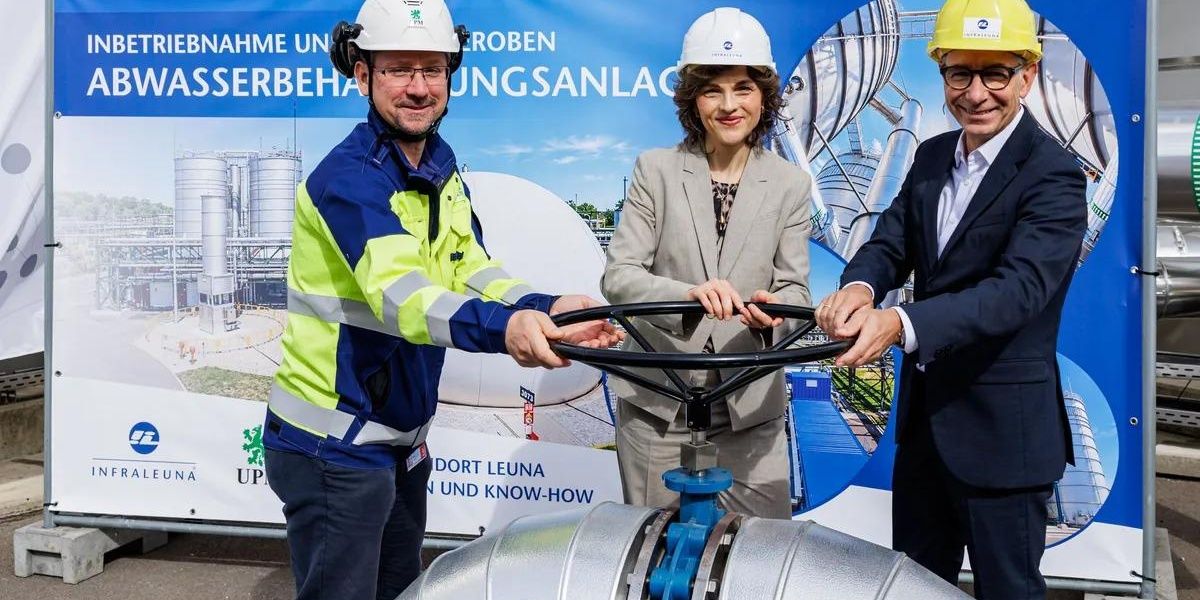
The facility was built as part of the Finnish company UPM’s establishment in the area and specifically enhances the site’s sustainable infrastructure by providing technology for treating complex industrial wastewater. UPM is currently commissioning a biorefinery in Leuna that is unique worldwide, where biochemicals are produced from sustainably sourced hardwood. These biochemicals replace fossil-based raw materials in numerous applications, such as packaging, textiles, cosmetics, and rubber. With an investment volume of approximately 1.3 billion euros, the project ranks among the largest industrial investments in Germany in recent years and is also the most significant in the field of biochemicals.
This innovative process also brings with it new infrastructure requirements, including the treatment of the resulting wastewater stream, which has a high organic load and requires specially adapted treatment.
This is exactly where the new wastewater pretreatment plant comes into play: The wastewater is first pretreated anaerobically—that is, without the addition of oxygen. In this process, organic substances are efficiently broken down using microbiological methods before the wastewater can be fed into the central biological wastewater treatment plant at the chemical site for further treatment.
The technology used offers a wide range of benefits: It achieves high levels of organic load degradation (COD reduction of at least 80 %) while significantly reducing energy consumption compared to conventional aerobic processes. In addition, it produces noticeably less sewage sludge. A particular added value stems from the process’s energy utilization: Approximately 6 MW of biogas is continuously generated and fed into the natural gas grid at the chemical site.
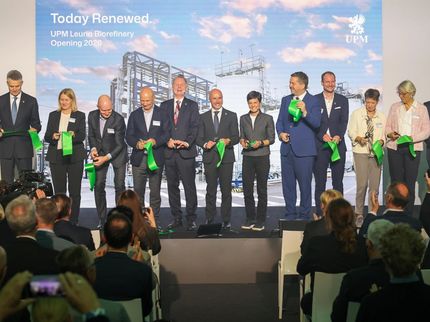
Minister of State Elisabeth Kaiser states: “The new anaerobic wastewater treatment plant is a significant investment in the competitiveness and future of Leuna as a chemical industry hub. I am particularly pleased that it not only makes the site more productive but also more sustainable, while providing renewable energy for other production processes. Leuna impressively demonstrates just how innovative the East German chemical industry is and what an important contribution it can make to economic development. As a chemical industry hub, Leuna thus serves as a prime example of successful industrial transformation. What is being achieved here can serve as a model and source of inspiration for chemical and industrial hubs throughout Germany.”
With a treatment capacity of 4,000 m³ of wastewater per day and investments totaling 36.7 million euros for the facility itself, plus an additional 6 million euros for the biogas feed-in system, it ranks among the most significant infrastructure projects at the site in recent years. Commissioning will take place in phases: First, UPM discharges increasing volumes of wastewater, and the bioreactors are started up using so-called inoculum sludge—specialized anaerobic bacteria that colonize small mineral carriers, primarily limestone, as a biofilm—while, at the same time, gas treatment begins and the gas storage tank is filled with biogas. Subsequently, the flow rate and load are continuously increased until the plant reaches full capacity.
Matthias Schleicher, Director of Leuna Biorefinery Operations, explains: “The Leuna chemical site offers us more than just a location—it offers a partner who is willing to break new ground with us. The anaerobic wastewater treatment plant, which InfraLeuna developed specifically for our biorefinery, is a concrete example of this: Not a one-size-fits-all solution, but a technically sophisticated system tailored precisely to our processes. This willingness to embrace new processes and requirements is crucial for companies like UPM—and a real locational advantage that makes a difference.”
“Leuna is the hub for sustainable chemistry. With the commissioning of this plant, we are taking the next major step here,” said Dr. Christof Günther, managing director of InfraLeuna GmbH. “Here, we combine advanced wastewater treatment with energy generation and resource efficiency. In doing so, we not only create ideal conditions for our customer UPM, but also strengthen the competitiveness of the entire Leuna chemical cluster.”
The new anaerobic wastewater treatment plant thus exemplifies the close integration of industrial innovation and high-performance local infrastructure and underscores the leading role of the Leuna chemical cluster in the industry.


Other news from the department manufacturing








Most read news











More news from our other portals



























Last viewed contents
Autarkize raises €2.3 million in seed funding to drive sustainable energy transition
1.7 trillion euros of high-tech potential lies untapped in Germany - Germany is at risk of falling behind in the technology competition - but six key technologies could change that
2026 KlarText Prize for Science Communication: Klaus Tschira Foundation Honors Seven Researchers - Articles such as “Good News for Those Who Hate Brussels Sprouts,” “The Stamp-Sized Lab,” and “Faster Drug Development Through Math” won over the jury

AkzoNobel and Axalta announce three directors to finalize the combined company Board
Innovation paves way to make ‘clean’ chemicals, plastics and food using solar energy - Integrated solar reactor uses sunlight, water, CO2 and engineered bacteria to grow biomass in a single beaker
Chemicals and energy sectors move away from fossil raw materials - Fraunhofer and an Estonian deep-tech start-up are testing a modular biomass platform on an industrial scale
From Flue Gas to Raw Material: Extracting Carbon from CO₂ Produced by Waste Incineration - KIT and EEW Energy from Waste (EEW) plan to use CO₂ from flue gases in the NECOC process

KAIST identifies a route to faster-charging, longer-lasting EV batteries - Research team uses a 3D digital twin to reveal localized degradation mechanisms during fast charging

Matthews Engineering and start-up hs-tumbler partner on dry battery electrode manufacturing - Companies aim to enable dry electrode manufacturing through trajectory mixing

Winter-ready lithium batteries: scientists use "polarity-contras" electrolyte strategy to outsmart extreme cold - Lithium metal batteries retain 80% capacity after 150 cycles at -40 °C

The competitiveness of low-carbon fuels depends on location - New infrastructure could boost European production