From wood to chemicals: UPM inaugurates pioneering biorefinery in Germany
With an annual capacity of 220,000 tonnes, it is the largest facility of its kind in the world
Advertisement


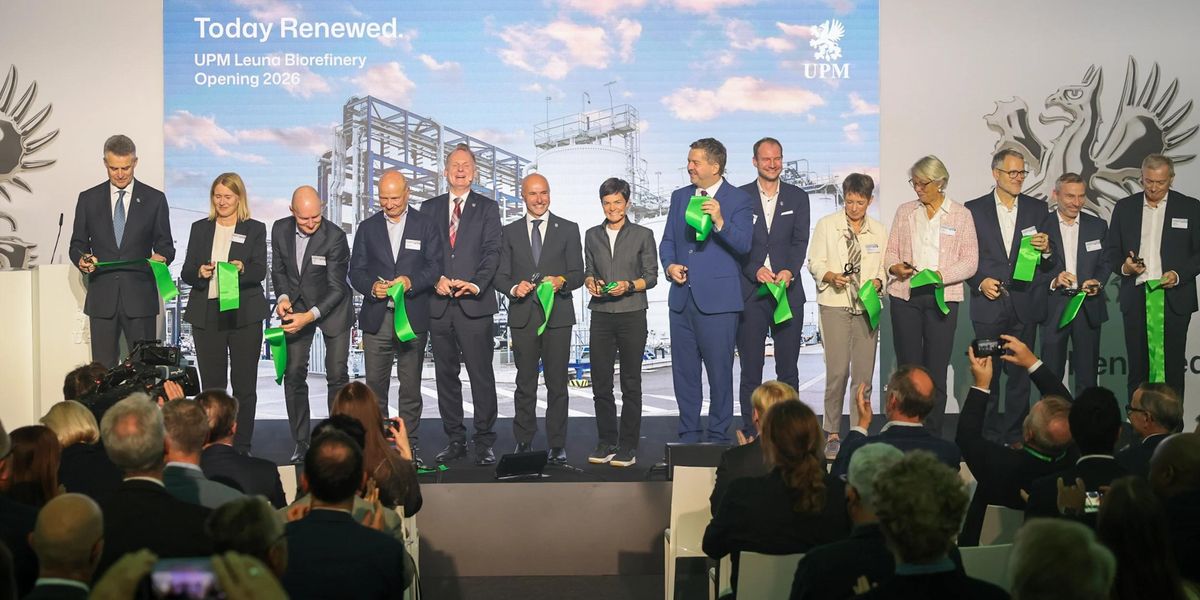
UPM inaugurated its biorefinery in Leuna, Germany, marking the start of a new industrial platform for renewable chemicals made from wood. The biorefinery converts lignocellulosic biomass, primarily wood from sustainably managed forests and sawmill residues, into biochemicals. With an annual capacity of 220,000 tonnes, it is the largest facility of its kind in the world. The ramp-up has progressed further. enzymatic hydrolysis and the production of lignin-derived specialty chemicals have reached stable operation, and UPM is ramping up sales of these products.
“The Leuna Biorefinery is a transformative investment for UPM and an important milestone in our growth journey. Our high-performance renewable chemicals open new markets for UPM and new opportunities for our customers. Together with our renewable fuels, the Leuna Biorefinery forms a platform for profitable growth and shows the ambition and energy with which UPM innovates,” said Massimo Reynaudo , President and CEO of UPM.
The biochemicals will be used in everyday products, from clothing and packaging to cosmetics, construction materials and tires. Many of these are still made from fossil-based raw materials. Manufacturers and brands look for new ways to innovate and differentiate, and the Leuna plant gives them renewable alternatives with the required performance. At the same time, global warming underlines the need for continued de-fossilization, and a considerable share of consumers looks for products made from renewable materials.
UPM’s Leuna Biorefinery is also a milestone for Europe’s bioeconomy. It shows that renewable carbon-based solutions can move beyond pilot projects into commercial-scale manufacturing, reducing dependence on imported fossil value chains and strengthening supply security.
“Europe’s competitiveness depends on creating new industries and scaling innovation. With Leuna, UPM turns Europe’s strengths in science and engineering into a new growth business,” said Reynaudo .
The biorefinery uses beechwood from thinnings and sawmill residues, sourced within about 200 kilometers and unsuitable for higher-value uses such as timber or furniture. Using enzymatic hydrolysis, it breaks the biomass down into industrial sugars and lignin, renewable raw materials that can replace fossil-based inputs in chemicals production. The facility represents a total investment of €1,370 million.


Other news from the department business & finance














Most read news












More news from our other portals



























Last viewed contents

SOPAT GmbH and Malvern Panalytical announce a distribution agreement for US market
BASF, Quantafuel and REMONDIS want to cooperate on chemical recycling of plastic waste - More recycling of plastic waste which otherwise would be incinerated

Innovation boost for the hydrogen economy: Real-time diagnostics for electrolyisers and fuel cells in operation - Optimize load capacity and efficiency, extend service life, and reduce operating costs — a technological leap with great potential
Nobian starts direct delivery of calcium chloride from Frankfurt - "At a time when many companies are reducing their product offerings, we are expanding ours in Europe..."
BAM, HZB and HU are conducting joint research on sodium batteries - Berlin Battery Lab develops batteries that conserve raw materials and is also open to partnerships with start-ups
Innovation paves way to make ‘clean’ chemicals, plastics and food using solar energy - Integrated solar reactor uses sunlight, water, CO2 and engineered bacteria to grow biomass in a single beaker
Chemicals and energy sectors move away from fossil raw materials - Fraunhofer and an Estonian deep-tech start-up are testing a modular biomass platform on an industrial scale
From Flue Gas to Raw Material: Extracting Carbon from CO₂ Produced by Waste Incineration - KIT and EEW Energy from Waste (EEW) plan to use CO₂ from flue gases in the NECOC process

KAIST identifies a route to faster-charging, longer-lasting EV batteries - Research team uses a 3D digital twin to reveal localized degradation mechanisms during fast charging

Matthews Engineering and start-up hs-tumbler partner on dry battery electrode manufacturing - Companies aim to enable dry electrode manufacturing through trajectory mixing

Winter-ready lithium batteries: scientists use "polarity-contras" electrolyte strategy to outsmart extreme cold - Lithium metal batteries retain 80% capacity after 150 cycles at -40 °C