Asahi Kasei, Circularise, and Furuya Metal Launch Project for Precious Metal Traceability in Chlor-Alkali Electrolysis Electrodes
Demonstration Project Targets Supply Security for Scarce Iridium and Ruthenium
Advertisement


Asahi Kasei, Dutch software and blockchain company Circularise, and Furuya Metal have launched a joint demonstration project to establish traceability for precious metals used in chlor-alkali electrolysis electrodes and evaluate the issuance of digital product passports (DPPs). The initiative aims to digitally track the origin, recovery, refining, and reuse of critical precious metals, supporting both circular resource utilization and greater supply chain transparency.
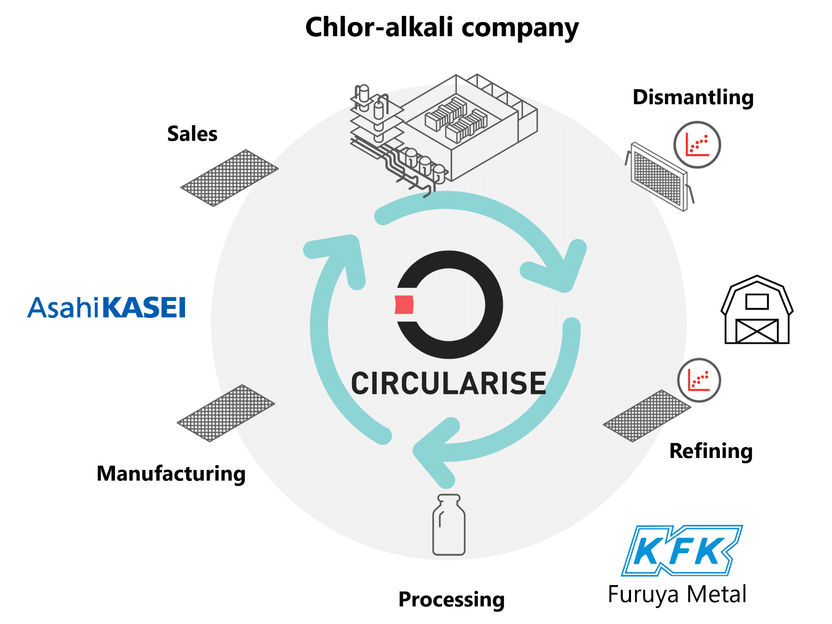
Three-company collaboration for traceability of precious metals in electrodes
Asahi Kasei
Precious metals such as iridium and ruthenium are essential materials for electrodes in chlor-alkali electrolysis as well as semiconductors, electronics, and advanced chemical applications. Demand is expected to further increase as hydrogen production technologies, including proton exchange membrane (PEM) electrolyzers, continue to scale globally. According to the International Platinum Group Metals Association, global annual primary iridium production is estimated at only around 7 metric tons, while annual ruthenium supply is estimated at approximately 30 metric tons. Both are among the world’s most supply-constrained critical metals, with production concentrated in a small number of mining regions and largely obtained as a by-product of platinum extraction.
This supply-demand imbalance has contributed to pronounced price volatility and heightened focus on recycling and circular resource management across industries. While companies can sometimes identify where end-of-life materials are collected and where metals are refined, tracking the materials throughout intermediate processing, refining, and subsequent reuse remains challenging. Without trusted traceability mechanisms, verifying recycled content and demonstrating circularity at scale can be difficult. Digital Product Passports (DPPs) offer a way to overcome this challenge.
The demonstration project builds on the metal recycling initiative launched in 2025 to recover and recycle precious metals from end-of-life chlor-alkali electrolysis cells and electrodes. That collaboration marked an important step toward creating a circular ecosystem for valuable metals within the chlor- alkali industry. By adding digital traceability and data-sharing capabilities, the new demonstration seeks to make the entire lifecycle of recycled precious metals visible, from recovery through reintegration into newly manufactured electrodes.
Circularise has spent nearly a decade developing supply chain traceability and secure data-sharing solutions for global industries including chemicals and battery materials. Between February and September 2025, Asahi Kasei and Circularise conducted an initial proof of concept using a simulated recycling scenario. The results showed that the Circularise platform could securely manage data on precious metals recovered from end-of-life electrodes and reused in new products.
Building on these findings, the partners are now moving into a real-world demonstration with Furuya Metal. The project will first focus on establishing traceability across the recycling chain, from the collection of spent electrodes through precious metal extraction, refining, and the production of recycled metal. It will then extend traceability downstream by linking material data to the manufacture of new electrodes, enabling the evaluation of DPPs.
“For Asahi Kasei, the sustainable utilization of precious metal resources is a critical priority,” said Yoshifumi Kado, Senior General Manager of Asahi Kasei’s Ion Exchange Membrane & Electrolysis System Division. “Building a truly circular system requires close collaboration among companies involved in collection, refining, and manufacturing. By bringing together Asahi Kasei’s experience in chlor-alkali electrolysis, Furuya Metal’s expertise in precious metal recycling, and Circularise’s digital traceability capabilities, we can develop a solution that would be otherwise difficult to do alone—pushing the entire industry forward.”
The initiative will contribute to higher recycling rates for precious metals used in chlor-alkali electrolysis while improving transparency across the value chain. Looking ahead, the companies see potential applications beyond chlor-alkali production, including electrolysis systems for hydrogen production and other industries that depend on critical minerals. By combining material recovery with trusted digital traceability, the partners will establish a scalable model that helps industries secure access to strategic resources while accelerating the transition toward a more circular economy.


Other news from the department business & finance










Most read news












More news from our other portals



























Last viewed contents

SOPAT GmbH and Malvern Panalytical announce a distribution agreement for US market
BASF, Quantafuel and REMONDIS want to cooperate on chemical recycling of plastic waste - More recycling of plastic waste which otherwise would be incinerated

Innovation boost for the hydrogen economy: Real-time diagnostics for electrolyisers and fuel cells in operation - Optimize load capacity and efficiency, extend service life, and reduce operating costs — a technological leap with great potential
Nobian starts direct delivery of calcium chloride from Frankfurt - "At a time when many companies are reducing their product offerings, we are expanding ours in Europe..."
BAM, HZB and HU are conducting joint research on sodium batteries - Berlin Battery Lab develops batteries that conserve raw materials and is also open to partnerships with start-ups
Innovation paves way to make ‘clean’ chemicals, plastics and food using solar energy - Integrated solar reactor uses sunlight, water, CO2 and engineered bacteria to grow biomass in a single beaker
Chemicals and energy sectors move away from fossil raw materials - Fraunhofer and an Estonian deep-tech start-up are testing a modular biomass platform on an industrial scale
From Flue Gas to Raw Material: Extracting Carbon from CO₂ Produced by Waste Incineration - KIT and EEW Energy from Waste (EEW) plan to use CO₂ from flue gases in the NECOC process

KAIST identifies a route to faster-charging, longer-lasting EV batteries - Research team uses a 3D digital twin to reveal localized degradation mechanisms during fast charging

Matthews Engineering and start-up hs-tumbler partner on dry battery electrode manufacturing - Companies aim to enable dry electrode manufacturing through trajectory mixing

Winter-ready lithium batteries: scientists use "polarity-contras" electrolyte strategy to outsmart extreme cold - Lithium metal batteries retain 80% capacity after 150 cycles at -40 °C