Detecting Invisible Hydrogen Leaks
Startup Aims to Avoid Costs in the Billions
Advertisement


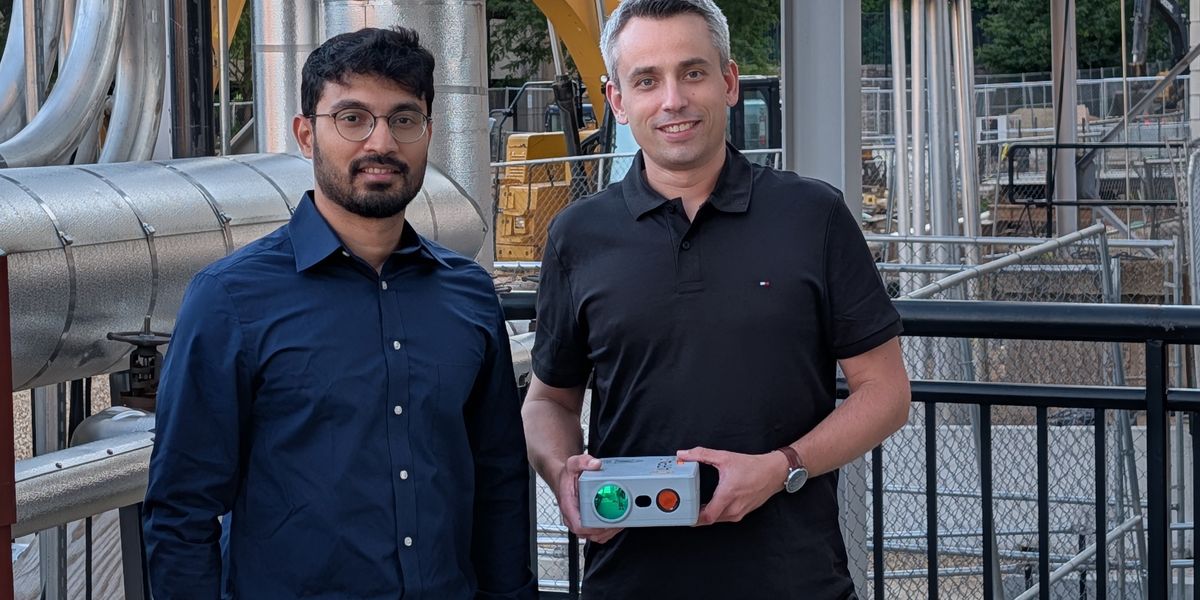
hydrogen escaping unnoticed costs billions worldwide, but until now there has been no technology capable of solving the problem. Researchers at the University of Duisburg-Essen now aim to bring a camera to market that makes the supposedly invisible visible. The AIRLense project will lay the groundwork for a spin-off company. To this end, the team led by Dr. Matthias Beuting is receiving a grant of approximately 1.4 million euros as part of the exist research transfer program.
When searching for a leak, you often see nothing. Hydrogen makes this particularly difficult because it is invisible to the human eye and is both odorless and tasteless. Furthermore, it absorbs no light in either the infrared or ultraviolet spectrum, making optical detection challenging. Yet hydrogen leaks are highly significant, both due to economic losses and safety risks. It is estimated that about one percent of the hydrogen produced escapes unnoticed along its entire value chain. The resulting losses cause annual damages of approximately two billion euros.
The four-member AIRLense team now aims to bring a technology to market that tackles the problem from a different angle: Instead of directly imaging the gas, their laser spectroscopy-based camera measures the interaction of hydrogen with the atmosphere. The system shows in real time—and without having to come into contact with the gas—where hydrogen is escaping. With the help of additional sensors and a novel algorithm, it can even determine the loss rate from the images.
The technological foundations were laid at the University of Wisconsin-Madison (UW), where Matthias Beuting conducted research for five years after earning his Ph.D. from the University of Duisburg-Essen (UDE). Together with Dr. Jojo Jacob from UW, he is now returning to UDE. The AIRLense team is rounded out by two other UDE graduates in physics and economics and will be affiliated with the Institute for Energy and Material Processes (EMPI) at UDE, where Prof. Dr. Christof Schulz will serve as mentor for the two-year project duration.
Duisburg offers ideal conditions for the development and scaling of the technology: North Rhine-Westphalia is expanding its hydrogen infrastructure, and the city itself plans to gradually transition its industry to hydrogen. At the same time, the team can draw on the unique research infrastructure of the University of Duisburg-Essen: The EMPI, one of the world’s leading institutes for laser measurement technology, is located right next to the Center for Fuel Cell Technology GmbH (ZBT), one of the leading research institutions for hydrogen infrastructure.
* The exist research transfer program, co-funded by the Federal Ministry for Economic Affairs and Energy (BMWE) and the European Social Fund (ESF), covers the critical phase in which research results are transformed into the foundation for a market-ready product. The team will use the grant funds, among other things, to complete remaining research work, further develop and test the technology, conduct market research to establish a viable business model, prepare for a university spin-off, and develop a strategy for its follow-on financing.
The team was assisted in securing the funding by the UDE Center for Startups and Innopreneurship (GUIDE), which will continue to support it in areas such as integration into startup networks.
Note: This article has been translated using a computer system without human intervention. LUMITOS offers these automatic translations to present a wider range of current news. Since this article has been translated with automatic translation, it is possible that it contains errors in vocabulary, syntax or grammar. The original article in German can be found here.


Other news from the department business & finance










Most read news












More news from our other portals



























Something is happening in the chemical industry ...
This is what true pioneering spirit looks like: Plenty of innovative start-ups are bringing fresh ideas, lifeblood and entrepreneurial spirit to change tomorrow's world for the better. Immerse yourself in the world of these young companies and take the opportunity to get in touch with the founders.
See the theme worlds for related content
Topic World Spectroscopy
Investigation with spectroscopy gives us unique insights into the composition and structure of materials. From UV-Vis spectroscopy to infrared and Raman spectroscopy to fluorescence and atomic absorption spectroscopy, spectroscopy offers us a wide range of analytical techniques to precisely characterize substances. Immerse yourself in the fascinating world of spectroscopy!

Topic World Spectroscopy
Investigation with spectroscopy gives us unique insights into the composition and structure of materials. From UV-Vis spectroscopy to infrared and Raman spectroscopy to fluorescence and atomic absorption spectroscopy, spectroscopy offers us a wide range of analytical techniques to precisely characterize substances. Immerse yourself in the fascinating world of spectroscopy!