A new design for an easily fabricated, flexible and wearable white-light LED
Advertisement


Researchers from National Chiao Tung University, Taiwan have created highly flexible, efficient white LEDs with potential use in wearable displays and non-flat surfaces, such as curved and flexible television screens. While the design itself is new, the LED was completely fabricated from pre-existing technologies, allowing others to easily replicate and build on the platform.
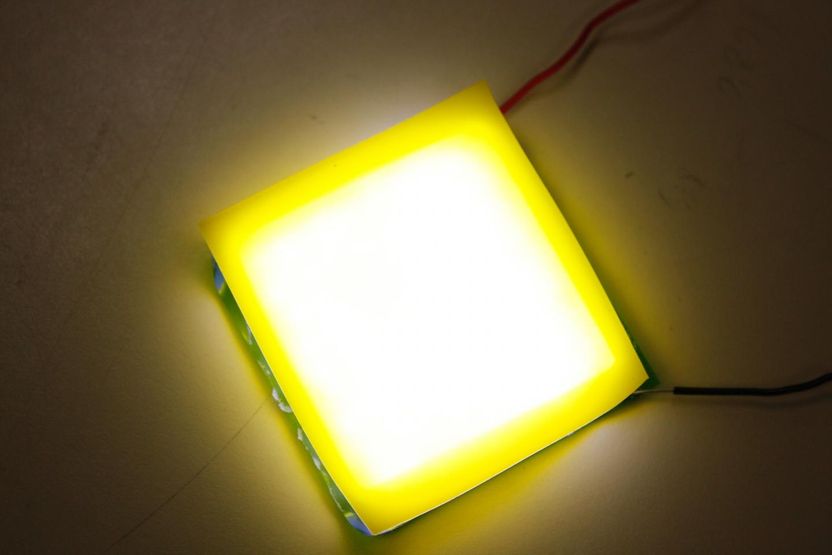
This is a a large area warm white light source with bending capability
Chin-Wei Sher, Chien-chung Lin, Hao-Chung Kuo/National Chiao Tung University
"Compared to organic light-emitting diodes, this design of flexible LEDs can be very attractive, due to the low cost, prolonged lifetime and high efficiency. In addition, all of the technologies associated with this design are currently available," said Chien-Chung Lin, associate professor, College of Photonics, National Chiao Tung University, Taiwan.
This is their first flexible LED device, while their previous work had involved conventional gallium-nitride LEDs.
The researchers' off-the-shelf LED device gets its flexibility from its two primary materials, polyimide and polydimethylsiloxane. To construct it, Lin and his colleagues first covered a polyimide substrate with copper foil shielding tape. In a process known as flip-chip bonding, which reduces thermal resistance and results in higher heat dissipation than traditional wire bonding, they mounted 81 Blue LED chips to the foil in an upside down position.
To provide a warm white-yellow light, the researchers then added another layer consisting of a yellow phosphor film that had been mixed and spin-coated in polydimethylsiloxane (PDMS), a widely used silicone-based organic polymer.
The researchers ran the device for a standard 1,000 hours, finding that its emission decayed by only 5%. Its potential for use in wearables was demonstrated when subjected to bending tests.
Original publication


Other news from the department science




















Most read news












More news from our other portals


























Last viewed contents
Combining 3D printing and metals science leads to stronger, crystal-inspired materials
Researchers reveal a novel metal where electrons flow with fluid-like dynamics - "This novel liquid will flow inside the metal exactly in the same way as water flows in a pipe”

Brenntag to acquire Italian activated carbon specialist

Ultracold atoms in a "Rydberg-dress" - Scientists have developed a novel technique to let atoms interact over large distances

OQ Chemicals Resumes Operations in German Plants
Agilent Technologies Presents Thought Leader Award to Dr. Arturo Keller - Scientist Recognized for Study of Agricultural Applications of Nanotechnology and Environmental Impact

Discovery paves the way for faster computers, longer-lasting batteries - Researchers have has discovered a ‘recipe’ which allows molecular switches to work at room temperature

Twelve ideas for the defossilisation of the plastics industry - “Start-ups provide crucial impulses for the future of our industry”
DKSH and Bruker AXS sign distribution agreement for Asia Pacific
New experiment could reveal make-up of the universe

Royal Society of Chemistry (RSC) - Cambridge, United Kingdom