Computer Simulation Discloses New Effect of Cavitation
Use for Reducing Wear in Pumps and Plain Bearings
Advertisement


Researchers have discovered a so far unknown formation mechanism of cavitation bubbles by means of a model calculation. In the Science Advances journal, they describe how oil-repellent and oil-attracting surfaces influence a passing oil flow. Depending on the viscosity of the oil, a steam bubble forms in the transition area. This so-called cavitation may damage material of e.g. ship propellers or pumps. However, it may also have a positive effect, as it may keep components at a certain distance and, thus, prevent damage.
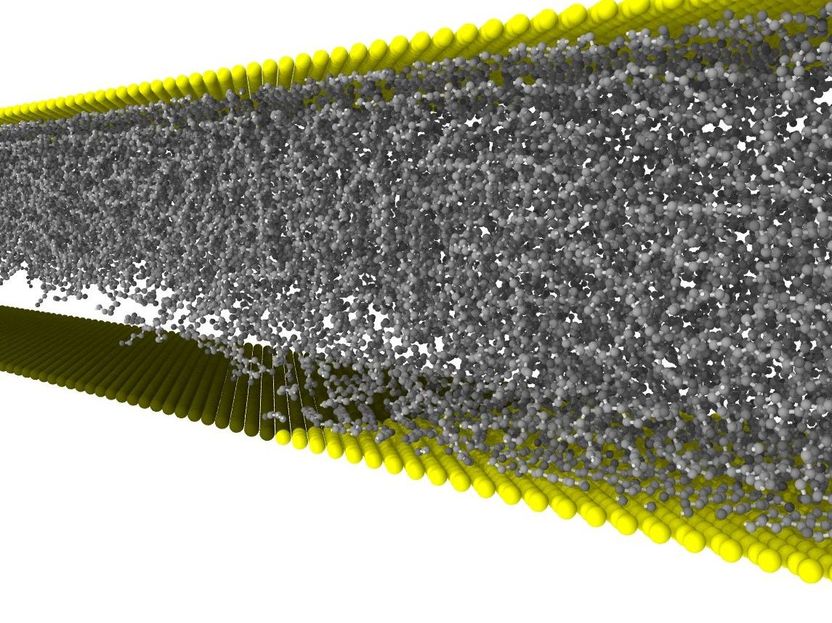
A cavitation bubble is formed in the lubricant between the oil-attracting (yellow) and the oil-repellent surface (black). When used as a buffer, it might reduce wear.
KIT
Materials and friction researchers wanted to know which influence chemically different surfaces have on the flow behavior of a lubricant. In particular, they were interested in flow behavior in nanometer-sized lubrication gaps, a critical case close to boundary friction, i.e. shortly before the surfaces are in direct contact. For this purpose, they generated a mathematical model, in which they varied viscosity of the lubricant and surface properties of the walls. “We were very surprised to find cavitation in the transition area of the surfaces, i.e. at the boundary between oil-attracting and oil-repellent,” Dr. Lars Pastewka and Professor Peter Gumbsch of KIT’s Institute for Applied Materials report.
Cavitation is a known and feared physical phenomenon due to its destructive force. “Existing cavitation models assume a certain geometry that causes cavitation, such as a constriction in a pump or a ship’s propeller producing high flow rates,” Pastewka explains. Here, Bernoulli’s physical law applies, according to which static pressure of a fluid decreases with increasing flow rate. If static pressure drops below the evaporation pressure of the fluid, steam bubbles are formed. If pressure increases again, e.g. if the fluid flow rate decreases after having passed a constriction in a pump, the steam in the bubbles condenses suddenly and they implode. The resulting extreme pressure and temperature peaks lead to typical cavitation craters and significant erosion even of hardened steel.
“This sudden implosion of steam bubbles, however, does not occur in most lubricated tribosystems,” Dr. Daniele Savio says, who has meanwhile taken up work at the Fraunhofer Institute for Mechanics of Materials in Freiburg. “As the fluid gap between two contacting surfaces usually is very narrow, the cavitation bubbles cannot grow and, hence, remain stable. The cavitation bubble then has no destructive effect and even serves as a buffer that reduces wear and friction of the surfaces. It is therefore important to generate this positive effect in a controlled manner,” he adds.
The simulation model of Savio and his colleagues confirms that chemically alternating surfaces may lead to cavitation bubbles. Their publication in Science Advances starts from the question of whether cavitation is the rule or an exception in situations where a lubricant flows between two surfaces. “Usually, surfaces in engines or cylinder systems are never homogeneous, i.e. only oil-attracting or oil-repellent,” Savio points out. “The effect calculated by us may therefore be encountered wherever alternating neighboring surface properties exist in lubricated engines and pumps.”
So far, cavitation has been considered a geometric effect resulting from shear forces, flow rate, and pressure differences exclusively. “It is a completely new finding that cavitation can also occur in transition areas of alternating surface properties,” Pastewka emphasizes. By the specific adjustment of surface chemistry, the researchers are convinced, interaction between surface and lubricant can be improved considerably. In the model simulations, an improved surface separation by 10% was observed.
“A distance increased by 10% means that normal forces and load carrying capacities of plain bearings can be increased,” Savio adds. In any case, surface chemistry has to be re-evaluated as a design element in mechanical engineering, the scientists agree.
Original publication


Other news from the department science



















These products might interest you




Most read news












More news from our other portals


























Last viewed contents

Magnetic nanoparticles change their magnetic structure in a magnetic field - International research team studies the effects of magnetic fields on magnetic nanoparticles
Breakthrough in capturing 'hot' CO2 from industrial exhaust - A metal-organic framework is capable of capturing CO2 at extreme temperatures
Quantum Tricks to Unveil the Secrets of Topological Materials
The nano-lasagna: Novel 2D materials gain momentum - Research team develops environmentally friendly MXene synthesis without hazardous hydrofluoric acid for industrial scaling

Starch Instead of Plastic: Colombian Startup Reinventing Fruit Packaging - Natupla: From ISC3 start-up of the month to a pioneer in starch-based, biodegradable plastics
Researchers Test Novel Titanium-Air Battery - This is the first time that experimental results of such a battery have been published
Flow research on the outskirts of space - Experiments in weightlessness isolate classic diffusion phenomenon
Hydrogen chloride can now be stored, processed, and electrolyzed safely thanks to breakthrough - New method paves the way for safer, more sustainable hydrogen and base chemical production
Bayer wins BDI Environmental Prize - Complexing agent helps to reduce impact on inshore waters

Do We Need to Reassess Chemicals? - Chlorinated organic substances can be converted into dioxins in the atmosphere

ASCO SAS - Lucé, France