Radioactive isotopes reveal age of oil and gas wastewater spills
Advertisement


Spills from oil and gas operations can contaminate local water and soil with high levels of toxic chemicals, salts and radioactivity, but in many cases there is insufficient information to determine how long ago the spill occurred and identify its source.
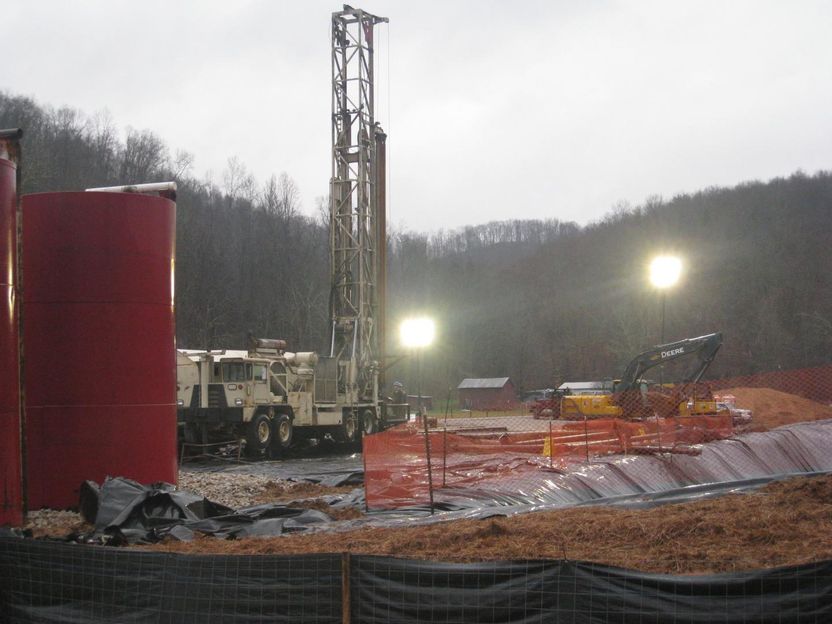
This is a spill site from oil and gas wastewater in West Virginia
Photo by Avner Vengosh, Duke University
A trio of new age-dating methods developed at Duke University can now answer these questions.
Tests in soils affected by oil and gas wastewater spills in West Virginia and North Dakota verify that the new methods can determine the age of spills and identify their origins, based on the variations of radium isotopes and their decay products found in contaminated soils or sediments. Radium's decay products include thorium and lead isotopes.
"The methods we've developed could be especially useful in areas where the source of contamination is unknown and could stem from either recent unconventional oil and gas activities associated with hydraulic fracturing or from a long legacy of conventional oil and gas operations in the same watershed," said Avner Vengosh, professor of geochemistry and water quality at Duke's Nicholas School of the Environment.
"By identifying differences in the distribution of isotopes of radium and its decay products, we can now detect the age and origin of spills and provide a clear answer about their source," Vengosh said.
Waters produced from unconventional oil and gas wells typically have radium isotope ratios (radium-228 to radium-226) that are different than those from conventional oil and gas operations, he said.
The researchers collected samples of radium-contaminated soil and sediment from two spill sites in West Virginia and North Dakota. The dates and origins of both spills were known and were used to calibrate the age-dating models.
"Essentially, this gives us a snapshot into the past - a point of reference we can use to determine the age and origin of soil contamination from oil and gas wastewater," said Nancy Lauer, a PhD student working with Vengosh who was lead author of the study.
"We developed three independent age-dating techniques that are based on the different decay rates of radium, thorium and lead isotopes. These range from isotopes with short half-lives of a few years to isotopes with much longer half-lives of decades," she said. "Together, they provide powerful tools to evaluate the age of the spills. Their integration also enables us delineate the initial radium isotopic signatures of the spill waters, indicating the nature of the wastewater that caused the spill."
By reconstructing the initial radium isotope ratio of the wastewater that contaminated the soil, Vengosh's team can determine the source of the fluids even if the wastewater itself is no longer present at the site.
Original publication


Other news from the department science




















Most read news












More news from our other portals


























Last viewed contents

Chemical shifts help track molecules breaking apart in real time - Ultrafast X-ray photoelectron spectroscopy offers a new way to watch reactions, atom by atom

Innovative Research Unveils News Path to Ethanol Production from CO2 - Discovery represents a significant step forward in understanding in the quest for sustainable energy solutions
Engineers develop 'chameleon metals' that change surfaces in response to heat
Light-induced shape shifting of MXenes - Femtosecond light creates switchable nano-waves in MXenes and moves the materials’ atoms at a record-breaking speed

Using a game of physical skill to explain lithium-ion batteries - Educational tool to explain the processes at work inside the battery cells and the electrochemistry behind them

How Surfaces Grow: Research Team Demonstrates Universal 2D Growth
List_of_drugs:_T

Blue phosphorus: How a semiconductor becomes a metal
Important Petrochemical: Ceresana Analyzes Entire Chinese Propylene Value Chain
Steel mill gases transformed into bioplastic - Korea-Spain joint research team develops an itaconic acid mass production method using artificial enzymes
List_of_drugs:_G
