Argonne scientists to control attractive force for nanoelectromechanical systems
DARPA to provide funding to quell Casimir force
Advertisement


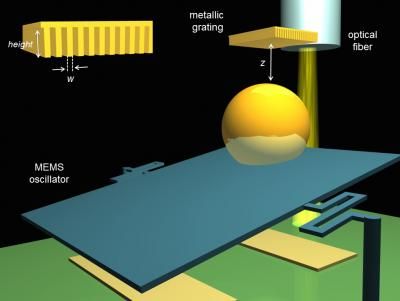
Scientists at the U.S. Department of Energy's Argonne National Laboratory are developing a way to control the casimir force, a quantum mechanical force, which attracts objects when they are only hundred nanometers apart.
"The Casimir force is so small that most experimentation has dealt simply with its characteristics," said Derrick Mancini, interim director of the Center for Nanoscale Materials. "If we can control this force or make it repulsive, it can have dramatic effects on the development of nanoelectromechanical systems."
Nanoelectromechanical systems (NEMS) are nano-meter size mechanical devices that can be used for actuation or sensing at the nano-scale. Many NEMS devices are currently being developed for unique applications in sensing, telecommunications, signal processing, data storage, and more. In the macro world, the Casimir force is so small that it can be barely detected, but at the nanoscale it becomes a quantum effect that scientists cannot currently control.
“As characteristic device dimensions shrink to the nanoscale, the effects of the attractive Casimir force becomes more pronounced making very difficult to control nano-devices. This is a technological challenge that need to be addressed before the full potential of NEMS devices can be demonstrated,” scientist Daniel Lopez said. “The goal is to not only limit its attractive properties, but also to make it repulsive. A repulsive force acting at the nano-scale would allow engineers to design novel NEMS devices capable of frictionless motion through nanolevitation.”
The approach to controlling this force involves nanostructuring the interacting surfaces to tune the effects of the Casimir force. Argonne National Laboratory was recently selected by the Defense Advanced Research Projects Agency (DARPA) to develop mechanisms to control and manipulate the Casimir force. This program will be developed in close partnership with Indiana University Purdue University Indianapolis, NIST and Los Alamos National Laboratory.


Other news from the department science








Most read news








More news from our other portals


























Last viewed contents
New Informational CD-ROM from SPECTRO: X-Ray- Fluorescence Technologies and Applications in Petrochemistry