Carbon dimer: precision measurement delivers new record value
New value deviates significantly from a much-noticed 2019 measurement, but agrees with older quantum chemical calculations

Advertisement


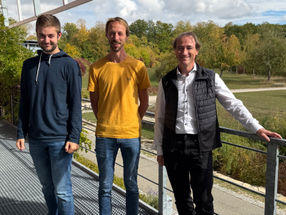
A team led by Innsbruck physicist Roland Wester has determined a fundamental property of the carbon dimer with unprecedented accuracy in the laboratory. The results provide a high-quality reference value for future calculations of the electronic structure of carbon molecules.
Carbon is the basic building block of life. The dimerC2, which consists of two carbon atoms and is observed in the tails of comets, for example, has been the subject of research for decades. A team led by Roland Wester and Katrin Erath-Dulitz from the Institute of Ion Physics and Applied Physics at the University of Innsbruck has now succeeded in measuring a central property of the molecule - the so-called electron affinity - more precisely than ever before by measuring the negatively charged molecular ion C2.
Electron affinity describes how strongly a molecule can bind an additional electron to itself. This value is a kind of molecular fingerprint that reveals something fundamental about the electronic structure and chemical reactivity of the compound, and is also an important reference for theoretical calculations in quantum chemistry. Despite intensive research, there has so far been disagreement about how stronglyC2 binds an electron.
Existing contradiction resolved
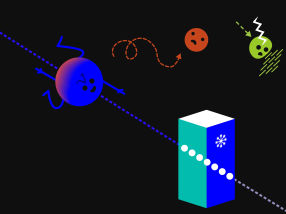
The Innsbruck team made use of the fact that ions can be trapped in space with the help of radio frequency fields. In such an ion trap, the researchers cooled the ions to a few degrees above absolute zero by colliding them with helium gas. The scientists bombarded the trapped ions with laser light and found out at what light energy the outermost electron is released from the molecule. This threshold value - comparable to the moment at which a ball gains just enough momentum to overcome a crest - directly provides the electron affinity they were looking for. "For these spectroscopy measurements, we only need a precisely calibrated laser, which makes this method more reliable than other, indirect measurement methods," says first author Sruthi Purushu Melath from the Atoms, Light and Molecules doctoral program.
The new measured value is 26364.2 ±0.5 cm-¹, which corresponds to an energy at which light begins to cause biological damage such as sunburn or the fading of colors. The uncertainty of only half a unit value makes this measurement the most precise of its kind to date. The new value deviates significantly from a much-noticed measurement from 2019, but agrees well with an older measurement and quantum chemical calculations. The result from Wester's working group thus ultimately resolves an existing contradiction between experiment and theory.
Note: This article has been translated using a computer system without human intervention. LUMITOS offers these automatic translations to present a wider range of current news. Since this article has been translated with automatic translation, it is possible that it contains errors in vocabulary, syntax or grammar. The original article in German can be found here.
Original publication


Other news from the department science











Most read news









More news from our other portals






















See the theme worlds for related content
Topic World Spectroscopy
Investigation with spectroscopy gives us unique insights into the composition and structure of materials. From UV-Vis spectroscopy to infrared and Raman spectroscopy to fluorescence and atomic absorption spectroscopy, spectroscopy offers us a wide range of analytical techniques to precisely characterize substances. Immerse yourself in the fascinating world of spectroscopy!

Topic World Spectroscopy
Investigation with spectroscopy gives us unique insights into the composition and structure of materials. From UV-Vis spectroscopy to infrared and Raman spectroscopy to fluorescence and atomic absorption spectroscopy, spectroscopy offers us a wide range of analytical techniques to precisely characterize substances. Immerse yourself in the fascinating world of spectroscopy!