Efficient Production of Solar Hydrogen Through Direct Coupling of Concentrating Solar Cells and Electrolyzer
Fraunhofer ISE is seeking investors for a spin-off
Advertisement


Splitting hydrogen from water molecules via electrolysis requires energy, which ideally comes from renewable energy sources. Scientists at the Fraun-hofer Institute for Solar Energy Systems ISE have developed a combined pho-tovoltaic/electrolysis module that efficiently produces hydrogen directly from solar energy. To do this, the water molecule is split using the high photo-voltage of multi-junction solar cells, which in turn are electrically and ther-mally connected to electrolyzer cells. A demonstrator from the research team tested outdoors converted up to 31.3 percent of solar energy into chemical energy, based on the higher heating value of hydrogen.
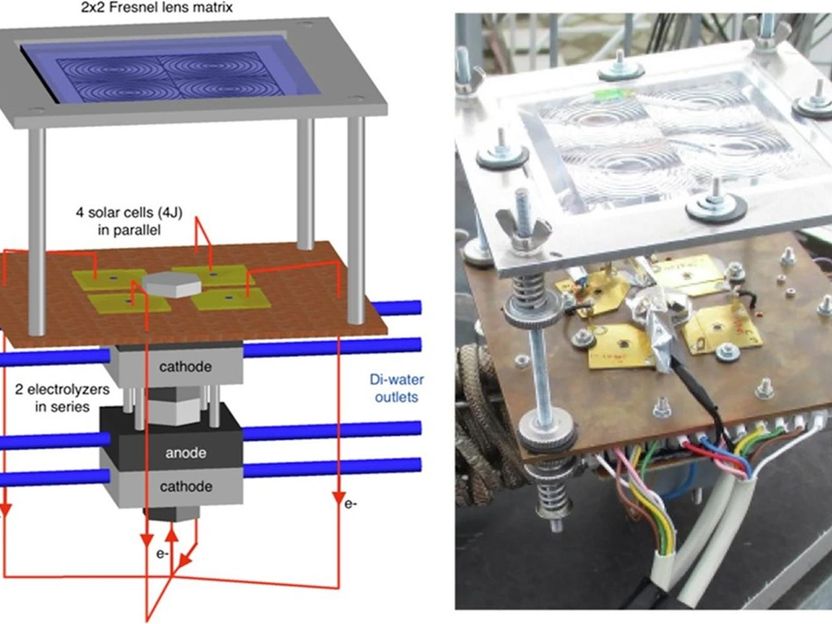
Schematic (left) and photograph (right) proof-of-concept of the concentrator PV-driven electrolyzer.
© Fraunhofer ISE
“For the photovoltaic/electrolysis modules we have developed, we use what is known as concentrating photovoltaics,” explains Dr. Juan Francisco Martínez Sánchez, project manager for the new development at Fraunhofer ISE. “A Fresnel lens array focuses direct sunlight onto highly efficient III-V solar cells, which in this application have an open-circuit voltage of over 4 volts.” III-V solar cells are the most efficient solar cells in the world, proven over many years and long-term stable. Currently, they are primarily used in space but can also produce electricity economically and efficiently on Earth in concentrating solar modules.
“For hydrogen production, we connected these solar cells directly to the cathode and anode of two PEM electrolysis cells connected in series, thereby achieving a perfect match between the two electrical characteristics,” adds Dr. Tom Smolinka, Head of the Membrane Electrolysis Department at Fraunhofer ISE. The electricity from the solar cells is thus used directly for hydrogen production without any detours and therefore without losses. In field tests, the new demonstrator of the photovoltaic/electrolysis module, with a lens area of 64 square centimeters, converted up to 31.3 percent of the solar energy into chemical energy, based on the higher heating value of hydrogen.
“Our new record shows that hydrogen can be produced very efficiently directly from sunlight,” says Dr. Frank Dimroth, head of the III-V Photovoltaics and Concentrator Technology Department at Fraunhofer ISE. “Development is still in its early stages, and it’s hard to say how quickly we’ll be able to achieve competitive systems. To further develop the concept, we are seeking investors for our planned spin-off, Clearsun Energy.”


Other news from the department science