Three-dimensional molecules through “domino cascade”
Chemists develop light-driven triple catalysis
Advertisement


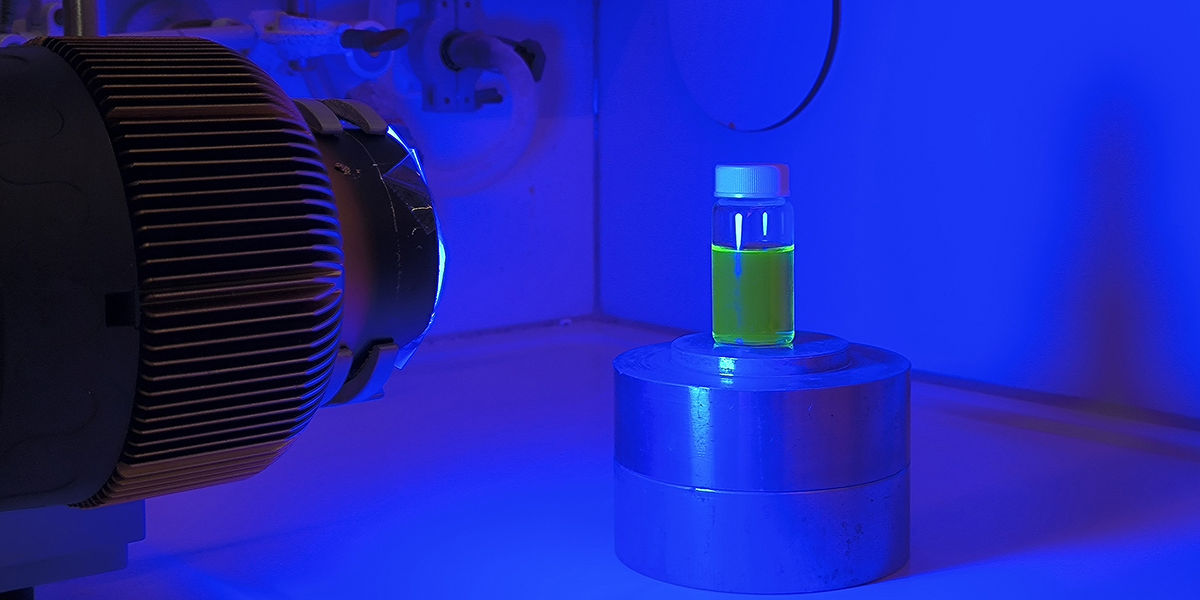
A team led by chemist Professor Frank Glorius from the Institute of Organic Chemistry at the University of Münster has developed a new light-driven reaction sequence. In this triple catalysis, one reaction step triggers the next like three dominoes in a row toppling one after the other. The molecular transformations occur sequentially in a single reaction vessel. Such one-pot synthesis is considered an ideal process because it is particularly resource- and energy-efficient. Central to the success of the current study is a photocatalyst, in this case a molecule that absorbs visible light and transfers the energy to the reactive molecules at each stage of the sequence. Using this method, the chemists converted bicyclic azaarenes, a class of nitrogen-containing aromatic carbon rings, into complex three-dimensional molecular scaffolds that frequently appear in pharmaceutical active ingredients. The study is published in the journal Nature Catalysis.
The first step of the new method begins with a previously unknown reaction in which two molecules (bicyclic azaarenes and vinylcyclopropanes) combine to form a large nine-membered ring framework. In the second step, the atoms within the molecule rearrange their bonds and convert it into another form (“sigmatropic rearrangement”). This rearrangement, which normally requires high temperatures, occurred at room temperature under mild conditions (thanks to photocatalysis). In the third and final step, light triggers further ring formation within the same molecule and fixes it in its three-dimensional structure. The team conducted detailed mechanistic analyses and computer-aided calculations to unveil the reaction pathway.
‘The design of triple-catalysis expands the chemical toolset by introducing a new reaction protocol to construct complex architectures that have traditionally relied on “harsh” reaction conditions,’ explains doctoral student Preeti Chahar. The triple catalysis also simplifies the molecular synthesis considerably, as only one reaction vessel and one photocatalyst are needed. As the team was able to show using various starting molecules, the method has the potential for broad applicability.
Original publication


Other news from the department science












Most read news








More news from our other portals






















See the theme worlds for related content
Topic world Synthesis
Chemical synthesis is at the heart of modern chemistry and enables the targeted production of molecules with specific properties. By combining starting materials in defined reaction conditions, chemists can create a wide range of compounds, from simple molecules to complex active ingredients.
Topic world Synthesis
Chemical synthesis is at the heart of modern chemistry and enables the targeted production of molecules with specific properties. By combining starting materials in defined reaction conditions, chemists can create a wide range of compounds, from simple molecules to complex active ingredients.