Nanodiamonds by Molecular Design
Nature study presents new route to tailor-made diamond nanoparticle
Advertisement


nanodiamonds are tiny diamond particles only a few nanometres in size. Because they are chemically highly stable and can host so-called colour centres, optically active defects in the crystal lattice, they are considered promising materials for quantum technologies, sensing and biomedical research. Until now, however, it has been difficult to reliably produce nanodiamonds with uniform size, high purity and precisely integrated optical properties.
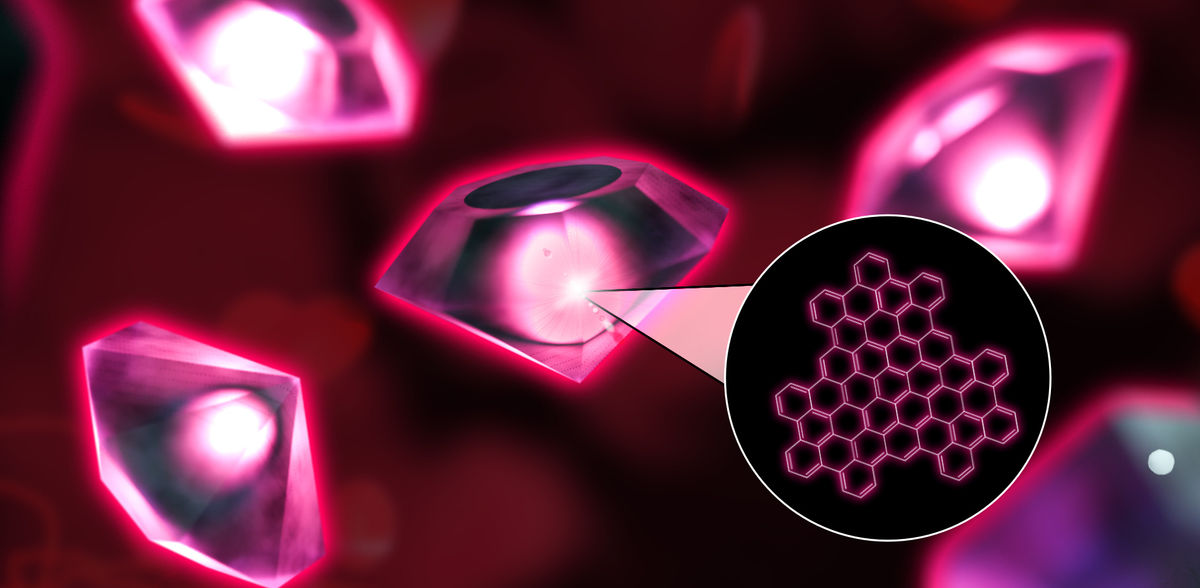
An international research team led by Dr Yingke Wu and Professor Tanja Weil at the Max Planck Institute for Polymer Research has now developed a new synthesis strategy: instead of breaking larger diamonds down into smaller particles, the team builds nanodiamonds from the bottom up using molecularly defined nanographene building blocks. Under high pressure and at high temperatures, these flat carbon molecules are directly converted into diamond-like, highly crystalline nanostructures.
The key advantage of this bottom-up approach lies in its control at the molecular level. Because the structure, size and composition of the starting molecules are precisely defined, the properties of the resulting nanodiamonds can be controlled much more effectively than with conventional milling or top-down methods. Using this strategy, the team was able to produce particularly small, uniform nanodiamonds measuring around three to four nanometres.
Another important aspect is that optically active colour centres can be incorporated into the diamond lattice directly during synthesis. By using suitable molecular precursors, silicon- and germanium-based emitters can be generated without the need for subsequent ion implantation, irradiation or further post-treatment. This makes it possible to produce fluorescent nanodiamonds with tailored optical properties in a single synthesis step.
“We believe this platform offers a scalable foundation for developing quantum sensors, integrated photonic emitters and programmable diamond-based nanomaterials,” says Tanja Weil.
The new molecular nanodiamonds open up promising opportunities for applications in quantum technology, for example as stable single-photon sources or nanoscale sensors. They are also of interest for biological and medical research: in the long term, they could serve as robust optical reporters to visualise processes in cells or other biological environments at the smallest scales.
The findings of the international team have been published in Nature.
Participating institutions
The study involved the German Electron Synchrotron (DESY), Goethe University Frankfurt, Johannes Gutenberg University Mainz, the Leibniz Institute for New Materials, the Max Planck Institute of Colloids and Interfaces, the Max Planck Institute for Polymer Research, the University of Cambridge, Saarland University, the University of Göttingen and Ulm University.
Original publication



Other news from the department science











Most read news












More news from our other portals















See the theme worlds for related content
Topic world Sensor technology
Sensor technology has revolutionized the chemical industry by providing accurate, timely and reliable data across a wide range of processes. From monitoring critical parameters in production lines to early detection of potential malfunctions or hazards, sensors are the silent sentinels that ensure quality, efficiency and safety.

Topic world Sensor technology
Sensor technology has revolutionized the chemical industry by providing accurate, timely and reliable data across a wide range of processes. From monitoring critical parameters in production lines to early detection of potential malfunctions or hazards, sensors are the silent sentinels that ensure quality, efficiency and safety.
Topic world Synthesis
Chemical synthesis is at the heart of modern chemistry and enables the targeted production of molecules with specific properties. By combining starting materials in defined reaction conditions, chemists can create a wide range of compounds, from simple molecules to complex active ingredients.

Topic world Synthesis
Chemical synthesis is at the heart of modern chemistry and enables the targeted production of molecules with specific properties. By combining starting materials in defined reaction conditions, chemists can create a wide range of compounds, from simple molecules to complex active ingredients.