My watch list
my.chemeurope.com  
Login  

New ways to use biomass

Tungsten carbide as catalyst for cost-effective conversion of cellulose into industrially useful carbon compounds

Wiley-VCH 2008

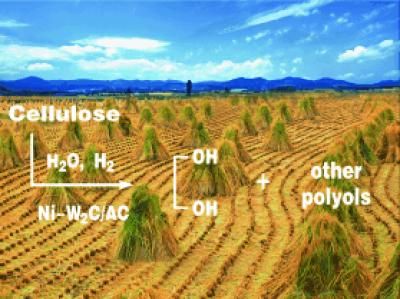
The expense of using precious-metal catalysts is avoided in the high-yielding conversion of cellulose to ethylene glycol (see picture; AC=activated carbon). This process occurs in up to 29 percent yield over a tungsten carbide catalyst, and in up to 61 percent yield when the catalyst is promoted with a small amount of nickel. An attractive feature of this reaction is the low yields of other polyols with respect to ethylene glycol.

09-25-2008: Alternatives to fossil fuels and natural gas as carbon sources and fuel are in demand. Biomass could play a more significant part in the future. Researchers in the USA and China have now developed a new catalyst that directly converts cellulose, the most common form of biomass, into ethylene glycol, an important intermediate product for chemical industry. As reported in the journal Angewandte Chemie, the catalyst is made of tungsten carbide and nickel on a carbon support.
Currently, biomass is mainly used in the form of starch, which is degraded to make sugars and then fermented to make ethanol. It would be cheaper to use cellulose, which is the main component of plant cell walls and thus the most plentiful organic compound on Earth. In contrast to starch from corn and grain, cellulose is not a food, so there would be no competition between its use as food or as raw material and fuel. At the moment, cellulose is mainly processed by fermentation. However, splitting cellulose into its individual sugar components, which can then be fermented, is a slow and cost-intensive process. The direct conversion of cellulose into useful organic compounds is thus an attractive alternative.

Initial reactions using various noble-metal catalysts have been developed. Their disadvantage is that large amounts of expensive metal are needed to break down the cellulose. On an industrial scale, these processes are thus not economical. A less costly and more effective catalyst is needed.

A team led by Tao Zhang at the Dalian Institute of Chemical Physics (China) and Jingguang G. Chen at the University of Delaware (Newark, USA) has now developed just such a system. The catalyst is made of tungsten carbide deposited on a carbon support. Small amounts of nickel improve the efficiency and selectivity of the catalyst system: a synergetic effect between the nickel and tungsten carbide not only allows 100% conversion of cellulose, but also increases the proportion of ethylene glycol in the resulting mixture of polyalcohols to an amazing 61%. Ethylene glycol is an important intermediate in the chemical industry. For example, in the plastics industry it is needed for the production of polyester fibers and resins, and in the automobile industry it is used as antifreeze.

Original publication: Jingguang G. Chen et al.; "Direct Catalytic Conversion of Cellulose into Ethylene Glycol Using Nickel-Promoted Tungsten Carbide Catalysts"; Angewandte Chemie International Edition 2008.
Watchlist

This is where you can add this news to your personal favourites

Additional Information

More about Wiley-VCH
  • News

    Pushing the Boundaries: New dye could open the door to in vivo applications of fluorescence anisotropy
    US scientists have synthesized a polymethine dye that can be used for fluorescence anisotropy imaging in the near-infrared (NIR) spectral range, making new in vivo applications of this technique possible. Until now, the method has been limited to the visible part of the spectrum, mainly bei ... more

    Graphene Rainbow

    Butterfly wings, rose petals and many other natural surfaces repell water strongly; they are superhydrophobic. Such surfaces have a hierarchical structure on the micrometer or nanometer scale. Their attractive properties and spectacular iridescent colors have triggered a group led by Hong-B ... more

    Avoid the Fallout

    Storage and containment of the "nuclear legacy", the highly radiotoxic residues from spent nuclear reactors is a pressing problem for the nuclear power industry that must be solved if nuclear power is to have a genuine contribution to providing carbon footprint minimised power. The search f ... more

  • Companies

    Wiley-VCH GmbH & Co.KGaA

    Wiley-VCH publishes monographs, textbooks, major references works and journals in print or online. Wiley-VCH can look back on over 80 years of publishing in chemistry, materials sciences, physics and the life sciences. more

More about Angewandte Chemie
  • News

    Algae for your fuel tank

    The available amount of fossil fuels is limited and their combustion in vehicle motors increases atmospheric carbon dioxide levels. The generation of fuels from biomass as an alternative is on the rise. In the journal Angewandte Chemie, Johannes A. Lercher and his team at the Technische Uni ... more

    Progress toward artificial tissue?

    For modern implants and the growth of artificial tissue and organs, it is important to generate materials with characteristics that closely emulate nature. However, the tissue in our bodies has a combination of traits that are very hard to recreate in synthetic materials: It is both soft an ... more

    Biomass as a source of raw materials

    For the protection of the environment, and because of the limited amount of fossil fuels available, renewable resources, such as specially cultivated plants, wood scraps, and other plant waste, are becoming the focus of considerable attention. Processes such as pyrolysis or liquefaction all ... more

More about University of Delaware
Contact
University of Delaware

19716 Newark
USA
Phone
+1302831-2792
  • News

    Physicists' findings about helium could lead to more accurate temperature

    In the May 7 edition of Physical Review Letters an international team led by University of Delaware researchers reports new findings about helium that may lead to more accurate standards for how temperature and pressure are measured. In the article the scientists provide a new theoretical ... more

    New catalyst paves the path for ethanol-powered fuel cells

    A team of scientists at the U.S. Department of Energy's (DOE) Brookhaven National Laboratory, in collaboration with researchers from the University of Delaware and Yeshiva University, has developed a new catalyst that could make ethanol-powered fuel cells feasible. The highly efficient cata ... more

    New ways to use biomass

    Alternatives to fossil fuels and natural gas as carbon sources and fuel are in demand. Biomass could play a more significant part in the future. Researchers in the USA and China have now developed a new catalyst that directly converts cellulose, the most common form of biomass, into ethylen ... more

Most read news
Your browser is not current. Microsoft Internet Explorer 6.0 does not support some functions on Chemie.DE