Putting a new spin on current research
Advertisement


Physicists in the USA and at the London Centre for nanotechnology have found a way to extend the quantum lifetime of electrons by more than 5,000 per cent, as reported in Physical Review Letters. Electrons exhibit a property called 'spin' and work like tiny magnets which can point up, down or a quantum superposition of both. The state of the spin can be used to store information and so by extending their life the research provides a significant step towards building a usable quantum computer.
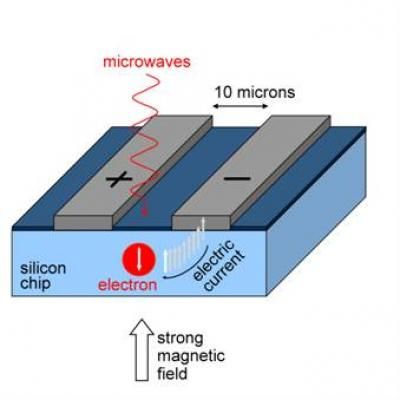
Microwaves are used to control the spin state of electrons held in silicon. This spin state can be watched in real time by measuring the electric current flowing between the (gray) electrodes.
UCL/London Centre for Nanotechnology
"Silicon has dominated the computing industry for decades," says Dr Gavin Morley, lead author of the paper. "The most sensitive way to see the quantum behaviour of electrons held in silicon chips uses electrical currents. Unfortunately, the problem has always been that these currents damage the quantum features under study, degrading their usefulness."
Marshall Stoneham, Professor of Physics at UCL (University College London), commented: "Getting the answer from a quantum computation isn't easy. This new work takes us closer to solving the problem by showing how we might read out the state of electron spins in a silicon-based quantum computer."
To achieve the record quantum lifetime the team used a magnetic field twenty-five times stronger than those used in previous experiments. This powerful field also provided an additional advantage in the quest for practical quantum computing: it put the electron spins into a convenient starting state by aligning them all in one direction.
Original publication: G. W. Morley, D. R. McCamey, H. A. Seipel, L.-C. Brunel, J. van To, C. Boehme; Physical Review Letters 2008.


Other news from the department science